
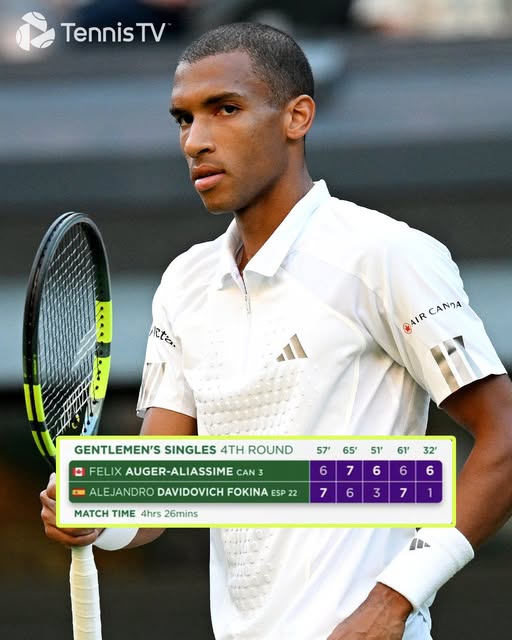
Professional tennis is often described as physical chess played at extraordinary speed. Few matches illustrate that better than Felix Auger-Aliassime's thrilling five-set victory over Alejandro Davidovich Fokina. Lasting more than four hours, the contest demanded tactical intelligence, emotional stability, superior conditioning, and continuous game adjustments from both competitors.
The scoreboard alone tells a remarkable story:
Felix Auger-Aliassime def. Alejandro Davidovich Fokina
6-7, 7-6, 6-3, 6-7, 6-1
After four hours and twenty-six minutes, Felix emerged victorious—not because he was always the better shot-maker, but because he became the smarter player as the match evolved.
This performance demonstrated why success at the highest level requires much more than powerful serves or blistering forehands. Championships are won by players who can constantly adapt.
An Epic Battle from the Opening Point
The opening set immediately established the tone.
Davidovich Fokina entered the match determined to disrupt Felix's rhythm.
Instead of allowing Felix to dictate with first-strike tennis, Davidovich mixed:
- Heavy topspin
- Flat acceleration
- Sudden drop shots
- Deep looping defense
- Counter-punching angles
Felix initially struggled to settle into his preferred attacking patterns.
The first set eventually reached a tiebreak where Davidovich executed cleaner under pressure.
Despite losing the opening set, Felix never appeared frustrated.
That would become one of the defining characteristics of the afternoon.
Early Tactical Problem
Davidovich's movement created a unique challenge.
Felix prefers:
- Big first serve
- Short points
- Forehand dominance
- Baseline control
Instead, Davidovich repeatedly forced him into:
- Longer rallies
- Defensive transitions
- Running forehands
- Extra recovery steps
The Spaniard was making Felix work far harder than expected.
Felix Begins Reading the Court
Championship-caliber players make adjustments.
Good players keep hitting harder.
Great players start thinking differently.
After the first set Felix gradually recognized several important patterns.
He noticed Davidovich frequently defended from well behind the baseline after absorbing pace.
Instead of constantly trying to hit outright winners, Felix started constructing points patiently.
This subtle change transformed the match.
Second Set: Momentum Begins to Shift
The second set was perhaps the most important.
Another loss would have placed Felix in an almost impossible situation.
Instead, he focused on three improvements.
Better First Serve Placement
Rather than relying only on power, Felix increased accuracy.
He targeted:
- Wide serves
- Body serves
- Slice serves
Changing locations prevented Davidovich from anticipating returns.
Free points became more frequent.
More Controlled Aggression
Felix reduced unnecessary risks.
Instead of attempting impossible winners from neutral positions, he patiently waited for shorter balls.
This dramatically lowered his unforced errors.
Better Shot Selection
Felix began attacking:
- Crosscourt first
- Down-the-line second
This forced Davidovich to defend wider before exposing the open court.
Simple tactical patience produced better opportunities.
Winning the Second Set Changed Everything
Although another tiebreak decided the second set, mentally it felt completely different.
Felix now believed his adjustments were working.
Davidovich, meanwhile, had spent enormous physical energy trying to maintain pressure.
The match was level.
Momentum had quietly changed sides.
Third Set: Felix Takes Control
The third set showcased Felix at his tactical best.
Several key improvements became obvious.
Aggressive Court Position
Felix moved closer to the baseline.
Instead of retreating after each shot, he stepped inside whenever possible.
Benefits included:
- Earlier ball contact
- Increased pace
- Shorter opponent reaction time
- Better offensive positioning
Every step forward placed Davidovich under additional pressure.
Taking the Return Earlier
Felix also attacked second serves more aggressively.
Rather than simply returning safely, he looked to immediately seize control of rallies.
Davidovich suddenly found himself defending from the first strike.
Improved Rally Construction
Earlier in the match Felix often searched for quick winners.
Now he built points using sequences such as:
Heavy crosscourt.
Heavy crosscourt.
Heavy crosscourt.
Sudden inside-out forehand.
Approach shot.
Volley.
This layered attack forced Davidovich into increasingly difficult defensive positions.
Power Stroke Analysis
One of Felix's greatest weapons remains his explosive groundstrokes.
Throughout the third and fifth sets, his forehand became the dominant shot on court.
Forehand
The forehand generated:
- Heavy topspin
- High racket-head speed
- Deep penetration
- Sharp angles
Rather than simply hitting hard, Felix hit with purpose.
He repeatedly opened the court before attacking the opposite corner.
His inside-out forehand was especially effective.
Backhand
Felix's backhand often receives less attention than his forehand.
However, during this match it played a vital tactical role.
Instead of forcing winners, he used the backhand to:
- Neutralize rallies
- Redirect pace
- Create angles
- Maintain depth
This prevented Davidovich from attacking his weaker wing.
Serve
Felix's serve remains among the ATP Tour's biggest weapons.
The improvements were noticeable.
He mixed:
- Flat serves
- Slice serves
- Kick serves
The variation disrupted Davidovich's return rhythm throughout the later stages.
Footwork: The Hidden Difference
Many fans focus only on shot-making.
Professional coaches often watch the feet first.
Felix's movement became noticeably sharper after the first set.
Key improvements included:
Split-Step Timing
He consistently landed balanced before each opponent strike.
This allowed explosive first movements in either direction.
Recovery Speed
Rather than admiring winners, Felix immediately recovered toward ideal court position.
This prevented Davidovich from exploiting open space.
Efficient Side Movement
Instead of crossing his feet unnecessarily, Felix relied on powerful lateral shuffle steps.
This conserved energy over four-plus hours.
Forward Movement
Felix increasingly recognized short balls.
Instead of hesitating, he attacked immediately.
His willingness to move forward shortened points at critical moments.
Mental Strength Wins Marathon Matches
Elite tennis is played as much in the mind as on the court.
Felix demonstrated remarkable emotional maturity.
Throughout four hours and twenty-six minutes:
- No visible panic
- No emotional collapse
- No reckless shot selection
- Continuous tactical thinking
Even after losing two tiebreaks, he remained committed to the game plan.
Many players become impatient after narrowly losing close sets.
Felix became even more disciplined.
That difference ultimately decided the match.
Davidovich Fokina's Outstanding Performance
Although defeated, Alejandro Davidovich Fokina deserves enormous credit.
His performance showcased why he remains one of the ATP Tour's most dangerous competitors.
He consistently challenged Felix through:
- Elite defensive speed
- Creative shot selection
- Excellent anticipation
- Fearless counter-attacking
- Relentless competitive spirit
His ability to retrieve seemingly impossible balls forced Felix to earn nearly every point.
For four sets, the match remained balanced because Davidovich refused to surrender baseline territory or momentum. His willingness to vary pace with looping topspin, sudden flat drives, and well-disguised drop shots continually disrupted Felix's preferred rhythm.
Unfortunately for the Spaniard, maintaining that extraordinary level of intensity for more than four hours demanded an enormous physical cost.
Fifth Set: Experience Takes Over
Championship matches often come down to one question:
Who still has the legs?
By the beginning of the fifth set, Felix looked noticeably fresher.
This was not merely a matter of fitness but also energy conservation. Throughout the match, Felix had gradually become more efficient in his movement. His footwork was cleaner, his recovery quicker, and his point construction smarter. Instead of engaging in unnecessary physical battles, he increasingly dictated shorter rallies whenever opportunities appeared.
Davidovich, meanwhile, showed signs of accumulated fatigue.
His first-step explosiveness declined slightly. Defensive slides became a fraction slower. A few groundstrokes landed shorter than earlier in the contest, allowing Felix to step inside the baseline and attack with confidence.
The scoreboard reflected that shift.
Felix dominated the deciding set 6–1, a scoreline that hardly reflected how competitive the previous four sets had been.
Physical Conditioning: Winning Before Match Day
A four-hour marathon is won long before players step onto Centre Court.
Elite conditioning involves far more than endurance running. Felix's physical preparation was evident in several areas:
Cardiovascular Endurance
Maintaining explosive movement after four hours requires exceptional aerobic conditioning. Felix continued sprinting for wide balls deep into the fifth set without obvious loss of intensity.
Muscular Endurance
His serve speed remained impressive throughout the match. Many players experience significant declines in racket-head speed late in long contests, but Felix continued generating power from both his legs and upper body.
Core Stability
Strong core muscles allowed Felix to rotate efficiently during forehands and serves, maintaining balance even while hitting on the run.
Recovery Between Points
Equally important was how Felix managed his recovery between rallies. He controlled his breathing, stayed composed, and prepared mentally for each point rather than dwelling on previous mistakes.
Tactical Adjustments That Changed the Match
Several strategic changes proved decisive:
1. Higher First-Serve Percentage
Rather than chasing maximum pace, Felix prioritized accuracy. More first serves meant fewer opportunities for Davidovich to attack second deliveries.
2. Patience in Baseline Exchanges
Felix stopped forcing low-percentage winners and instead trusted his consistency until the right opportunity appeared.
3. Attacking the Short Ball
Whenever Davidovich's groundstrokes landed short, Felix immediately stepped forward and took time away from his opponent.
4. Better Court Positioning
Standing closer to the baseline reduced Davidovich's ability to dictate with heavy topspin and gave Felix earlier contact points.
5. Intelligent Variety
Felix mixed pace, spin, and direction more effectively as the match progressed, making his patterns less predictable.
Lessons for Club and Recreational Players
This match offers valuable lessons for players of all levels:
- Adjust your tactics, not just your effort. Hitting harder is rarely the answer when a strategy isn't working.
- Footwork creates opportunities. Good positioning often matters more than spectacular shot-making.
- Stay emotionally steady. Losing a close set does not mean the match is over.
- Build points with purpose. Construct rallies instead of searching for winners too early.
- Fitness is a weapon. Endurance allows your technique and decision-making to remain effective late in matches.
What This Victory Means for Felix
Victories like this are significant beyond simply advancing to the next round.
Five-set wins test every aspect of a player's game:
- Technical execution
- Tactical flexibility
- Emotional resilience
- Physical endurance
- Competitive mindset
Felix passed each test.
Matches of this nature also build confidence. Knowing you can survive a grueling contest against a dangerous opponent provides momentum heading into future rounds, especially in Grand Slam competition where best-of-five tennis rewards adaptability and stamina.
Final Thoughts
Felix Auger-Aliassime's victory over Alejandro Davidovich Fokina was not defined by one spectacular shot or one unforgettable rally. It was defined by continuous improvement.
He recognized the problems presented by his opponent, adjusted his serving patterns, refined his rally construction, sharpened his footwork, and maintained exceptional mental composure over four hours and twenty-six minutes.
Davidovich pushed him to the limit, but Felix responded with the qualities that separate elite competitors from merely talented players: patience, discipline, intelligence, and resilience.
The final 6–1 fifth set was the reward for every adjustment made throughout the afternoon. It showcased a player who trusted his preparation, believed in his game plan, and found another level when it mattered most.
If Felix continues to combine his explosive athleticism with this level of tactical maturity and mental strength, he will remain a formidable contender on the ATP Tour and a dangerous opponent for anyone standing across the net.