
Alex Eala Makes History Again at Wimbledon: The Game IQ, Tactical Adjustments, and Champion's Mindset Fueling the Philippines' Greatest Tennis Breakthrough
For decades, Philippine tennis searched for the player capable of standing shoulder-to-shoulder with the world's elite. Many possessed talent. Some carried tremendous promise. Yet Grand Slam tennis demands something far beyond talent—it requires the rare combination of tactical intelligence, physical endurance, emotional resilience, and the ability to solve problems under relentless pressure.
Alex Eala is proving she belongs in that conversation.
Her remarkable Wimbledon run is no accident. It is not simply the story of a gifted left-hander enjoying a breakthrough tournament. It is the product of years of elite development, high-performance coaching, and an increasingly sophisticated understanding of how to win matches against the world's best.
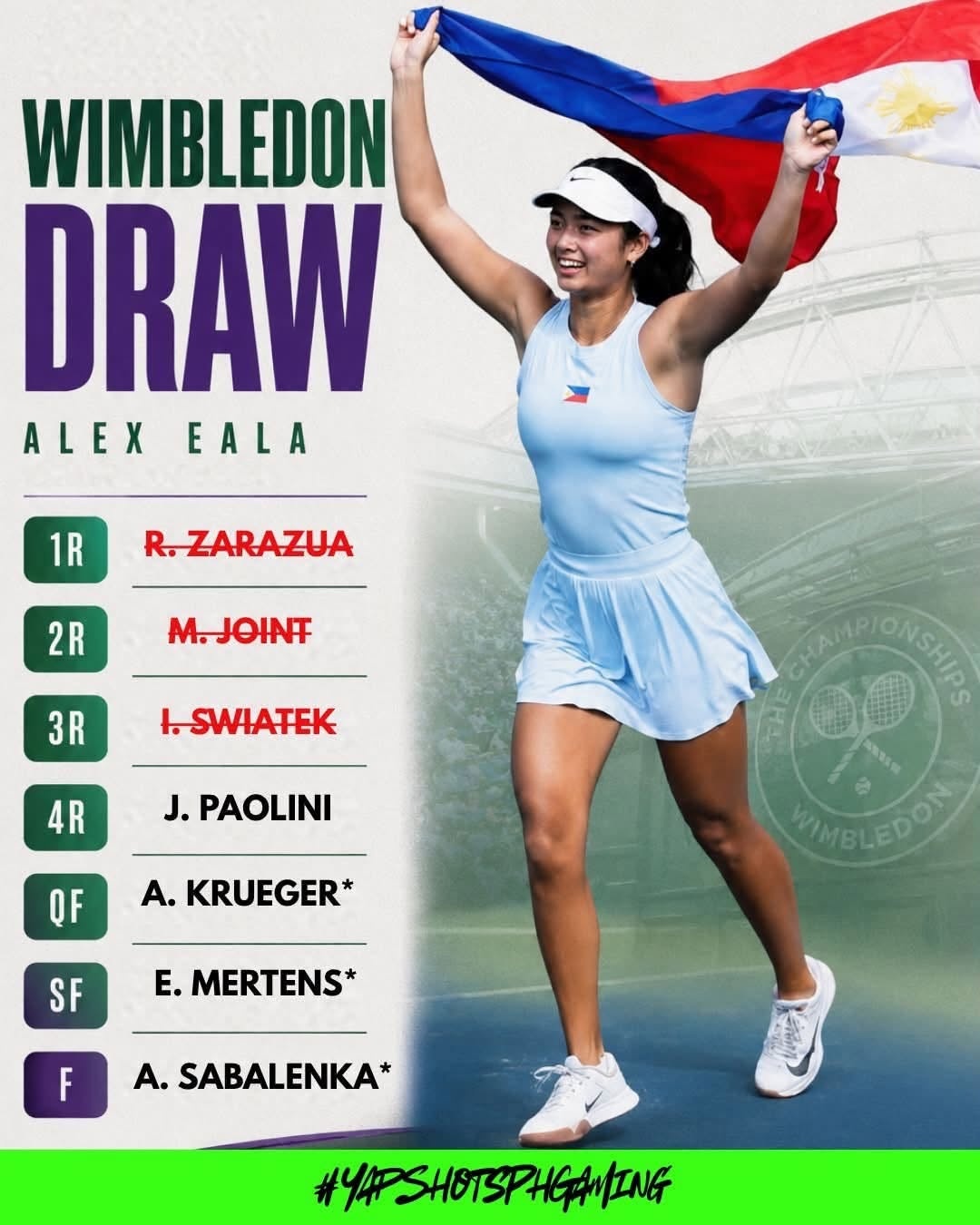
Looking at her projected path, Eala has already removed several dangerous obstacles and continues advancing through one of tennis' most demanding events. Every victory represents another layer of confidence—and another lesson in championship tennis.
From an ATP coaching perspective, what stands out isn't merely the results.
It's how she is winning.
Champions don't simply hit better shots.
Champions make better decisions.
And throughout this Wimbledon campaign, Eala has repeatedly demonstrated the kind of tactical maturity usually seen in players with far more Grand Slam experience.
Wimbledon Is the Ultimate Tennis Examination
Grass courts expose every weakness.
Unlike clay, there is little time to recover after poor positioning.
Unlike hard courts, the lower bounce forces players to stay exceptionally balanced.
Every serve matters.
Every first strike matters.
Every transition matters.
Winning at Wimbledon requires players to think one shot ahead rather than reacting to what has already happened.
That has become one of Alex Eala's greatest strengths.
Instead of trying to overpower opponents on every rally, she continually adjusts her patterns according to the match situation.
This is what coaches call situational tennis.
Rather than playing one style for two hours, elite competitors constantly evolve throughout the match.
Adjustment No. 1: Reading Opponents Earlier
One noticeable improvement in Eala's recent performances is how quickly she recognizes her opponent's preferred rally patterns.
Many younger professionals need an entire set before identifying tendencies.
Eala often identifies them within only a few games.
She begins noticing:
- preferred backhand direction
- second-serve placement
- forehand recovery habits
- movement toward short balls
- return positioning
Once those tendencies become obvious, she slowly changes her own shot selection.
This creates uncertainty.
Instead of allowing opponents to dictate rallies, she begins asking questions they weren't prepared to answer.
That is elite Game IQ.
Game IQ Is Becoming Her Biggest Weapon
People naturally notice powerful forehands.
They admire aggressive winners.
They celebrate acrobatic defense.
But coaches often focus on something completely different.
Decision-making.
Elite tennis is largely about making the correct decision under tremendous pressure.
Alex Eala increasingly shows excellent judgment by choosing:
- when to attack
- when to defend
- when to absorb pace
- when to redirect pace
- when to change rally height
- when to approach the net
These choices separate Top 100 players from Grand Slam contenders.
As experience grows, Eala's decision-making continues becoming faster.
That means fewer unforced errors.
More controlled aggression.
Higher-quality shot selection.
And ultimately, more victories.
The Hidden Improvement: Rally Construction
One mistake casual fans make is assuming points are won by the final shot.
Professional coaches know otherwise.
Most points are actually won by the two or three shots before the winner.
Alex Eala has become significantly better at constructing rallies.
Instead of attempting low-percentage winners from difficult positions, she patiently builds the point.
For example:
First shot:
Move opponent wide.
Second shot:
Attack the open middle.
Third shot:
Push opponent deep behind the baseline.
Fourth shot:
Finish into open court.
That's championship tennis.
Every shot has purpose.
Nothing is random.
The Left-Handed Advantage
Being left-handed offers unique tactical opportunities.
But only if players know how to maximize them.
Eala increasingly exploits natural left-handed angles.
Wide serves open the court immediately.
Crosscourt forehands naturally attack right-handed backhands.
Return positions become more uncomfortable for opponents accustomed to facing right-handed players.
Grass courts amplify these advantages because points develop much faster.
The first strike often determines the entire rally.
Power Is Becoming More Efficient
One of the biggest misconceptions surrounding power hitters is that bigger swings create more pace.
Professional biomechanics say otherwise.
True power comes from:
- balance
- timing
- hip rotation
- kinetic chain efficiency
- contact point
Watching Eala now compared with two years ago reveals a player producing heavier shots without appearing to swing dramatically harder.
That is improved efficiency.
The racquet head accelerates later.
Her body remains balanced longer.
Energy transfers more effectively from the legs upward.
The result is heavier ball penetration with lower physical cost.
That matters enormously over two weeks at Wimbledon.
Stamina Wins Grand Slams
A Grand Slam is unlike any other tournament.
Winning requires recovering repeatedly between long matches.
Players aren't merely competing against opponents.
They're competing against fatigue.
Elite conditioning allows athletes to:
- recover faster
- maintain concentration
- sustain serve speed
- preserve footwork quality
- avoid mental lapses late in sets
Eala appears increasingly capable of maintaining her movement intensity deep into matches.
That improvement doesn't happen overnight.
It reflects months of disciplined physical preparation.
Momentum Is Never Accidental
One of tennis' greatest myths is that momentum simply "happens."
Experienced ATP coaches disagree.
Momentum is manufactured.
Players create momentum by controlling:
- emotional reactions
- tempo between points
- first-serve percentage
- return depth
- body language
- energy management
Alex Eala demonstrates growing emotional discipline.
Instead of celebrating every winner excessively or becoming visibly frustrated after errors, she increasingly resets quickly.
That emotional consistency allows momentum to stay on her side longer.
Championship tennis is emotional control disguised as athletic performance.
Mental Toughness Is Becoming Visible
The biggest transformation isn't necessarily technical.
It's psychological.
Pressure affects everyone.
Even Grand Slam champions experience nerves.
The difference lies in how quickly they recover.
Elite competitors treat mistakes as information rather than disasters.
Eala increasingly shows that mindset.
A missed forehand no longer snowballs into three poor games.
Instead, she resets.
Refocuses.
Executes the next point.
That is precisely the mentality coaches attempt to build over years of professional competition.
This Wimbledon run represents more than a collection of victories. It showcases a player whose Game IQ, tactical flexibility, stamina, efficient power, and emotional resilience are all evolving together. Those qualities—not just raw talent—are what allow players to compete deep into Grand Slam tournaments and challenge the world's elite.