
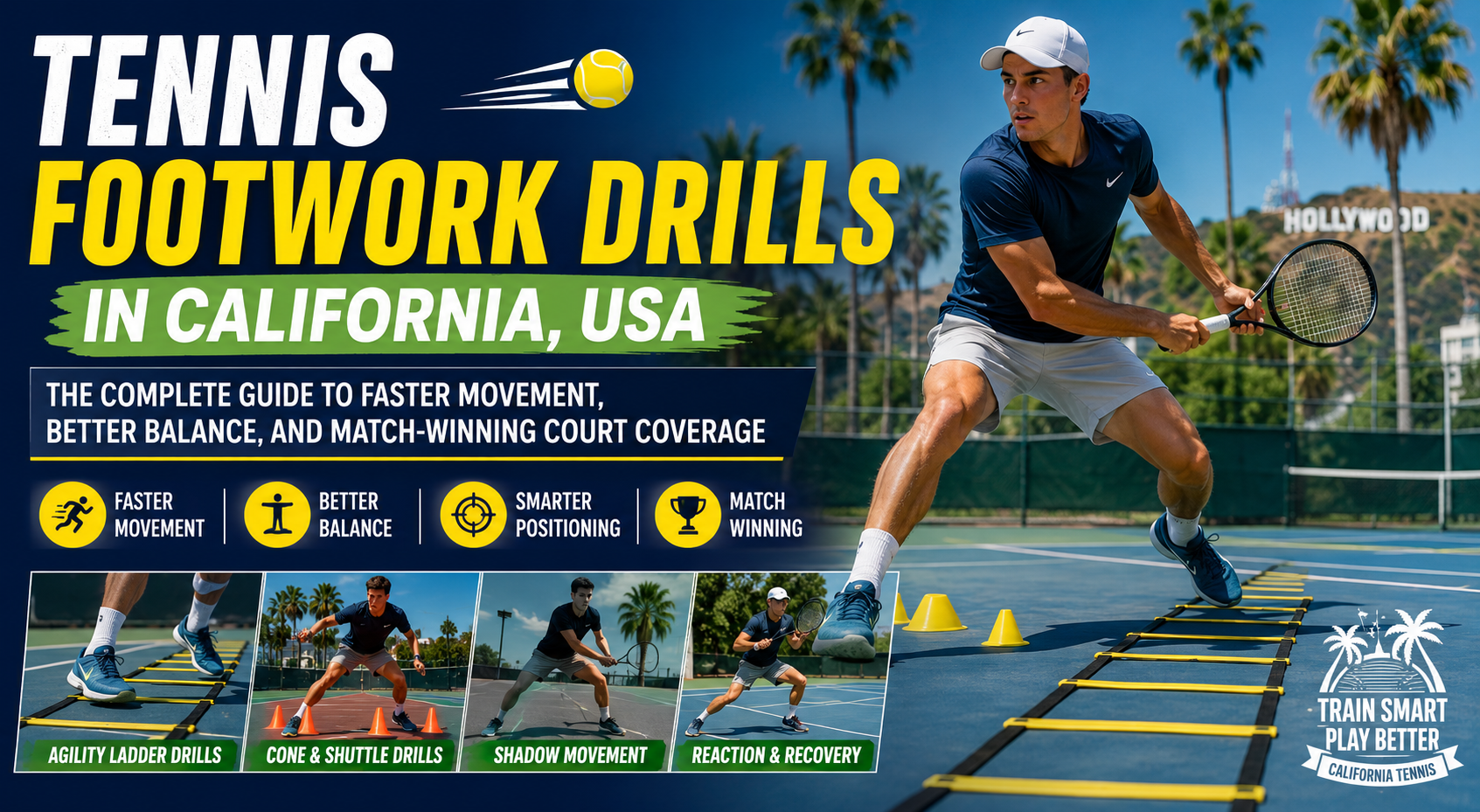
In modern tennis, powerful groundstrokes alone are not enough to win matches. Whether you are a junior player competing in California tournaments, a college athlete, a USTA competitor, or an adult recreational player, your success often depends on one critical skill: footwork for defensen and attack
Professional players such as Carlos Alcaraz, Jannik Sinner, and Novak Djokovic consistently demonstrate that elite movement allows them to arrive at the ball earlier, recover faster, and maintain balance under pressure. Movement of foot keeps them at high position to make a powerful stroke otherwise they will be choke if they move delay. Keep the drills moving for muscle foot memory
Across California, tennis academies, clubs, and private coaches spend countless hours developing movement patterns because coaches understand a simple truth:
The player who moves better usually plays better.
From the hard courts of Southern California to the public courts of Northern California, footwork training has become one of the most important areas of player development.
This guide explains:
- Why footwork matters this give you high edge to win the game and make even longer rally consistently.
- The best tennis footwork drills always make a dril for balance and movement slow , and fast movement
- Equipment needed for training is important to improve and enhance better training.
- How California players can improve movement faster
- Where to buy tennis training equipment
- How to find a qualified tennis coach in California
Why Footwork Is So Important in Tennis
Many players believe tennis is primarily about strokes.
However, experienced ATP and WTA coaches often say:
"Footwork creates the stroke."
Poor movement causes:
- Late contact
- Mishits
- Loss of balance
- Increased errors
- Reduced power
- Slower recovery
Good movement creates:
- Better timing
- More consistent ball striking
- Faster court coverage
- Improved defense
- Better offense
- Greater confidence
The difference between advanced players and beginners is often not racket skill but movement efficiency.
The California Tennis Environment
California has long been considered one of the strongest tennis regions in the United States.
Players train year-round because of:
- Excellent weather
- Large number of courts
- Strong junior competition
- High-level academies
- USTA tournaments
- College recruiting opportunities
This competitive environment means players must continuously improve movement and athleticism.
The Foundation of Tennis Footwork
Before learning advanced drills, players should understand four basic movement principles.
Split Step
The split step is a small hop performed just before the opponent contacts the ball.
Benefits include:
- Faster reaction time
- Better balance
- Explosive first movement
Without a proper split step, players often feel slow regardless of athletic ability.
Recovery Steps
After hitting a shot, players must recover immediately.
Elite players:
- Hit
- Recover
- Reset
They do not admire their shots.
This recovery habit allows them to be ready for the next ball.
Adjustment Steps
Small adjustment steps help players find ideal spacing before contact.
Many players miss because they stop moving too early.
Professional players continue adjusting their feet until the moment of impact.
Balance and Stability
Power starts from the ground.
Stable feet create:
- Better weight transfer
- Improved rotation
- More consistent strokes
Balance is one of the hidden secrets of elite tennis.
Best Tennis Footwork Drills
1. Ladder Footwork Drill
The agility ladder remains one of the most effective training tools.
Benefits
- Quick feet
- Coordination
- Rhythm
- Agility
Basic Pattern
Run through the ladder:
- One foot per square
- Two feet per square
- Lateral shuffle
- In-and-out pattern
Perform:
- 5–10 repetitions
- 20–30 seconds each
2. Cone Sprint Drill
Set five cones across the baseline.
Sprint:
- Forward
- Backward
- Side-to-side
This develops:
- Acceleration
- Deceleration
- Direction changes
All essential tennis movements.
3. Shadow Swing Movement Drill
No ball required.
Move:
- Forehand corner
- Recover
- Backhand corner
- Recover
Execute full swings while moving.
Benefits include:
- Muscle memory
- Footwork patterns
- Conditioning
Many professional players still use this simple drill daily.
4. Figure-Eight Drill
Place two cones several feet apart.
Move continuously around both cones in a figure-eight pattern.
This improves:
- Balance
- Coordination
- Endurance
- Direction changes
5. Spider Drill
One of the toughest conditioning drills.
Start at center court.
Sprint to:
- Forehand corner
- Backhand corner
- Service line
- Net
- Opposite side
Touch each location before returning.
Benefits:
- Court coverage
- Explosiveness
- Match conditioning
6. Cross-Over Recovery Drill
Many advanced players struggle with recovery movement.
Practice:
- Wide forehand
- Cross-over step recovery
- Reset position
This develops efficient movement similar to professional match play.
7. Resistance Band Movement Drill
Attach a resistance band around the waist.
Partner applies resistance while the player moves.
Benefits include:
- Explosive first step
- Leg strength
- Recovery speed
8. Reaction Footwork Drill
Partner points randomly.
Player reacts immediately.
Move:
- Left
- Right
- Forward
- Backward
This drill improves tennis-specific reaction speed.
Advanced Footwork Training Used by ATP Players
Elite players train beyond simple movement patterns.
Advanced drills include:
- Multi-ball movement
- Randomized feeding
- Recovery sprint combinations
- Open-stance recovery
- Defensive sliding
- Neutral-to-offensive transitions
Modern tennis requires movement under pressure rather than movement in predictable patterns.
Hard Court Footwork in California
California players spend much of the year on hard courts.
Hard courts require:
- Explosive first step
- Strong deceleration
- Efficient recovery
- Lower center of gravity
Because hard courts are less forgiving than clay courts, players must maintain excellent balance to avoid injuries.
How Often Should You Practice Footwork?
For most players:
Beginners
2 sessions weekly
Intermediate Players
3–4 sessions weekly
Tournament Players
4–6 sessions weekly
Elite Juniors
Daily footwork training
Consistency is more important than occasional intense workouts.
Equipment Needed for Tennis Footwork Training
Fortunately, footwork training does not require expensive equipment.
Essential tools include:
- Agility ladder
- Cones
- Resistance bands
- Speed hurdles
- Reaction lights
- Tennis balls
- Court markers
These tools can dramatically improve movement quality.
Where to Buy Tennis Footwork Equipment in California
California players have many excellent options.
Tennis Warehouse
One of the largest tennis equipment retailers in the United States.
Offers:
- Agility ladders
- Cones
- Resistance equipment
- Training accessories
- Tennis shoes
Wilson
Excellent source for:
- Training gear
- Tennis balls
- Court equipment
HEAD Tennis
Provides:
- Training equipment
- Rackets
- Accessories
Amazon
Convenient for:
- Agility ladders
- Cones
- Resistance bands
- Training packs
Dick's Sporting Goods
Widely available throughout California.
Carries:
- Athletic training gear
- Tennis accessories
- Conditioning equipment
Tennis Shoes Matter for Footwork
Many movement problems originate from poor footwear.
Good tennis shoes provide:
- Stability
- Lateral support
- Durability
- Traction
Players should replace shoes before tread becomes excessively worn.
Proper footwear can significantly improve movement confidence.
How to Find a Tennis Coach in California
A qualified coach can identify movement flaws that players often miss.
Look for coaches who evaluate:
- Split step timing
- Recovery patterns
- Balance
- Court positioning
- Efficiency of movement
USTA California
Provides:
- Tournament information
- Junior development resources
- Coach connections
- Training opportunities
PTR Certified Coaches
The Professional Tennis Registry certifies thousands of tennis instructors.
Official website:
Professional Tennis Registry (PTR)
You can search for certified professionals throughout California.
USPTA Certified Coaches
The United States Professional Tennis Association maintains a large network of teaching professionals.
Official website:
Their directory helps players find instructors by location.
Local Tennis Clubs
California is home to hundreds of clubs offering lessons.
Examples include:
- The Bay Club
- Lifetime Fitness
- Tennis Coalition of San Francisco
Many clubs offer:
- Private coaching
- Group clinics
- Junior programs
- High-performance training
Common Footwork Mistakes
Many players unknowingly limit their progress.
Common errors include:
Standing Flat-Footed
Players react slower and lose explosiveness.
No Split Step
Reaction time decreases dramatically.
Watching Shots Too Long
Players fail to recover after hitting.
Crossing Feet Incorrectly
Balance suffers during movement.
Taking Large Adjustment Steps
Players struggle with timing and spacing.
Correcting these habits often produces immediate improvement.
Building a Weekly Footwork Program
A California player could follow:
Monday
Agility ladder
20 minutes
Tuesday
On-court movement drills
30 minutes
Wednesday
Recovery and stretching
Thursday
Cone drills and sprint work
30 minutes
Friday
Shadow movement training
20 minutes
Saturday
Match play
Sunday
Active recovery
This schedule develops movement without overtraining.
Why Footwork Separates Champions from Everyone Else
Watch any professional match closely.
The biggest difference is not necessarily power.
It is positioning.
Elite players arrive:
- Earlier
- More balanced
- Better prepared
Their strokes appear effortless because their footwork places them in ideal hitting positions.
Whether training in Los Angeles, San Diego, Orange County, Sacramento, San Jose, or anywhere else in California, players who invest in footwork training often see faster improvement than those who focus exclusively on stroke mechanics.
Final Thoughts
Tennis footwork is the foundation upon which every successful stroke is built. California's year-round tennis environment offers players countless opportunities to improve movement, agility, and court coverage. By incorporating agility ladders, cone drills, shadow swings, spider drills, reaction exercises, and recovery training into a regular routine, players can dramatically elevate their performance.
Investing in quality training equipment, wearing proper tennis shoes, and working with a knowledgeable coach can accelerate progress even further. The best players understand that every great shot begins with great movement. Master your footwork, and every part of your game—from consistency to power to confidence—will improve.