
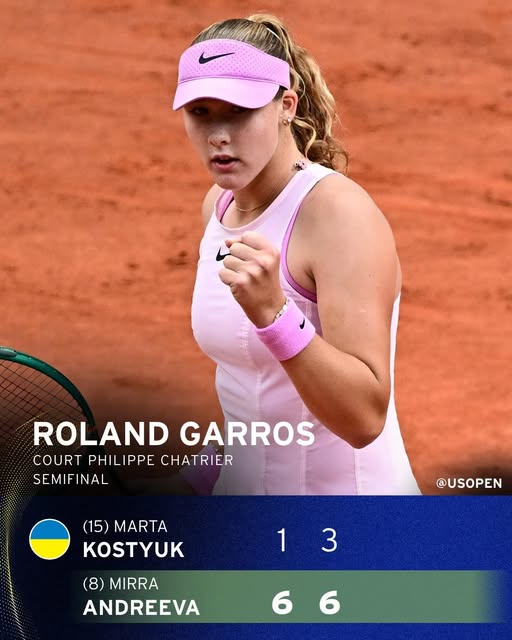
The semifinal result against Marta Kostyuk was more than just another victory for Mirra Andreeva. The straight-sets win demonstrated something that tennis analysts, coaches, and opponents have been noticing throughout the season: her game has evolved into a far more complete and dangerous version of itself.
Many young players arrive on the WTA Tour with exceptional talent. Few manage to transform that talent into a complete championship package at such a young age. Andreeva appears to be doing exactly that.
The scoreline against Kostyuk highlighted a player who is no longer relying solely on natural shot-making ability. Instead, she is beginning to combine elite tactical intelligence, improved physical endurance, superior mental focus, and remarkable point construction.
If she continues winning consistently and maintains her development trajectory, the possibility of reaching World No. 1 next year no longer sounds unrealistic.
The Evolution of Mirra Andreeva
When Andreeva first emerged on tour, observers were immediately impressed by her court awareness.
Unlike many teenagers who rely primarily on power, Andreeva possessed:
- Advanced court geometry
- Exceptional anticipation
- Natural defensive instincts
- Intelligent shot selection
- Remarkable composure
However, her game still had limitations.
Against elite power players, she occasionally struggled physically during long matches.
Her serve lacked consistent free points.
Her stamina sometimes fluctuated deep into tournaments.
Her forehand could occasionally break down under sustained pressure.
Today, those weaknesses are gradually disappearing.
What makes her particularly dangerous is that her strengths are becoming stronger while her weaknesses are shrinking.
That is often the formula behind future World No. 1 players.
ATP Coach Perspective: The Most Important Improvement
An ATP-level coach evaluating Andreeva's recent performances would likely identify one key area:
Her ability to maintain tactical discipline for an entire match.
Many talented young players can execute a game plan for one set.
Champions execute it for two or three hours.
Against Kostyuk, Andreeva consistently followed the correct patterns:
- Targeting weaker positions
- Opening the court patiently
- Defending intelligently
- Transitioning from defense to offense
- Avoiding low-percentage risks
That maturity is rare for a player still in her teenage years.
Several established stars did not possess this level of tactical consistency until their early twenties.
Stamina Has Reached Another Level
One of the biggest developments in Andreeva's game is physical endurance.
Elite tennis increasingly rewards players who can maintain quality under fatigue.
Championship matches often come down to who executes best after two hours of physical punishment.
Andreeva appears significantly stronger physically than she was just one year ago.
Key improvements include:
Recovery Between Points
She recovers quickly after long rallies.
Her breathing stabilizes faster.
Her movement remains explosive.
Endurance During Long Exchanges
Many opponents attempt to wear her down.
Instead, Andreeva often becomes stronger as matches progress.
Consistent Footwork
Fatigue usually affects movement first.
Yet Andreeva's footwork remains efficient deep into matches.
This allows her to continue generating high-quality shots even late in sets.
Her Movement Is Becoming Elite
Movement separates good players from great players.
Andreeva's movement on clay has become one of her greatest weapons.
She combines:
- Speed
- Balance
- Sliding ability
- Recovery positioning
- Anticipation
What makes her special is not necessarily raw speed.
It is efficiency.
She often appears one step ahead because she reads the game exceptionally well.
This reduces energy expenditure and allows her to remain fresh throughout matches.
The Backhand: A Future Hall-of-Fame Weapon
Andreeva's two-handed backhand has become one of the most reliable strokes in women's tennis.
The shot possesses:
- Stability
- Accuracy
- Depth
- Directional control
She can hit:
Crosscourt
Creating angles that pull opponents off the court.
Down The Line
Punishing opponents who leave space.
Defensive Backhands
Turning defensive situations into neutral rallies.
Offensive Winners
Finishing points when opportunities appear.
Few players her age possess such complete backhand capabilities.
Many coaches already consider it among the best backhands on tour.
Forehand Improvement Is Changing Everything
Earlier in her development, the forehand occasionally lagged behind the backhand.
That gap is shrinking rapidly.
The forehand now shows:
- More acceleration
- Greater confidence
- Improved consistency
- Better spin variation
Most importantly, she is beginning to dictate points with it.
When opponents focus on neutralizing her backhand, she now possesses the forehand firepower to punish them.
This balance makes her much harder to attack.
Serve Development Continues
The serve remains the area with the most room for improvement.
However, significant progress is visible.
Recent matches show:
- Improved placement
- Better disguise
- Increased confidence
- More aggressive second serves
She is earning more free points than before.
If her serve continues improving over the next twelve months, it could elevate her from Grand Slam contender to dominant force.
Historically, many future World No. 1 players made their biggest leap after upgrading their serve.
Andreeva may be following that path.
Return Of Serve Excellence
Perhaps the most underrated aspect of her game is returning.
She consistently:
- Neutralizes powerful servers
- Creates immediate pressure
- Forces difficult first shots
- Wins early rally control
Elite returners often become Grand Slam champions because they remove opponents' easiest points.
Andreeva is becoming one of those players.
Mental Focus Beyond Her Years
Talent wins matches.
Mental strength wins championships.
Andreeva's mental evolution may be her most impressive transformation.
Against top opposition she demonstrates:
Emotional Stability
She rarely panics.
Point-To-Point Discipline
Each point receives equal focus.
Resilience
Mistakes do not linger.
Tactical Commitment
She trusts her game plan.
Many players lose because emotions interfere with execution.
Andreeva increasingly separates emotion from performance.
That is a hallmark of elite competitors.
Handling Pressure Like A Veteran
Grand Slam semifinals create enormous pressure.
Crowds grow louder.
Media attention intensifies.
Expectations increase.
Yet Andreeva appears comfortable in these environments.
Against Kostyuk she displayed remarkable calm.
Important points were approached with:
- Controlled breathing
- Clear decision-making
- Positive body language
- Tactical clarity
This mental framework is usually developed through years of experience.
She is building it unusually early.
Why Opponents Struggle Against Her
Several factors make Andreeva difficult to play.
She Changes Speeds
Not every ball arrives with the same pace.
She Changes Heights
Different trajectories disrupt rhythm.
She Creates Angles
Opponents constantly move laterally.
She Defends Exceptionally
Winners are difficult to find.
She Thinks Ahead
She anticipates patterns quickly.
This combination forces opponents into uncomfortable situations.
Many players leave matches feeling mentally exhausted.
Clay Court Intelligence
Clay rewards patience and intelligence.
Andreeva thrives in both categories.
She understands:
- Court positioning
- Point construction
- Spin usage
- Defensive recovery
- Tactical variation
Her clay-court IQ is among the best on tour.
This explains why she continues producing strong results on the surface.
The Championship Mindset
Champions possess unique habits.
Andreeva increasingly demonstrates many of them.
These include:
Continuous Improvement
Every tournament reveals new progress.
Learning From Losses
Defeats become lessons.
High Standards
She expects excellence.
Long-Term Thinking
Development remains the priority.
This mindset often separates future legends from talented players who plateau.
Comparing Her Trajectory To Former No. 1 Players
Several similarities emerge when comparing Andreeva's rise to past champions.
Like many former World No. 1 players, she possesses:
- Elite tennis IQ
- Mental maturity
- Adaptability
- Competitive toughness
- Continuous improvement
The exact timeline remains uncertain.
However, the ingredients are clearly present.
What Must Improve To Reach No. 1
While her future looks bright, some areas still require growth.
More First-Serve Power
Additional free points will help.
Increased Physical Strength
Particularly against heavy hitters.
Closing Matches Faster
Reducing time on court preserves energy.
Continued Forehand Growth
Turning it into a true weapon.
If these improvements continue, the gap between Andreeva and the very top of the rankings could disappear quickly.
Why World No. 1 Is A Realistic Goal
Ranking systems reward consistency.
Andreeva's game is built around consistency.
She already possesses:
- Deep tournament runs
- Strong clay results
- Tactical maturity
- Mental stability
- Physical improvement
If she continues reaching semifinals and finals regularly, ranking points will accumulate rapidly.
The path to World No. 1 is difficult.
But it is no longer difficult to imagine.
ATP Coach Voice: The Future Looks Extremely Bright
An ATP coach watching Andreeva today would likely say:
"What stands out is not just the talent. It's how quickly she absorbs information and applies it in matches. Most young players need years to develop this level of tactical understanding. She is already thinking several shots ahead. If she continues improving physically and adds a few more weapons to the serve and forehand, she has every tool necessary to become the best player in the world."
That assessment reflects what many within professional tennis increasingly believe.
The Next Stage Of Evolution
The most exciting aspect of Andreeva's development is that she is still improving.
Her ceiling remains unknown.
Each season reveals:
- Better movement
- Better stamina
- Better serving
- Better tactical awareness
- Better mental control
That combination is rare.
When a player improves simultaneously across multiple categories, major breakthroughs often follow.
Conclusion
Mirra Andreeva's victory over Marta Kostyuk represented far more than a semifinal triumph. It showcased a player whose game has evolved into a significantly higher level.
Her stamina has improved dramatically. Her movement is becoming elite. Her backhand is already among the best on tour. Her forehand continues to grow stronger. Most importantly, her mental focus resembles that of a seasoned champion rather than a teenager.
The transformation is not based on one spectacular shot or one impressive tournament. It is built upon steady improvement across every major component of elite tennis.
If she continues winning consistently, remains healthy, and maintains her current development pace, the conversation surrounding Mirra Andreeva will soon shift from whether she can win Grand Slam titles to whether she can become World No. 1.
Based on what she is showing today, that possibility looks increasingly realistic. The talent is undeniable, the work ethic appears exceptional, and the competitive mindset continues to mature.
For the rest of the WTA Tour, that combination should be a very concerning development. For tennis fans, it may be the beginning of one of the sport's next great championship careers.