ATP USA Expert Analysis
Grand Slam tournaments are not won with talent alone.
They are won through suffering.
They are won through resilience.
They are won by players who continue fighting when their legs are heavy, their lungs are burning, and their minds are begging for relief.
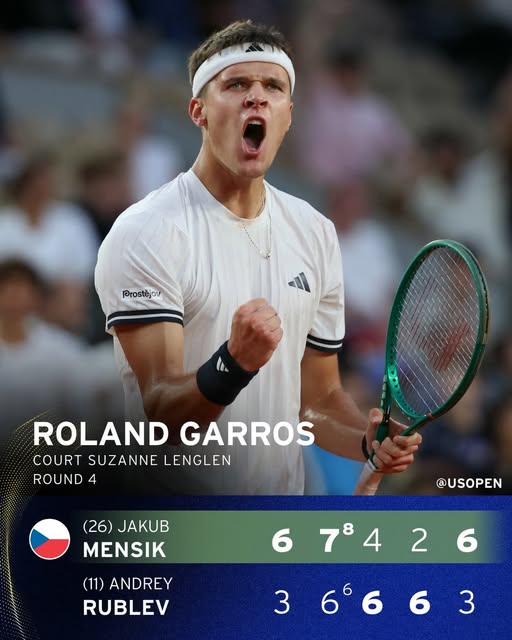
At Roland Garros, Jakub Mensik delivered exactly that kind of performance.
In a thrilling five-set battle against Andrey Rublev, the Czech rising star demonstrated why many ATP analysts believe he possesses the tools to become one of the future stars of men's tennis.
The scoreboard tells only part of the story.
Mensik defeated Rublev in five dramatic sets, surviving momentum swings, pressure moments, physical challenges, and tactical adjustments from one of the most dangerous shot-makers on the ATP Tour.
This was not simply a victory.
This was a statement.
A statement that Mensik belongs on the biggest stages.
A statement that he is learning how to win difficult matches.
Most importantly, it was a statement that his hunger for Grand Slam success is growing stronger with every tournament.
From an ATP expert perspective in the United States, this match offered a fascinating glimpse into the future of men's tennis.
The Dream Every Young Player Chases
Every young professional enters tennis with one dream.
Winning a Grand Slam.
The dream begins as a child.
It starts on practice courts.
It grows during junior tournaments.
It becomes stronger with every sacrifice.
For players like Mensik, Roland Garros represents more than a tournament.
It represents possibility.
Every victory moves him closer to the sport's highest level.
Every match teaches lessons that cannot be learned in practice.
Against Rublev, Mensik took another important step toward that dream.
The Challenge of Facing Andrey Rublev
Many fans underestimate how dangerous Rublev can be.
That is a mistake.
Few players strike the ball with greater force.
Rublev's strengths are obvious:
- Massive forehand power
- Aggressive court positioning
- High-intensity baseline play
- Relentless pressure
- Fearless shot-making
When Rublev finds rhythm, he can overwhelm almost anyone.
The challenge for Mensik was clear.
He could not simply react.
He needed solutions.
He needed adjustments.
Most importantly, he needed courage.
The Opening Set: Mensik Announces His Intentions
From the first games, Mensik looked composed.
There was no sign of intimidation.
This is significant.
Many younger players become cautious against established stars.
Mensik did the opposite.
He attacked.
He trusted his strokes.
He played with conviction.
The opening set showcased one of the most important aspects of his game:
Belief
Belief changes everything in tennis.
Without belief, talent becomes hesitant.
With belief, talent becomes dangerous.
Mensik entered the match believing he could win.
That confidence was visible from the opening points.
ATP USA Perspective: Confidence Cannot Be Coached
Technical skills can be improved.
Fitness can be developed.
Tactics can be taught.
Genuine confidence is different.
The greatest champions possess an internal conviction that survives difficult moments.
Mensik increasingly displays this quality.
He is beginning to compete like a player who expects success rather than merely hopes for it.
That mentality often separates future champions from ordinary professionals.
Rublev Strikes Back
Elite players rarely disappear quietly.
Rublev responded exactly as expected.
The Russian raised his intensity.
His forehand became more aggressive.
His court positioning improved.
His energy increased.
Suddenly the momentum shifted.
This is where many young players panic.
They become frustrated.
They lose tactical discipline.
They rush points.
Mensik remained calm.
That decision would prove critical later.
The Middle Stages: Tactical Chess on Clay
Casual fans often focus only on winners.
Professional coaches focus on patterns.
The middle portion of the match became a tactical battle.
Each player searched for weaknesses.
Each player adjusted positioning.
Each player attempted to gain control.
Several important trends emerged.
Mensik Targeted Depth
Rather than aiming for spectacular winners, he repeatedly pushed Rublev behind the baseline.
This reduced Rublev's attacking opportunities.
Rublev Increased Pace
The Russian attempted to shorten rallies.
He understood that extended exchanges favored Mensik's movement.
Mensik Stayed Patient
Patience is difficult under pressure.
The young Czech displayed remarkable maturity.
The Thrilling Tiebreak Moment
Grand Slam matches often hinge on a few points.
The tiebreak represented one of those moments.
The atmosphere intensified.
Every shot carried greater significance.
Every decision mattered.
The pressure became enormous.
This is where champions begin to reveal themselves.
Mensik played some of his most courageous tennis during these crucial points.
He trusted his game.
He trusted his preparation.
He trusted his instincts.
The result was a tiebreak victory that changed the complexion of the match.
Why Big-Point Performance Matters
Many players perform well during ordinary points.
Champions perform well during important points.
The difference is substantial.
Pressure affects:
- Decision-making
- Footwork
- Shot selection
- Emotional control
Players who embrace pressure gain enormous advantages.
Mensik demonstrated an encouraging ability to remain aggressive when the stakes increased.
That trait cannot be overstated.
Grand Slam titles are won through big-point excellence.
Stamina Becomes a Major Factor
As the match progressed, physical conditioning became increasingly important.
Five-set matches are athletic wars.
Every rally drains energy.
Every sprint accumulates fatigue.
Every slide on clay taxes the body.
The physical demands become relentless.
At this stage, stamina begins separating players.
Mensik's conditioning impressed throughout the contest.
His movement remained explosive.
His reactions stayed sharp.
His intensity never disappeared.
That consistency became one of the decisive factors.
Full Match Preparation Pays Off
Matches like this are won long before players enter the stadium.
Preparation matters.
Elite preparation includes:
Physical Training
Building endurance and strength.
Tactical Planning
Studying opponents.
Mental Rehearsal
Preparing for adversity.
Recovery Management
Ensuring the body is ready.
Nutrition
Maintaining energy levels.
Mensik looked prepared in every category.
His team deserves significant credit.
The foundation was clearly established before the first ball was struck.
The Fourth Set: Rublev Refuses to Quit
One reason Rublev remains dangerous is his competitive spirit.
Even when momentum shifted against him, he continued fighting.
The fourth set showcased his determination.
His forehand exploded.
His energy increased.
His aggression intensified.
Many players would have folded.
Rublev did not.
The match suddenly became even more dramatic.
For Mensik, the challenge was psychological.
Could he remain composed?
Could he avoid frustration?
Could he stay committed to the game plan?
The answer was yes.
The Deciding Set: Character Revealed
The fifth set is where tennis strips away all excuses.
There is nowhere to hide.
No shortcuts.
No easy solutions.
Only execution remains.
This is where character becomes visible.
Mensik's performance during the deciding set may have been the most impressive portion of the match.
His focus sharpened.
His movement remained strong.
His shot selection improved.
Most importantly, his courage never disappeared.
He continued taking calculated risks.
That willingness to trust his game ultimately made the difference.
Stroke Analysis: Why Mensik's Game Is So Effective
Several technical strengths stood out.
The Forehand
The forehand continues to develop into a major weapon.
Its strengths include:
- Heavy pace
- Excellent penetration
- Offensive versatility
- Reliable depth
Against Rublev, the shot repeatedly created opportunities.
The Backhand
The backhand displayed remarkable stability.
Even under pressure, Mensik remained confident.
This consistency prevented Rublev from targeting one side.
Balanced players are difficult to attack.
Mensik increasingly fits that description.
The Serve
The serve played an important role throughout the match.
Key strengths included:
- Effective placement
- Variety
- Important first serves under pressure
As Mensik matures physically, the serve could become even more dangerous.
Return of Serve
Returning against Rublev is never easy.
The Russian generates tremendous pace.
Mensik handled this challenge well.
His returns consistently started rallies and prevented Rublev from dominating service games.
Speed and Agility Made the Difference
Modern tennis rewards movement.
Mensik's athleticism continues to improve.
Several qualities stand out:
Explosive First Step
He reacts quickly.
Defensive Recovery
He recovers exceptionally well after difficult shots.
Court Coverage
His range allows him to extend rallies.
Offensive Transition
He quickly turns defense into attack.
These abilities become invaluable during five-set battles.
ATP USA Expert Assessment
From an American ATP analyst perspective, Mensik displayed several characteristics commonly associated with future elite players.
Competitive Courage
He embraced pressure.
Tactical Intelligence
He adjusted throughout the match.
Physical Endurance
He remained strong deep into the fifth set.
Emotional Stability
He stayed composed despite momentum swings.
Shot-Making Ability
His offensive tools continue to improve.
These qualities create a compelling long-term outlook.
The Hunger to Win a Grand Slam
Perhaps the most encouraging aspect of Mensik's performance was his ambition.
Great players are driven by goals.
The greatest players are obsessed with them.
Mensik appears increasingly determined to reach the highest level.
That hunger is visible.
It appears in:
- His intensity
- His preparation
- His body language
- His willingness to compete
Championship dreams require extraordinary commitment.
Mensik looks prepared to embrace that challenge.
Learning from Every Round
Grand Slam success is built gradually.
Every match teaches something.
Every victory adds experience.
Every challenge creates growth.
This victory over Rublev may prove particularly valuable.
The lessons learned from a five-set battle cannot be replicated elsewhere.
Such experiences accelerate development.
Why the Tennis World Is Watching
The ATP Tour constantly searches for the next generation of stars.
Several young players have already emerged.
Mensik is quickly joining that conversation.
The reasons are obvious:
- Physical talent
- Mental resilience
- Tactical growth
- Competitive fearlessness
The combination is rare.
That rarity explains the growing excitement.
The Road Ahead
One victory does not guarantee future success.
Tennis remains unforgiving.
New challenges await.
Tough opponents remain.
The path to a Grand Slam title is long.
However, performances like this suggest Mensik is moving in the right direction.
His development continues.
His confidence grows.
His experience expands.
These factors create momentum.
Momentum often becomes the foundation for major breakthroughs.
Final Thoughts
Jakub Mensik's dramatic five-set victory over Andrey Rublev at Roland Garros was far more than a place in the next round. It was a showcase of determination, preparation, physical endurance, tactical intelligence, and championship ambition.
Throughout the match, Mensik demonstrated the qualities required to succeed at the highest levels of professional tennis. He adjusted when necessary, remained composed under pressure, trusted his game during critical moments, and displayed the stamina needed to survive one of the sport's toughest tests.
From an ATP USA expert perspective, perhaps the most exciting takeaway is not the result itself but what it reveals about Mensik's future. His game continues to mature. His confidence continues to rise. His hunger to compete for Grand Slam titles becomes more evident with every tournament.
The journey toward becoming a major champion is never easy.
But after this thrilling Roland Garros performance, one thing appears increasingly clear:
Jakub Mensik is no longer simply a promising young talent.
He is becoming a serious force in men's tennis—and a player who may one day turn his Grand Slam dreams into reality.