
ATP USA Expert Analysis
At the business end of a Grand Slam, style points no longer matter.
Winning matters.
Advancing matters.
Finding solutions under pressure matters.
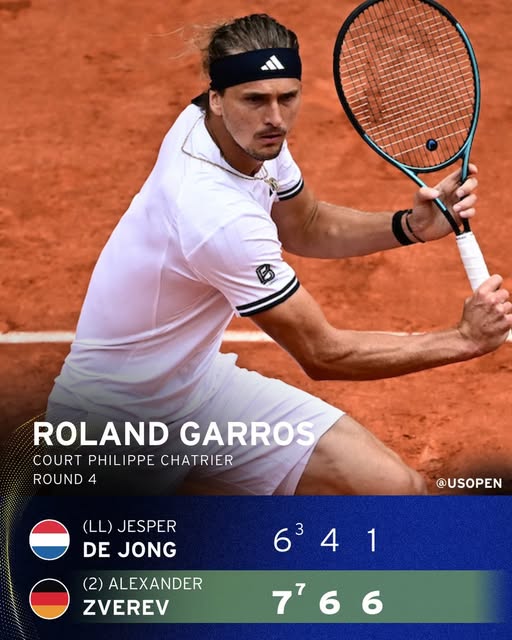
That is exactly what Alexander "Sascha" Zverev accomplished during his fourth-round victory over Jesper de Jong at Roland Garros. The German star once again demonstrated why he remains one of the most dangerous players on clay courts, overcoming a determined opponent through smart adjustments, superior physical conditioning, and the mental discipline that separates contenders from champions.
The final score may suggest a comfortable victory, but experienced ATP observers understand that Grand Slam matches are rarely as simple as the numbers indicate.
Every match is a puzzle.
Every opponent presents a unique challenge.
Every round requires new solutions.
Against Jesper de Jong, Zverev showed why he continues to be one of the most complete players on the ATP Tour and why many experts still view him as a legitimate contender for the Roland Garros title.
From an ATP analyst perspective in the United States, the most impressive aspect of the victory was not the power of his serve or the strength of his backhand.
It was his ability to recognize problems early and make the necessary adjustments before the match could become dangerous.
That is championship-level tennis.
Quarterfinals Are Earned, Not Given
The deeper players advance into a Grand Slam, the higher the level becomes.
By the fourth round, there are no easy matches.
The remaining competitors have already survived multiple rounds of pressure.
They have adapted to conditions.
They have developed confidence.
They believe they can win.
For Zverev, reaching another Roland Garros quarterfinal is evidence of remarkable consistency.
Consistency is often overlooked in modern tennis.
Fans celebrate spectacular winners and dramatic victories.
Coaches appreciate reliability.
The ability to repeatedly reach the second week of Grand Slam tournaments demonstrates a player's professionalism, fitness, and mental toughness.
Zverev continues to display all three.
The Opening Challenge
Every match begins with uncertainty.
No matter how much scouting information exists, players must still adjust to the reality of competition.
Jesper de Jong entered the match with confidence.
The Dutch player had already exceeded expectations and had nothing to lose.
Those circumstances can be dangerous.
Players with nothing to lose often swing freely.
They take risks.
They play aggressively.
They force favorites to respond.
Early in the contest, De Jong demonstrated exactly why he had reached the fourth round.
His movement was sharp.
His energy was high.
His belief was obvious.
The challenge for Zverev was to remain patient.
ATP USA Expert View: Patience Wins on Clay
Clay-court tennis rewards discipline.
Unlike fast hard courts or grass courts, clay extends rallies.
Players must earn points.
This reality often frustrates aggressive competitors.
The temptation is to force winners too early.
The smartest players resist that temptation.
Zverev's experience became an important factor.
Rather than chasing spectacular shots, he trusted the structure of his game.
He understood that over time, the pressure would begin to accumulate on the other side of the net.
This patience is one of the most underrated elements of elite clay-court tennis.
Game Adjustments That Changed the Match
The best ATP players constantly solve problems.
Winning is often about adaptation rather than domination.
Several adjustments stood out during Zverev's performance.
1. Increased Depth on Groundstrokes
Depth is one of the most important concepts in professional tennis.
Deep shots push opponents behind the baseline.
This reduces attacking opportunities.
As the match progressed, Zverev consistently drove the ball deeper into the court.
The result was immediate.
De Jong found himself defending more frequently.
Instead of dictating points, he was reacting.
This subtle tactical adjustment shifted momentum toward the German.
2. Better Court Positioning
Elite tennis is often decided by inches.
Small positional improvements create major advantages.
Zverev gradually moved closer to the baseline.
This adjustment allowed him to:
- Take time away from his opponent
- Strike the ball earlier
- Control rally tempo
- Increase offensive pressure
When Zverev controls court position, he becomes extremely difficult to defeat.
His combination of reach and power makes him one of the most effective baseline players in the world.
3. Smarter Serve Placement
Many fans focus solely on serve speed.
Professionals focus on serve location.
A well-placed serve can be more effective than a faster one.
Throughout the match, Zverev varied his serve patterns intelligently.
He mixed:
- Wide serves
- Body serves
- Flat deliveries
- Kick serves
This variety prevented De Jong from establishing a comfortable return rhythm.
The serve became a strategic weapon rather than simply a source of power.
The Importance of Mental Focus
Grand Slam tennis is as much mental as physical.
The difference between victory and defeat often comes down to concentration.
Mental focus is especially important against lower-ranked opponents.
Many favorites lose because they underestimate opponents.
Complacency is dangerous.
Zverev avoided that trap.
His body language suggested respect.
His effort level remained high.
His attention to detail never disappeared.
These qualities are crucial during major tournaments.
Champions maintain intensity regardless of ranking.
How Elite Players Handle Momentum Swings
Momentum shifts are inevitable.
No player dominates every point.
The key is managing adversity.
Throughout the match, there were moments when De Jong generated energy.
He won important rallies.
He created pressure.
He challenged Zverev's rhythm.
The German's response was impressive.
Rather than becoming frustrated, he stayed composed.
This emotional stability prevented small problems from becoming major issues.
Young players often panic during momentum swings.
Veterans remain calm.
Zverev's experience was visible in these moments.
Stamina and Physical Conditioning
One of the most impressive aspects of Zverev's game is his physical development.
Standing over six feet tall, he possesses unusual endurance for a player of his size.
Clay-court tennis demands:
- Endless movement
- Frequent sliding
- Long rallies
- Repeated acceleration
Players who are not properly conditioned eventually break down.
Zverev continues to demonstrate exceptional stamina.
His movement late in matches often looks nearly identical to his movement early in matches.
This consistency reflects countless hours of preparation.
ATP Conditioning Perspective
Modern tennis conditioning extends far beyond running.
Elite preparation includes:
Strength Training
Building explosive power.
Mobility Training
Maintaining flexibility and movement efficiency.
Recovery Protocols
Accelerating recovery between matches.
Nutrition
Supporting performance and endurance.
Hydration Management
Maintaining physical and cognitive function.
Sleep Optimization
Maximizing recovery capacity.
Zverev's physical performance suggests a comprehensive approach to preparation.
His ability to sustain intensity deep into tournaments is not accidental.
It is the result of professional planning.
The Backhand Remains a World-Class Weapon
Every elite player has signature strengths.
For Zverev, the two-handed backhand remains one of the finest shots in men's tennis.
Several qualities make it special.
Consistency
He rarely misses routine backhands.
Power
The shot can immediately shift rallies.
Directional Control
He changes direction exceptionally well.
Defensive Reliability
Even under pressure, the stroke remains stable.
Against De Jong, the backhand repeatedly helped Zverev regain control of points.
It remains one of the most trusted weapons in his arsenal.
Forehand Development Continues
For years, analysts focused on Zverev's forehand as an area requiring improvement.
Recent seasons have shown noticeable progress.
The forehand now appears:
- More confident
- More aggressive
- More reliable
This development is significant.
A stronger forehand creates balance.
Opponents can no longer target one side comfortably.
The improvement has helped elevate Zverev's overall level.
Return of Serve Excellence
Returning serve on clay requires patience and discipline.
Players must neutralize powerful deliveries while maintaining positioning.
Zverev's return game was quietly effective.
He consistently:
- Put returns into play
- Started rallies effectively
- Applied pressure on second serves
These actions prevented De Jong from enjoying easy service games.
The cumulative effect became increasingly important as the match progressed.
The Maturity Factor
One of the biggest differences between the younger Zverev and the current version is maturity.
Experience teaches valuable lessons.
Players learn:
- How to manage emotions
- How to recover from mistakes
- How to navigate difficult moments
- How to conserve energy
These lessons become especially important during Grand Slam events.
The Zverev seen today appears more complete than the player who first emerged as a young ATP star.
Why Roland Garros Fits His Game
Certain tournaments naturally suit specific players.
Roland Garros complements many of Zverev's strengths.
The slower clay surface rewards:
- Patience
- Defense
- Consistency
- Physical endurance
These qualities align well with his skill set.
His heavy groundstrokes gain effectiveness.
His movement remains efficient.
His tactical discipline becomes valuable.
As a result, Paris continues to be one of his strongest Grand Slam opportunities.
Championship Aspirations
Reaching the quarterfinals is important.
Winning the tournament remains the ultimate goal.
For players of Zverev's caliber, success is measured differently.
The expectations are higher.
The standards are higher.
Deep runs are expected.
Titles are pursued.
The quarterfinal represents another step toward that objective.
The Competition Ahead
Grand Slam quarterfinals feature the world's best players.
Every opponent presents unique challenges.
Future matches will require:
- Tactical flexibility
- Emotional control
- Physical resilience
- Strategic intelligence
Fortunately for Zverev, these areas continue to improve.
His current form suggests he is prepared for difficult battles ahead.
ATP USA Expert Assessment
From an American ATP analyst perspective, several observations stand out:
Elite Physical Shape
Zverev looks strong and prepared for long matches.
Tactical Maturity
His adjustments are becoming increasingly sophisticated.
Improved Confidence
His decision-making appears more decisive.
Emotional Stability
He remains composed during pressure situations.
Championship Potential
His overall level continues to place him among the most dangerous players in major tournaments.
These qualities are essential for players seeking Grand Slam success.
What This Victory Means
Victories like this build momentum.
Momentum matters in tennis.
Confidence grows.
Execution improves.
Belief strengthens.
As players advance deeper into tournaments, these factors become increasingly important.
Zverev now enters the quarterfinals carrying valuable momentum.
He has demonstrated:
- Strong form
- Smart adjustments
- Physical readiness
- Mental focus
That combination makes him a serious threat.
Final Thoughts
Alexander "Sascha" Zverev's march into the Roland Garros quarterfinals was not simply another victory on the ATP Tour. It was a demonstration of the qualities required to compete for Grand Slam titles.
His performance against Jesper de Jong showcased intelligent tactical adjustments, outstanding physical conditioning, elite backhand execution, improved offensive balance, and the mental discipline necessary to thrive under pressure.
Perhaps most importantly, Zverev displayed the maturity of a player who understands that championships are rarely won through spectacular moments alone. They are won through consistency, adaptation, focus, and resilience.
As Roland Garros enters its decisive stages, Zverev continues to look like one of the tournament's most complete competitors. If he maintains this level of physical endurance, tactical intelligence, and emotional control, his quest for a major title remains very much alive.
The quarterfinal ticket has been secured.
The bigger challenge now begins.
And based on what ATP observers have seen so far in Paris, Sascha Zverev appears ready for it.