
For nearly two decades, Novak Djokovic stood at the summit of professional tennis like an immovable force. Generations of players arrived with dreams of replacing him, yet most eventually fell to the Serbian legend’s unmatched discipline, endurance, and mental resiliencee.
But tennis eventually humbles everyone.
Even the greatest champions.
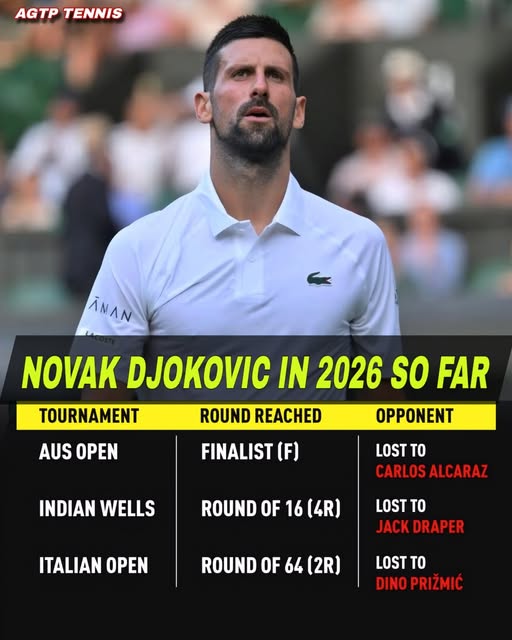
Now, in 2026, the sport appears to be entering one of its most fascinating transitional periods in modern history. Novak Djokovic has played only three tournaments so far this season:
- Australian Open — Finalist (lost to Carlos Alcaraz)
- Indian Wells — Round of 16 (lost to Jack Draper)
- Italian Open — Round of 64 (lost to Dino Prizmic)
Djokovic has also confirmed he will not play another event before the French Open due to high demand physical.
Everything is now focused on Paris.
And yet, despite recent losses and the visible effects of aging, one truth remains across the tennis world:
Never count out the GOAT.
From a UK professional tennis perspective, this moment feels less like a collapse and more like the final, emotionally complex chapter of one of the greatest sporting dynasties ever built.
The empire may be showing cracks.
But legends do not disappear quietly.
The Reality of Time in Professional Tennis
No athlete defeats time forever.
Not Roger Federer.
Not Rafael Nadal.
Not Serena Williams.
Not Andy Murray.
And eventually, not Novak Djokovic.
The physical demands of modern tennis are brutal:
- explosive movement
- endless recovery
- repeated directional changes
- physical endurance
- emotional pressure
- rapid adaptation against younger athletes
Djokovic built his legacy through extraordinary physical durability and flexibility. For years, he moved with almost superhuman elasticity.
But aging changes recovery speed first. Need rest time to recover
Then explosiveness.
Then endurancee.
Even the smallest decline matters at elite level.
A half-second slower recovery.
A slightly shorter slide.
A fraction less explosiveness.
Against younger opponents, those details become decisive.
Djokovic’s 2026 Season So Far
On paper, Djokovic’s season has looked unusual by his historic standards.
Australian Open Final
Reaching another Grand Slam final at his age remains extraordinary.
But the loss to Carlos Alcaraz symbolized something important:
The next generation is no longer intimidated.
Alcaraz attacked with freedom, athleticism, and fearless aggression.
Years ago, younger players often entered major matches against Djokovic already mentally defeated.
That psychological fear is beginning to fade.
Indian Wells Defeat to Jack Draper
The loss to Jack Draper highlighted another evolving reality:
The depth of the younger generation is increasing rapidly.
Draper’s physicality, left-handed variation, and aggressive baseline pace exposed moments where Djokovic looked slightly slower defending extended exchanges.
Not dramatically slower.
But enough to matter.
Italian Open Loss to Dino Prizmic
This result shocked much of the tennis world.
Prizmic represents the fearless new generation entering ATP tennis with modern athleticism and confidence.
For younger players today, Djokovic is still respected deeply.
But he is no longer untouchable.
That psychological transition is massive.
The Aging Process in Tennis is part of process of retirement pro player
From a UK pro tennis perspective, Djokovic’s situation is completely natural.
Aging in tennis usually affects players in several stages.
1. Recovery Becomes Harder
Playing consecutive matches becomes more physically draining.
2. Explosive Defense Slightly Declines
Djokovic’s legendary sliding defense remains elite, but younger opponents recover explosively with fresher legs.
3. Scheduling Becomes More Selective
This is exactly what Djokovic is now doing.
Instead of grinding full schedules, he carefully targets major tournaments.
4. Motivation Changes
After winning nearly everything possible, maintaining emotional hunger becomes more difficult.
Why Djokovic Is Focusing Everything on Roland Garros
The decision to skip additional tournaments before the French Open is strategic.
Djokovic understands:
- Grand Slams define legacy
- conserving energy matters
- recovery is critical at this stage of his career
Clay is physically demanding, but Roland Garros also rewards:
- experience
- point construction
- emotional patience
- tactical discipline
Those remain Djokovic strengths.
Even with physical decline, his Tennis IQ remains extraordinary.
That is why nobody wants to face him in Paris.
Never Count Out the GOAT
Many people made the mistake before:
- counting him out after injuries
- doubting him after losses
- predicting decline too early
And Djokovic repeatedly responded by winning Grand Slams.
That history creates enormous respect inside the sport.
Because champions like Djokovic possess something younger players are still learning:
the ability to survive pressure moments repeatedly.
Experience matters enormously in five-set tennis.
The Rise of the New Generation
Still, the sport is undeniably changing.
A new generation is arriving with:
- explosive athleticism
- fearless mentality
- modern shot production
- improved movement
- aggressive court positioning
Players like:
- Carlos Alcaraz
- Jannik Sinner
- Jack Draper
- Holger Rune
- Dino Prizmic
- Ben Shelton
represent the next evolution of ATP tennis.
They grew up studying Djokovic, Nadal, and Federer.
Now they believe they can replace them.
Carlos Alcaraz: The New Standard of Explosive Tennis
Alcaraz represents perhaps the clearest symbol of the new era.
His game combines:
- explosive speed
- creativity
- fearless aggression
- heavy topspin
- improved defense
- emotional intensity
He brings chaos and athletic unpredictability to matches.
That style contrasts sharply with Djokovic’s structured precision.
The contrast feels symbolic:
old-school control versus modern explosive freedom.
Jannik Sinner: The Machine-Like Evolution
While Alcaraz represents creativity, Sinner represents efficiency.
Sinner’s calm, repeatable, technically clean style reflects the modern evolution of baseline tennis.
He applies relentless pressure through:
- clean timing
- balance
- movement efficiency
- emotional control
- repeatable mechanics
Against aging players, that relentless pace becomes exhausting.
Why Younger Players Fear Djokovic Less Now
For years, Djokovic dominated partly because opponents mentally collapsed under pressure.
Now younger players arrive believing:
- they belong
- they can match the pace
- they can survive physically
- they can handle the moment
That psychological shift changes the entire ATP landscape.
Fear is disappearing.
Confidence is rising.
Djokovic’s Greatest Weapon Still Remains
Even with aging, Djokovic still possesses the most dangerous weapon in tennis:
Mental resilience.
When matches become complicated, emotional, or physically difficult, he remains incredibly hard to break mentally.
Younger players may hit harder.
But many still struggle emotionally during major moments.
Djokovic understands pressure better than almost anyone in sports history.
The Physical Demands of Modern ATP Tennis
Modern tennis is becoming increasingly brutal physically.
Today’s players hit:
- heavier topspin
- faster pace
- wider angles
- more explosive returns
Rallies require constant high-intensity movement.
This evolution naturally favors younger bodies.
Even legends eventually struggle sustaining that intensity week after week.
The Importance of Match Scheduling
Djokovic’s reduced schedule is not weakness.
It is survival strategy.
At this stage, preserving:
- joints
- recovery energy
- mental freshness
- explosive movement
becomes essential.
Roger Federer and Rafael Nadal eventually adopted similar approaches late in their careers.
The Emotional Side of Watching a Legend Age
For tennis fans, watching legends decline is emotionally difficult.
Because fans remember:
- impossible recoveries
- legendary comebacks
- emotional Grand Slam victories
- years of dominance
Seeing vulnerability feels strange.
But it is also part of sport’s beauty.
Every era eventually transitions.
The End of the Big Three Era
For nearly twenty years, Federer, Nadal, and Djokovic dominated tennis history.
Their era produced:
- extraordinary rivalries
- historic finals
- unmatched consistency
- legendary moments
Now that era is slowly ending.
And tennis must emotionally adjust to a future without constant Big Three dominance.
The New Era Will Look Different
The next generation will not copy Djokovic exactly.
The game itself is evolving.
The future ATP style emphasizes:
- explosive movement
- aggressive baseline pace
- rapid transitions
- shorter reaction time
- physical versatility
Players now train differently from younger ages.
Technology, sports science, and movement training continue accelerating development.
Djokovic’s Tennis IQ Still Makes Him Dangerous
Despite physical decline, Djokovic remains tactically brilliant.
His Tennis IQ includes:
- pattern recognition
- emotional control
- shot selection
- defensive positioning
- momentum management
Even younger opponents often struggle solving his tactical puzzles over five sets.
That is why he remains dangerous at Grand Slams.
Why Roland Garros Could Still Produce Magic
Clay rewards experience more than many surfaces.
Djokovic understands:
- point construction
- physical pacing
- emotional momentum
- tactical patience
If his body holds up physically, he could still make another deep run.
Nobody truly wants to face Djokovic in a major tournament.
Because champions with nothing left to prove become emotionally dangerous.
UK Pro Tennis View: Respect the Transition
From a UK professional tennis perspective, this period should not be viewed simply as “decline.”
Instead, it should be viewed as:
- generational transition
- athletic evolution
- the natural cycle of sport
Every champion eventually passes the torch.
But great champions force the next generation to earn it fully.
Djokovic is still doing exactly that.
Great Highlights of Djokovic’s Legacy
Highlight 1: Mental Toughness
Perhaps the greatest mental competitor tennis has ever seen.
Highlight 2: Defensive Elasticity
His movement changed modern defensive tennis forever.
Highlight 3: Return of Serve
Widely considered the greatest returner in history.
Highlight 4: Longevity
Competing at elite level deep into his late career is extraordinary.
Highlight 5: Grand Slam Dominance
His championship consistency redefined modern greatness.
What Younger Players Must Still Learn
Talent alone does not create dynasties.
The younger generation still must prove:
- long-term consistency
- emotional endurance
- physical durability
- Grand Slam resilience
Winning one big tournament is different from dominating for a decade.
Djokovic mastered sustained excellence.
That remains the hardest achievement in sports.
Could Djokovic Still Win Another Slam?
Absolutely.
Even at this stage, counting him out completely would be dangerous.
Why?
Because:
- his experience is unmatched
- his Tennis IQ remains elite
- his motivation rises for majors
- five-set tennis rewards mental strength
If physically healthy, he remains capable of defeating anyone.
The Symbolic Nature of 2026
This season feels symbolic.
The younger generation is no longer arriving.
They are here.
And yet Djokovic still stands in the middle of the transition, refusing to disappear quietly.
That tension makes this chapter fascinating.
Final Thoughts
Novak Djokovic’s empire may be entering its final phase, but greatness does not vanish overnight.
The aging process is real.
The younger generation is rising.
The physical demands are increasing.
The sport is evolving rapidly.
And yet, Djokovic remains one of the most dangerous competitors in tennis.
His reduced schedule, focus on Roland Garros, and strategic preparation reflect a champion adapting intelligently to time rather than fighting reality blindly.
From a UK pro tennis perspective, this is not merely decline.
It is the passing of eras.
Carlos Alcaraz, Jannik Sinner, Jack Draper, Dino Prizmic, and others now represent the future of ATP tennis — explosive, fearless, athletic, and modern.
But before the new era fully takes over, they still must overcome the greatest survivor the sport has ever seen.
Because Novak Djokovic built his career on proving people wrong.
And even now, with younger stars rising and questions surrounding his future, one truth remains impossible to ignore:
Never count out the GOAT.