In professional tennis, one mistake can destroy an entire tournament.
Not a technical mistake.
Not even a physical mistake.
Sometimes the biggest danger is mental underestimation.
That is exactly why Elena Rybakina is approaching her upcoming Italian Open clash against Alex Eala with extreme seriousness.
Even though Eala currently sits outside the Top 10 and enters the matchup as the underdog, Rybakina already understands the danger.
And that understanding alone says everything about why she became one of the best players in the world.
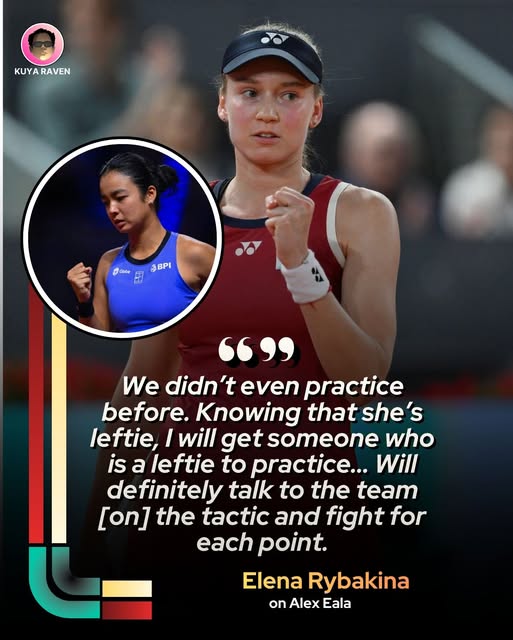
Before their Round of 32 battle in Rome, Rybakina openly admitted she plans to practice against left-handed players specifically to prepare for Eala’s game style.
That detail may sound small to casual fans.
But for experienced tennis coaches in the United States, it reveals elite-level respect and tactical intelligence.
Because champions who continue winning consistently all understand one brutal truth:
The moment you underestimate someone…
you become vulnerable.
And against a fearless player like Alex Eala, vulnerability can become disaster very quickly.
Why Rybakina Is Taking Eala Seriously
Many fans look only at rankings.
Elite players look deeper.
Rybakina understands several dangerous realities about Eala immediately:
- she is left-handed,
- she plays aggressively without fear,
- she absorbs pressure well,
- and she already owns victories against elite-level opponents.
That changes preparation completely.
One of the biggest mistakes high-ranked players make is assuming lower-ranked opponents will become mentally intimidated automatically.
But modern women’s tennis has changed dramatically.
Young players today attack fearlessly.
They grew up hitting against power.
They grew up watching Top 10 players online constantly.
They no longer enter the court emotionally defeated.
Alex Eala belongs to this new generation.
And Rybakina clearly recognizes it.
The Danger of a Left-Handed Opponent
From a USA coaching perspective, the left-handed factor is enormous.
Lefties create completely different geometry on court:
- serves curve differently,
- forehands attack unusual angles,
- crosscourt exchanges change rhythm,
- and defensive recovery patterns become uncomfortable.
Even elite players can struggle initially if they are not adjusted mentally.
This is why Rybakina specifically said she wants left-handed practice before facing Eala.
That is not fear.
That is professional respect.
Great champions prepare for discomfort before it arrives.
Why Elite Players Never Relax Mentally
One lesson separates champions from talented players:
Elite champions respect every opponent.
Not emotionally.
Not dramatically.
Strategically.
Rybakina knows something dangerous about Eala:
the Filipina star has already shown instincts capable of upsetting elite players.
That matters psychologically.
Some players perform beautifully against weaker opponents but collapse under pressure against elite competition.
Others rise emotionally against bigger names.
Eala belongs closer to the second category.
That makes her dangerous.
Players with fearless mentality can suddenly create chaos in major tournaments because they swing freely without emotional burden.
Meanwhile the higher-ranked player carries all the pressure.
Rybakina understands this dynamic perfectly.
Why Underestimating Opponents Destroys Matches
After 20 years analyzing professional tennis in the United States, one pattern appears repeatedly:
Most shocking losses begin mentally before the first ball.
The favorite enters the court:
- emotionally relaxed,
- tactically lazy,
- or slightly unfocused.
The underdog enters hungry.
That emotional imbalance changes everything.
Once the underdog gains confidence early:
- the crowd becomes involved,
- pressure increases,
- timing tightens,
- and panic begins.
Suddenly the match becomes dangerous.
This is exactly why Rybakina refuses to underestimate Eala.
Because smart champions eliminate emotional surprises early.
Alex Eala’s Dangerous Instinct
One reason coaches respect Eala is her natural competitive instinct.
Some young players possess beautiful technique but lack killer mentality.
Eala is different.
She competes aggressively.
She believes she belongs.
She attacks opportunities emotionally.
That instinct matters enormously against elite players.
Top 10 athletes often expect hesitation from younger opponents.
Eala does not naturally play scared.
That changes match dynamics immediately.
If given confidence early, she can suddenly:
- accelerate fearlessly,
- attack returns aggressively,
- and create scoreboard pressure.
That is dangerous against any elite player.
Why Rybakina’s Preparation Is Elite Thinking
Rybakina’s decision to practice against a left-handed sparring partner demonstrates one of the most underrated qualities in tennis:
professional humility.
Some champions rely too heavily on talent.
Others prepare obsessively.
The greatest players usually belong to the second category.
Rybakina understands that every opponent requires specific adaptation.
Especially someone unfamiliar.
First-time matchups are tricky because:
- timing patterns are unknown,
- spin reactions feel different,
- and emotional rhythm becomes unpredictable.
Practicing against a lefty before Eala helps reduce surprise reactions.
This is elite preparation science.
The Tactical Challenge of Facing Eala
From a tactical perspective, Eala presents unique challenges.
Her left-handed patterns naturally target different court zones.
For right-handed players like Rybakina:
- wide serves pull movement awkwardly,
- crosscourt forehands change recovery positioning,
- and return timing feels unfamiliar.
If not prepared properly, even elite players can lose rhythm early.
That is why preparation matters.
Rybakina is not trying to dominate emotionally before the match.
She is trying to remove uncertainty.
That is smart tennis.
Why Being the Favorite Is Mentally Harder
Many fans assume favorites have easier matches mentally.
Actually, the opposite is often true.
The underdog swings freely.
The favorite protects expectations.
Rybakina enters carrying:
- ranking pressure,
- media pressure,
- tournament expectations,
- and reputation pressure.
Eala enters with opportunity.
That emotional difference changes psychology.
If the match becomes tight early, pressure can suddenly shift heavily onto the favorite.
This is why champions try to control matches quickly tactically.
What Makes Rybakina Dangerous
Even with all this respect toward Eala, Rybakina still possesses major advantages.
Her game is built for elite-level control:
- huge serve,
- clean baseline power,
- calm emotional presence,
- and efficient movement.
When locked in rhythmically, she becomes extremely difficult to disrupt.
Unlike emotional players who fluctuate dramatically, Rybakina often stays internally stable during pressure moments.
That emotional neutrality is one reason she consistently wins at the highest level.
The Serve Advantage
One major factor entering the matchup is Rybakina’s serve.
Few players in women’s tennis generate:
- her pace,
- her placement precision,
- and her easy power.
Against younger players, the serve can become emotionally suffocating because free points reduce rhythm opportunities.
Eala must handle this intelligently.
If she allows Rybakina easy service control, the match could become very difficult quickly.
How Eala Can Create Problems
If Eala wants realistic upset chances, several things become critical:
Aggressive Return Positioning
She cannot allow Rybakina full serving comfort.
Even missed aggressive returns send psychological messages.
Lefty Forehand Pressure
Her crosscourt lefty forehand could expose awkward recovery patterns early.
This may become one of the key tactical battles.
Emotional Freedom
Underdogs become dangerous when emotionally loose.
If Eala plays fearless tennis early, momentum could become interesting.
Extended Rallies
Rybakina prefers controlled offensive rhythm.
Longer unpredictable rallies may increase discomfort gradually.
The Hidden Danger of First-Time Opponents
Professional players often admit unfamiliar opponents can feel uncomfortable initially.
Why?
Because patterns are not fully programmed mentally yet.
Against familiar rivals:
- timing expectations exist,
- tactical solutions already exist,
- and emotional reactions feel more controlled.
Against new opponents:
- surprise appears,
- instincts get tested,
- and adjustments happen live.
This is another reason Rybakina is preparing carefully.
Why USA Coaches Respect This Mentality
American high-performance coaches constantly teach players:
“Respect every opponent equally.”
Not emotionally.
Professionally.
The moment athletes begin assuming victory mentally, intensity drops unconsciously.
Footwork slows slightly.
Preparation becomes casual.
Decision-making becomes lazy.
That tiny decrease in sharpness can destroy matches at elite level.
Rybakina’s comments suggest she understands this deeply.
The Match Is Also About Adaptation
One fascinating element of this battle will be in-match adaptation.
Because no matter how much preparation exists, real match rhythm always feels different.
Who adjusts faster?
Who reads patterns quicker?
Who handles pressure better?
Those questions often decide elite tennis.
Rybakina’s experience advantage matters enormously here.
But Eala’s unpredictability creates intrigue.
Why Alex Eala Keeps Attracting Attention
Eala continues attracting global attention because her development trajectory feels exciting.
She combines:
- fearless mentality,
- left-handed variation,
- improving physicality,
- and competitive courage.
That combination always interests coaches.
Especially because left-handed players naturally create tactical discomfort.
Even when rankings suggest clear favorites, matchups still matter tremendously in tennis.
And stylistically, Eala has tools capable of creating pressure.
The Importance of Tactical Discipline
For Eala, emotional control becomes essential.
Young players sometimes become too excited against stars.
That excitement creates:
- rushed points,
- overhitting,
- and emotional volatility.
To compete seriously against Rybakina, Eala must stay tactically disciplined:
- choose smart aggression,
- build points carefully,
- and avoid emotional chaos.
Why Champions Prepare Like This
Rybakina’s preparation reminds younger athletes of something important:
Great champions do not rely only on talent.
They prepare scientifically.
They study:
- patterns,
- spins,
- movement tendencies,
- and emotional habits.
Even a Top 2 player still prepares carefully for lower-ranked opponents.
That humility often separates champions from temporary stars.
The Psychological Chess Match
This match may become fascinating psychologically.
Eala has freedom.
Rybakina has expectation.
Eala can attack emotionally.
Rybakina must remain composed.
If the match stays close early, emotional tension may increase dramatically.
That is where experience matters most.
What 20 Years of Tennis Coaching Teaches
After two decades analyzing elite tennis in the United States, one truth becomes undeniable:
Matches are rarely won by rankings alone.
Matches are won through:
- preparation,
- emotional control,
- tactical adaptation,
- and competitive respect.
Rybakina’s comments reveal all four elements.
She is preparing carefully because she understands danger exists.
And honestly…
that mindset is exactly why she remains one of the world’s best players.
Final Thoughts: Never Underestimate the Hungry Opponent
Elena Rybakina already understands the biggest danger in professional tennis:
Underestimating the wrong opponent.
That is why she is practicing against left-handed players before facing Alex Eala at the Italian Open.
Because Eala is not entering the court hoping simply to compete.
She is entering believing she can win.
And players with belief become dangerous.
Rybakina still holds major advantages:
- experience,
- power,
- ranking,
- and tactical maturity.
But she also knows something important:
modern tennis punishes complacency brutally.
Especially against fearless young talents.
This is why elite champions respect preparation deeply.
Because the moment you relax mentally…
the upset already begins.
And in Rome, Elena Rybakina clearly has no intention of letting that happen.