
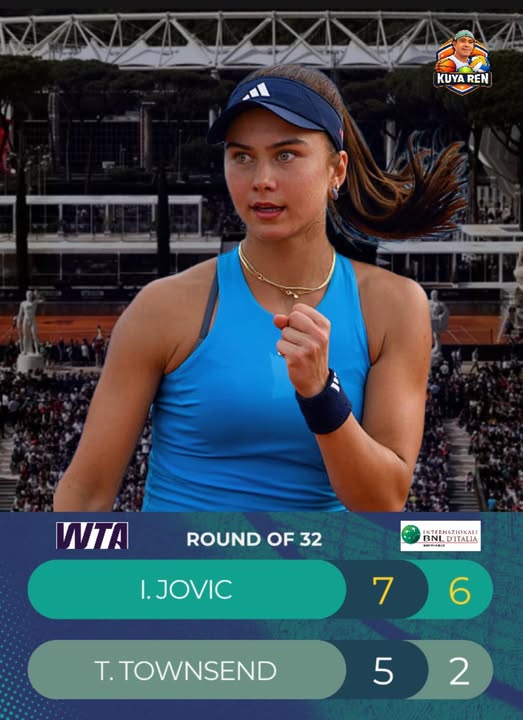
The scoreline looked clean.
Iva Jovic defeated Taylor Townsend in straight sets, 7-5, 6-2, during a thrilling Rome battle that revealed far more than just another victory on paper.
Because this was not simply about talent.
This was about adjustment.
Positioning.
Footwork explosion.
Tactical courage.
And one young player slowly learning how to control chaos against one of the most creative left-handed players in women’s tennis.
For USA tennis analysts, this match became extremely interesting because it showcased a modern lesson in high-level adaptation.
At the start of the match, Townsend’s variety and lefty disruption caused serious problems. The rhythm looked uncomfortable for Jovic early. The patterns were messy. The timing was unstable. The emotional tempo kept changing.
But then something shifted.
Jovic’s movement patterns changed.
Her court positioning evolved.
Her forehand spacing became cleaner.
And suddenly the momentum exploded in her direction.
What happened tactically during this match may become one of the most important learning moments in Jovic’s development.
Because beating Taylor Townsend is never simple.
Especially on clay.
The Hidden Difficulty of Playing Taylor Townsend
Many casual fans underestimate how difficult Townsend is tactically.
But coaches understand immediately.
Townsend is one of the most disruptive rhythm players in women’s tennis because she mixes:
- left-handed angles,
- soft hands,
- net pressure,
- slice variation,
- sudden pace changes,
- and unpredictable court geometry.
Against traditional baseline players, this becomes mentally exhausting.
You cannot simply hit hard repeatedly and expect easy rhythm.
Townsend forces opponents to think constantly.
That creates hesitation.
And hesitation destroys timing.
Early in the match, Jovic appeared affected by exactly this problem.
The First Set Was Emotional Warfare
The opening stages were tense.
Jovic had moments where her footwork looked rushed. The spacing on the forehand side occasionally became crowded. Her recovery position after aggressive shots was slightly too central, allowing Townsend to expose angles.
This is common against crafty left-handed players.
The ball arrives differently:
- spins differently,
- curves differently,
- and changes strike timing.
Townsend used this beautifully early.
Her slice patterns pulled Jovic forward unexpectedly.
Her lefty serve created awkward return positioning.
Her short-angle forehands disrupted rhythm.
For a younger player, this can become overwhelming emotionally.
And for several games, Jovic looked caught between:
- attacking too early,
- or becoming too passive.
That internal tactical confusion is dangerous.
But then came the adjustment phase.
The Footwork Explosion That Changed the Match
From a USA high-performance coaching perspective, the turning point was not a single winner.
It was movement structure.
Jovic suddenly began exploding through her first recovery step much better after contact.
This changed everything.
Instead of admiring shots momentarily — a common issue among younger players — she began recovering aggressively into neutral balance positions immediately.
That allowed her to:
- attack the next ball earlier,
- defend sharper angles,
- and maintain rally pressure consistently.
Elite tennis is often decided not by the shot itself…
but by the movement after the shot.
This is what top American coaches call:
“explosive recovery positioning.”
And Jovic improved dramatically in this area during the match.
Why Her Forehand Became More Dangerous
Once her footwork stabilized, her forehand suddenly became far heaviere.
Several technical adjustments appeared:
Earlier Preparation
Jovic stopped preparing late against Townsend’s spinning lefty ball.
Instead, she set the racket earlier and allowed cleaner acceleration through contact.
This improved:
- timing,
- directional control,
- and penetration.
Better Spacing
Early in the match, she crowded the ball occasionally.
Later, her lateral adjustment steps improved significantly.
This created cleaner strike zones.
The result?
Her forehand began exploding through the court instead of floating shorter.
More Aggressive Weight Transfer
Jovic started driving body weight forward instead of falling backward during pressure exchanges.
That forward transfer changed rally momentum immediately.
Now Townsend began defending more often.
That psychological shift mattered enormously.
Townsend’s Variety Was Still Dangerous
Even after momentum changed, Townsend remained dangerous because of her creativity.
One of the biggest challenges in facing Townsend is emotional patience.
She constantly changes:
- spin,
- pace,
- height,
- and rhythm.
Many younger players panic and overhit against this style.
Jovic deserves enormous credit for eventually resisting that trap.
Instead of trying to end every rally instantly, she began building points more intelligently.
That maturity was one of the biggest signs of growth in the match.
The Backhand Stability Was Critical
Another underrated factor in the victory was Jovic’s backhand control.
Against left-handed players, the backhand side often becomes vulnerable because of spinning crosscourt pressure.
Early in the match, Townsend tested this repeatedly.
But Jovic adjusted beautifully by:
- staying lower physically,
- absorbing spin earlier,
- and redirecting pace more confidently down the line.
This changed court geometry completely.
Now Townsend could no longer control patterns comfortably.
The match started tilting.
Why Court Positioning Won the Match
One of the smartest adjustments Jovic made was court depth management.
Early:
- she drifted slightly too far behind the baseline,
- giving Townsend time to create angles.
Later:
- she stepped closer,
- took balls earlier,
- and robbed Townsend’s creativity window.
This was huge tactically.
Creative players need time.
Aggressive court positioning removes time.
USA coaches constantly teach this concept:
“Take away the artist’s canvas.”
That is exactly what Jovic eventually accomplished.
The Emotional Growth Was Visible
Perhaps the most impressive aspect of the performance was emotional composure.
Young players often become emotionally unstable against tricky veterans.
Townsend’s style can create frustration quickly because rallies rarely feel clean rhythmically.
But Jovic gradually settled mentally.
Her body language improved.
Her between-point composure improved.
Her decision-making became calmer.
Instead of emotional chaos, she started showing emotional structure.
That is extremely important for long-term development.
The Second Set Was a Tactical Statement
Once Jovic fully understood the rhythm patterns, the second set became dramatically different.
The scoreline 6-2 reflected tactical control.
Now her:
- recovery speed,
- court positioning,
- and first-strike aggression
were functioning together.
Townsend suddenly had less freedom to improvise.
That is what elite pressure does.
When aggressive players maintain proper footwork discipline, creative opponents lose space to operate.
Jovic began dictating:
- rally tempo,
- baseline depth,
- and directional pressure.
That was the decisive shift.
The Importance of Explosive First Step Recovery
One hidden lesson from this match involves recovery movement.
Most fans focus only on winners.
Elite coaches focus on:
the first movement after contact.
Jovic improved this massively during the matche.
Her recovery step became:
- faster,
- wider,
- and more explosive.
This matters because tennis is a sport of repeated repositioning.
The player who recovers balance faster controls future options.
Late in the match, Jovic’s movement looked far more organized physically.
That organization allowed cleaner offense.
Why Younger Players Should Study This Match
This match is extremely valuable for junior players studying modern tennis.
Why?
Because it demonstrates that matches are rarely won through pure hitting alone.
Jovic succeeded because she adapted:
- tactically,
- emotionally,
- and physically.
Young players often believe:
“hit harder = win.”
But high-level tennis is more intelligent than that.
You must:
- adjust spacing,
- understand patterns,
- control emotions,
- and solve problems dynamically.
Jovic showed all of these qualities progressively during the match.
Townsend Still Showed Why She’s Dangerous
Despite the loss, Townsend reminded everyone why she remains one of the most uncomfortable opponents in women’s tennis.
Her creativity is elite.
Very few players possess:
- her touch,
- her improvisation,
- and her transition instincts.
Even during losing stretches, she forced Jovic to think constantly.
That mental pressure alone can break many young players.
This is why defeating Townsend always requires tactical maturity.
The Role of Clay Court Tennis
Clay amplified the tactical complexity beautifully.
On faster surfaces, pure pace sometimes dominates quickly.
Clay forces:
- movement quality,
- patience,
- and recovery discipline.
This surface exposed every detail:
- footwork balance,
- spacing,
- emotional patience,
- and point construction.
That made Jovic’s adjustments even more impressive.
What USA Coaches Will Love Most
American development coaches watching this match likely loved one thing most:
Jovic solved problems during competition.
That skill separates future elite players from talented juniors.
Many young athletes only play well when comfortable.
Elite professionals adjust under discomfort.
Jovic experienced:
- tactical confusion,
- emotional pressure,
- and rhythm disruption early.
Instead of collapsing mentally, she adapted progressively.
That is a major positive sign for future development.
Her Forehand Could Become Elite
The forehand remains Jovic’s biggest long-term weapon potential.
When balanced correctly, the shot:
- accelerates naturally,
- penetrates through the court,
- and creates immediate pressure.
But the key is positioning.
Her forehand becomes dangerous only when:
- spacing is clean,
- hips are aligned,
- and recovery balance remains stable.
This match showed how dramatically footwork quality affects stroke power.
Once her feet improved, the forehand exploded.
The Match Became About Space Control
By the second set, Jovic controlled space beautifully.
She:
- stepped inside the baseline more often,
- redirected aggressively,
- and compressed Townsend’s time.
This forced shorter defensive replies.
Once Townsend lost depth controlle, the match accelerated quickly toward Jovic’s advantage.
That is modern aggressive tennis:
take time away before creativity develops.
Mental Maturity Is Developing
One encouraging sign was Jovic’s emotional recovery after difficult points.
Earlier in development, younger players often:
- overreact emotionally,
- rush points,
- or force winners recklessly.
Jovic showed increasing patience instead.
That emotional discipline allowed her tactical brain to remain active.
This may become one of the most important developments in her career moving forward.
Final Thoughts: A Match About Adjustment, Not Just Winning
Iva Jovic did more than win a match in Rome.
She demonstrated:
- tactical intelligence,
- emotional adaptation,
- explosive footwork recovery,
- and evolving court awareness.
Against a creative veteran like Taylor Townsend, those qualities matter enormously.
The match revealed a young player learning how to:
- solve patterns,
- organize movement,
- and stabilize aggressive tennis under pressure.
The biggest transformation was not power.
It was positioning.
Once Jovic’s footwork exploded into cleaner recovery patterns, her entire game changed:
- forehand became heavier,
- court positioning improved,
- confidence increased,
- and tactical clarity appeared.
That is the hidden truth of elite tennis.
Great shots begin with great feet.
And in Rome, Jovic’s feet may have told the real story of the match.