
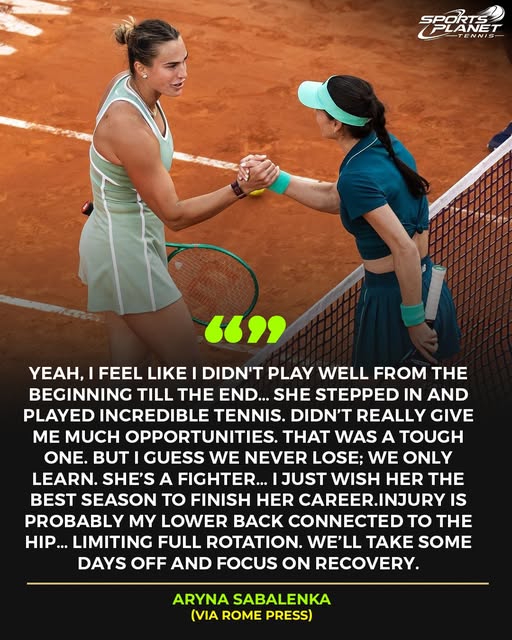
The tennis world was stunned in Rome after Aryna Sabalenka suffered and hummber down an unexpected defeat against Sorana Cîrstea. For many fans, it looked like a simple upset on paper. But inside the match, the story was far deeper than rankings, statistics, or predictions.
Sabalenka latere admitted she was struggling physically throughout the battle, dealing with lower back and hip discomfort that limited her explosive movement and timing. The World No. 1 confessed she simply could not perform at the standard expected from her elite level. Yet despite the frustration, she showed respect toward Cîrstea’s fighting spirit and professionalism.
This loss in Rome may become one of the most important moments of Sabalenka’s 2026 season — not because she lost, but because it exposed the reality every champion eventually faces.
Even the strongest players in the world can suddenly look human.
And now, the focus shifts toward French Open, where recovery, mental reset, and physical management become more important than power hitting.
The Pressure of Being World No. 1
Holding the No. 1 ranking in women’s tennis is not just about talent anymore. It becomes a daily emotional war.
Every opponent enters the court with extra motivation. Every match becomes a target opportunity. Every weakness becomes visible under the microscope of media and fans.
For Sabalenka, the expectations have become enormous over the last two seasons. Her aggressive baseline power, improved mental stability, and fearless serving transformed her into one of the most dominant forces on tour.
But dominance in tennis is fragile.
One small physical limitation can destroy timing. One injury can interrupt confidence. One bad movement can affect shot selection for an entire match.
In Rome, that reality appeared clearly.
Sabalenka’s movement looked hesitant at moments. Her explosive first step was missing. The usual heavy penetration on her forehand lacked consistency. Instead of dictating rallies, she often reacted defensively — something very unusual for her game style.
From the perspective of elite American coaching philosophy, this was not merely a “bad day.”
This was a physical problem slowly affecting tactical identity.
When Physical Pain Changes Your Entire Game
In modern tennis, lower back and hip injuries are dangerous because they influence almost every movement pattern.
A powerful player like Sabalenka relies heavily on rotational energy. Her serve, forehand, and return game depend on explosive hip rotation and core stability. Once discomfort appears in those areas, several technical problems immediately follow:
- Reduced serve speed
- Delayed court positioning
- Poor balance on open-stance forehands making a error lost of control
- Slower defensive recovery luck of footwork anticipation
- Increased unforced errors due to mindset emotion choke.
- Mental hesitation under pressure
This is why injured players often look “reluctant” on court.
It is not fear.
It is the subconscious body protecting itself. Making defence into more errors
American high-performance coaches often explain this as “competitive survival mode.” The athlete continues fighting mentally, but the body refuses full commitment to movement patterns.
That appeared visible throughout Sabalenka’s Rome defeat.
Instead of attacking early, she hesitated during critical exchanges. Balls that she normally crushes crosscourt landed shorter. Defensive slides looked uncomfortable. Even her emotional reactions seemed restrained compared to her usual fiery intensity.
The body was negotiating with pain.
And in elite tennis, hesitation is deadly.
Give Credit to Sorana Cîrstea
While attention focused on Sabalenka’s physical struggles, it would be unfair to ignore the excellent performance from Sorana Cîrstea.
The Romanian veteran played disciplined, intelligent tennis.
Rather than trying to overpower Sabalenka directly, she forced extended rallies, redirected pace smartly, and tested movement repeatedly. That is veteran tennis IQ.
Experienced players recognize weakness quickly.
Once Cîrstea noticed Sabalenka struggling physically, she increased rally tolerance and made the World No. 1 move laterally again and again. This was not accidental. It was strategic pressure.
Many younger players panic against elite power hitters and try ending points too early. Cîrstea stayed calm. She trusted patterns. She trusted court geometry.
That patience became one of the biggest factors in the upset.
This is why veteran players remain dangerous even without top rankings. Experience allows them to exploit moments that others fail to recognize.
The Psychological Side of Injury
One of the hardest realities for elite athletes is accepting they cannot perform at full level.
Champions are built around identity.
Sabalenka’s identity is aggression, intimidation, and emotional force. When physical pain removes those weapons, frustration appears quickly because the player no longer recognizes her own game.
That psychological disconnect can become more damaging than the injury itself.
You begin questioning timing.
You hesitate on movement.
You stop trusting instincts.
The difference between elite tennis and average tennis is often commitment.
When commitment disappears by even 5%, performance collapses dramatically.
In Rome, Sabalenka looked mentally trapped between two decisions:
- attack aggressively and risk pain,
- or protect the body and lose tactical control.
Neither option felt comfortable.
This internal conflict is extremely common among injured players heading toward Grand Slam season.
Why Rome Matters Before Roland Garros
Rome has historically been one of the best preparation tournaments before Roland Garros because the clay conditions resemble Paris more closely than Madrid.
Long rallies.
Heavy topspin.
Physical grinding.
Extended movement patterns.
If a player struggles physically in Rome, alarm bells naturally begin ringing before Paris.
For Sabalenka, the biggest concern may not be the loss itself.
It is recovery time.
Clay-court tennis places enormous stress on hips and lower back because sliding requires constant balance adjustments and rotational stabilization. If her discomfort continues into Roland Garros, every long match could become dangerous physically.
The positive news is this:
Grand Slam scheduling allows more recovery days between matches.
Unlike smaller tournaments, players at Roland Garros often have additional rest opportunities that help injury management.
If Sabalenka’s team handles treatment correctly, she can still become one of the favorites in Paris.
And make no mistake:
Healthy Sabalenka remains terrifying on any surface.
The Evolution of Sabalenka’s Mental Strength
Several years ago, a defeat like this might have triggered emotional collapse publicly.
But modern Sabalenka has changed significantly.
One of the biggest improvements in her career has been emotional maturity. She now speaks with more honesty after losses, accepts responsibility, and avoids unnecessary excuses.
Her Rome comments reflected professionalism.
Instead of disrespecting her opponent or hiding behind frustration, she openly admitted:
- she was struggling physically,
- she could not play her best level,
- and Cîrstea deserved respect.
That matters.
Champions earn long-term respect not only through victories but through accountability during difficult moments.
American tennis experts often say:
“True maturity in sports begins after painful losses.”
Sabalenka’s reaction suggests she understands the bigger picture now.
The season is long.
Grand Slams matter most.
Recovery is priority.
The Dangerous Trap of Playing Through Pain
Modern tennis schedules are brutal.
Top players travel constantly between surfaces, countries, and climates. Recovery windows become smaller every season.
Sometimes athletes continue competing because rankings pressure, sponsorship obligations, and competitive instinct refuse to allow rest.
But playing through injury can create technical damage.
When athletes compensate unconsciously:
- the serving motion changes,
- footwork patterns become uneven,
- timing breaks down,
- and secondary injuries can appear.
This is especially risky before Roland Garros, where clay matches often become physical marathons lasting over two hours.
Sabalenka’s team must now decide carefully:
- push immediate intensity,
- or prioritize long-term health.
The smartest elite programs usually choose preservation before Grand Slam events.
Why Fans Overreact to One Loss
Tennis fans often react emotionally after upsets.
The moment a top-ranked player loses, social media suddenly creates dramatic narratives:
- “She’s finished.”
- “The pressure is too much.”
- “Her game is declining.”
But elite tennis is more complex than one result.
Every top player experiences difficult stretches physically and mentally.
Even legends like:
- Serena Williams
- Rafael Nadal
- Novak Djokovic
- Iga Świątek
have suffered surprising losses before winning major titles again.
Sometimes setbacks become necessary warning signs.
They force recovery.
They force tactical review.
They force humility.
Rome may ultimately help Sabalenka arrive mentally sharper in Paris.
Clay Court Tennis Punishes Weakness
Clay exposes everything.
Poor movement becomes visiblee.
Weak conditioning becomes obvious.
Mental impatience gets punished immediately.
Unlike faster surfaces where power can hide flaws temporarily, clay demands complete balance:
- physical endurance,
- tactical patience,
- emotional discipline,
- and movement efficiency.
When Sabalenka is healthy, her improved clay movement makes her dangerous. Over the last two years, she developed far better point construction and patience on slower courts.
But with limited mobility, her aggressive style becomes harder to sustain.
That is why physical recovery over the next days becomes critical.
What USA Coaches Are Saying About Sabalenka
Several American tennis analysts believe Sabalenka’s biggest strength remains her willingness to evolve.
Earlier in her career, she depended almost entirely on raw power. Now she mixes:
- smarter rally management,
- improved defense,
- heavier spin variation,
- and more emotional control.
This evolution is why she became World No. 1.
According to elite USA coaching philosophy, great champions are not defined by perfect seasons. They are defined by adaptation after adversity.
That will now become Sabalenka’s mission before Roland Garros.
Adapt.
Recover.
Reset.
The Importance of Team Communication
One underrated part of professional tennis is communication between:
- coaches,
- physiotherapists,
- fitness trainers,
- and the player.
Sometimes elite athletes hide pain because they fear appearing weak.
Other times they underestimate injuries emotionally because they are obsessed with competition.
The best teams create honest communication systems where the athlete feels safe admitting limitations early.
Sabalenka’s openness after Rome may actually be positive internally. It suggests awareness instead of denial.
Denial is dangerous in tennis.
Awareness allows solutions.
Why Roland Garros Is Still Wide Open
Despite this loss, Sabalenka remains one of the biggest threats entering Paris.
Why?
Because Grand Slam tennis operates differently from regular tournaments.
Elite champions adjust across two weeks.
Momentum changes daily.
Recovery cycles matter.
Confidence can return suddenly.
One dominant early-round victory can completely reset emotional energy.
Sabalenka’s aggressive style still gives opponents enormous pressure because very few players can absorb her pace consistently over three sets.
If physically healthy enough, she can still overpower almost anyone in the draw.
Lessons Young Players Can Learn
Young athletes watching this situation should understand an important lesson:
Even World No. 1 players struggle physically and mentally sometimes.
Tennis development is not linear.
There are moments:
- where confidence disappears,
- where movement feels heavy,
- where timing collapses,
- where frustration grows.
The key is response.
Sabalenka did not disrespect her opponent.
She did not create drama.
She acknowledged reality professionally.
That mindset is valuable for younger players learning how to handle adversity.
The Human Side of Champions
Fans often forget professional athletes are human beings first.
Behind rankings and trophies are bodies under stress:
- constant travel,
- pressure,
- physical pain,
- media expectations,
- emotional fatigue.
Sabalenka’s Rome defeat reminded the tennis world that even dominant champions can become vulnerable unexpectedly.
But vulnerability does not equal weakness.
Sometimes it reveals courage.
Playing through discomfort while still respecting your opponent shows professionalism many younger athletes never learn.
Final Thoughts: This Loss Could Become Fuel
In elite sports, painful defeats sometimes create the strongest motivation.
Sabalenka now enters a critical phase before Roland Garros:
- recover physically,
- rebuild movement confidence,
- restore tactical aggression,
- and protect emotional balance.
The Rome loss hurts because expectations are enormous for a World No. 1.
But seasons are not defined by one tournament.
Champions are remembered for how they respond after setbacks.
If Sabalenka heals properly and rediscovers her explosive movement, this defeat may eventually become only a temporary chapter before another deep Grand Slam run.
And perhaps that is the most dangerous version of Aryna Sabalenka:
A champion with something to prove again.