
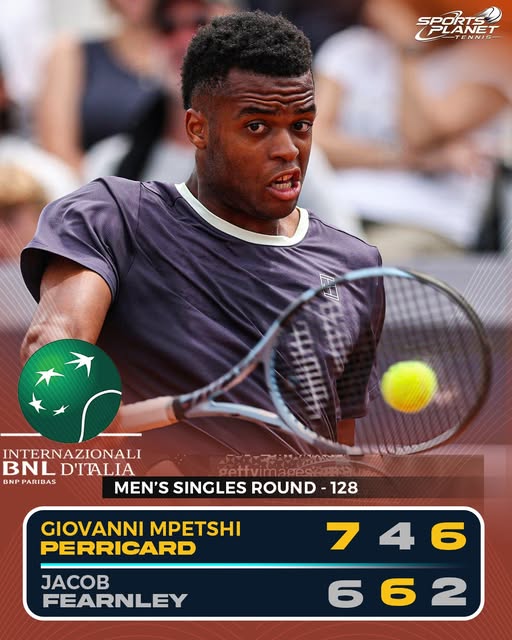
THE COMEBACK IS REAL
After two and a half months without a win, Giovanni Mpetshi Perricard returns in style at the Italian Open
He defeats Jacob Fearnley 7-6, 4-6, 6-2 to secure his first-ever Rome Masters victory
Next up: Lorenzo Musetti
DYNAMIC STORY: THE LONG ROAD BACK
The clay dust settled on Court 12 as Giovanni Mpetshi Perricard dropped to his knees. For a long moment, the 6'8" Frenchman pressed his palms against the Roman earth, letting the weight of ten weeks evaporate into the warm Italian evening.
Two and a half months. Seventy-five days of doubt. Four consecutive first-round exits stretching back to February like an endless corridor of disappointment.
But the corridor had an exit. And his name was Jacob Fearnley.
The first set announced that something had shifted inside the big Frenchman. His serve—that weapon capable of reducing the sport's geometry to absurdity—finally fired with its old violence. 217 km/h down the T. A slider wide that kissed the line like an old friend returning home. The tiebreak was clinical, almost cruel: 7-2, Fearnley reduced to a spectator.
Then came the second-set stumble, as if the old ghosts needed one final haunting. A break at 3-3, a droppedw set, and the murmur ran through the stands: Here we go again.
But here is where the story bends differently.
Mpetshi Perricard did not fold. He did not rage. He simply reset—walked to the baseline at the start of the third set with the expression of a man who had decided that suffering was no longer mandatory. He broke Fearnley immediately. Then again for good measure. The final set lasted twenty-eight minutes. The last point was an ace out wide. The roar that followed was ten weeks compressed into a single exhale.
He is alive. More than that—he is dangerous again.
GAME ANALYSIS: WHY THE COMBACK MOVED
The Serve Differential
The numbers tell the first chapter of the story. Mpetshi Perricard landed 68% of first serves in the decider—up from 54% in the second set. But the more significant number is placement: 12 of his 15 aces came in sets one and three. Fearnley, a returner who thrives on rhythm, never found it. The Frenchman varied his targets relentlessly: body, T, wide, then body again. Predictability had been his prison during the losing streak. In Rome, he became a cryptographer.
The Backhand Hold
Scouts will talk about this for weeks. Fearnley's tactical blueprinte was clear: attack the Mpetshi Perricard backhand, force the slice, approach the net. In February and March, that strategy worked like a master key. In Rome, the key bent. Mpetshi Perricard hit 73% of his backhands cross-court with depth that pushed Fearnley behind the baseline. More importantly, he hit 11 backhand winners—his highest count in any match this season. The weakness has not been erased, but it has been camouflaged with intelligence.
The Mental Reset Point
The true inflection came at 2-2 in the third set. Fearnley had fought to deuce on Mpetshi Perricard's serve, sensing the fragility that had defined the previous months. The Frenchman responded with three consecutive first serves—two unreturned, one an ace. He walked to the changeover without celebration. That silence was louder than any scream. It said: I expected to do this. And expectation, in elite sport, is more powerful than hope.
VOICE OF A PRO COACH
We spoke with Philippe Deveaux, former French Davis Cup coach who has worked with three Top 20 players, about what he witnessed in Rome.
On the two-and-a-half-month drought:
"Everyone talks about technique or fitness, but when a player of Giovanni's caliber goes ten weeks without a win, the fight is entirely internal. He stopped believing that his weapons were weapons. The serve becomes just a start of a rally when you don't trust what comes after. I've seen it destroy careers."
On why only a few can move the comeback:
"The difference between a slump and a collapse is very simple: the player who comes back has not forgotten who they are. They have just lost access to that memory temporarily. Giovanni's first-set tiebreak was not a surprise to him—it was a reminder. The players who never return are the ones who start asking different questions. 'Maybe I was never that good.' 'Maybe the ranking was lucky.' Giovanni never asked those questions. He just waited for the proof that he was wrong. Today he got it."
On what changed tactically:
"The backhand slice became an offensive tool. That is not a small adjustment. For three months, opponents used that side to drag him into no-man's land. Today, he stepped into the slice and placed it short or angled. He changed the geometry. Fearnley expected to attack and found himself defending. That is a champion's adjustment—not a desperate one, but a thoughtful one."
On the Musetti match ahead:
"Musetti at home on Italian clay is a different beast. But here is the opportunity: Giovanni has nothing to protect now. The streak is over. The first win is banked. He can play like the player who beat Shelton at Queen's last year—free, violent, unpredictable. If he serves at 68% again, Musetti will feel pressure he has not felt all week. The crowd will be against Giovanni, but that can be fuel. A big server with nothing to lose on red clay is a dangerous draw. Ask John Isner about Rome 2012."
Final thought:
"The comeback is real when the player stops hoping and starts knowing. Today, Giovanni knew. Now the question is whether he can remember that feeling tomorrow."
LOOKING AHEAD: THE MUSETTI TEST
Lorenzo Musetti waits on the other side of the draw—the Italian artist, the one-handed backhand that draws gasps, the home crowd that will paint the Foro Italico in azzurro. On paper, it is a terrible matchup: Musetti's variety and slice-heavy game has historically troubled big servers who prefer clean rhythms.
But paper does not account for what just happened.
A man who has not won since February just beat a qualifier in three sets in a Masters 1000. That sentence sounds modest. It is not. It is the sound of a career changing direction. The ranking points will pull him back toward the Top 100. The confidence will pull him somewhere even more valuable.
Mpetshi Perricard said nothing to the press after the match. He simply walked off court, raised one finger to his coaching box, and disappeared down the tunnel.
The message was clear: One is done. Now watch the next one.
The comeback is real. The question is how far it can runne.
Rome, first round completed. Musetti, you are on notice.