There’s confidence—and then there’s conviction backed by evidence. When people say Jannik Sinner “will win again,” it’s not hype. It’s a conclusion drawn from patterns: discipline, consistency, and a level that keeps rising at exactly the right time.
Now the question becomes sharper, more specific, and more demandinge:
Can Sinner complete his path to a Masters 1000 title in Rome—and make it six straight titles?
From a U.S. coach-level analytical perspective, the answer is not automatic. But it is very real.
The Stakes in Rome: More Than Just Another Tournament
The Italian Open is not just any stop on the tour. It is:
- A Masters 1000 event
- Played on clay, just before Roland Garros
- A tournament where pressure and expectations peak—especially for an Italian
Sinner enters with:
- World No. 1 status
- Momentum from recent dominance
- The memory of finishing runner-up last year
That last point matters. Players don’t forget finals they didn’t win. They study them. They correct them.
This is not a new opportunity—it’s unfinished business.
The “Six in a Row” Narrative: What It Really Means
Winning five consecutive titles is already elite. Winning six? That moves into rare territory.
But here’s the reality from a coaching standpoint:
Winning streaks are not about momentum alone—they are about maintaining standards under increasing pressure.
Each match becomes harder because:
- Opponents elevate their level
- Expectations increase
- Physical fatigue accumulates
- Tactical patterns become more studied
Sinner’s challenge is not just to play well—it’s to avoid regression.
And so far, his biggest strength is exactly that: he doesn’t drop.
Why Sinner’s Level Is So Hard to Break Right Now
When we say his game is “so high,” we’re talking about a combination of factors rarely aligned at once:
1. Baseline Dominance
Sinner controls ralliess with:
- Early ball striking
- Heavy pace through both wings
- Consistent depth
He doesn’t just hit hard—he hits clean and repeatable.
2. Improved Serve Patterns
His serve is no longer just a starting shot—it’s a weapon:
- Higher first-serve percentage
- Better placement under pressure
- More effective +1 forehand patterns
3. Movement Efficiency on Clay
Clay exposes inefficiency. Sinner has improved:
- Sliding control
- Recovery positioninge
- Balance during defensive exchanges
4. Emotional Neutrality
He rarely gives opponents emotional openings. No panic, no visible frustration, no momentum swings.
From a coaching perspective, this is what makes him dangerous:
There are no obvious dips to attack.
The Absence of Carlos Alcaraz: Opportunity or Trap?
The absence of Carlos Alcaraz changes the landscape—but not necessarily in the way people assume.
Yes, it removes:
- The defending champion
- One of the most explosive clay-court players
But it also creates:
- A clearer path on paper
- Greater expectation on Sinner
And expectation can be a double-edged sword.
Without Alcaraz, Sinner is no longer just a contender—he is the primary target.
Every opponent enters the match with:
- Nothing to lose
- A clear tactical goal: disrupt the No. 1
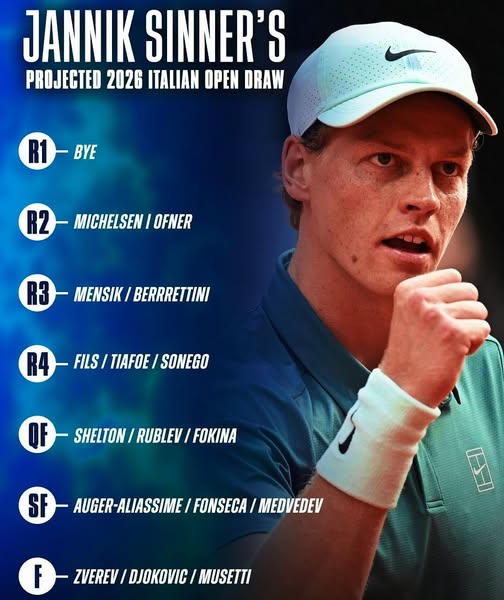
Potential Final: Djokovic or Zverev
If Sinner reaches the final, the likely threats are:
- Novak Djokovic
- Alexander Zverev
From a U.S. coaching lens, these are two very different problems.
Matchup Analysis: Sinner vs. Novak Djokovic
What Djokovic Brings
Djokovic offers:
- Elite return of serve
- Defensive mastery
- Unmatched experience in big finals
- Ability to absorb pace and redirect
He is the ultimate disruptor of rhythm.
Tactical Battle
Against Djokovic, Sinner must:
- Maintain aggressive court positioning
- Avoid being pushed into passive ralliess
- Finish points efficiently
The danger:
If rallies extend too long, Djokovic gains control.
Coaching Insight
Sinner’s path to victory:
- Take time away from Djokovic
- Use depth to prevent counterattacks
- Stay patient—but not passive
Matchup Analysis: Sinner vs. Alexander Zverev
What Zverev Brings
Zverev’s strengths include:
- Big first serve
- Strong backhand
- Ability to dictate from baseline
He plays a more direct, power-based game than Djokovic.
Tactical Battle
Against Zverev, Sinner must:
- Neutralize the serve early
- Target forehand inconsistencies
- Control rally tempo
Coaching Insight
Sinner has the edge in:
- Rally tolerance
- Shot consistency
- Movement
But Zverev can shorten points quickly—making momentum swings dangerous.
The Real Key: Sinner vs. Himself
At this level, the biggest threat is not always the opponent—it’s internal.
From a coaching perspective, Sinner’s only real vulnerabilities are:
1. Over-Pressing in Big Moments
Trying to finish points too quickly
2. Slight Drop in First-Serve Percentage
Which opens the door for aggressive returns
3. Mental Fatigue
After multiple deep runs and titles
If he avoids these, his baseline level is higher than almost anyone on tour right now.
Clay Court Dynamics: Why Rome Fits His Game
Clay rewards:
- Patience
- Consistency
- Physical endurance
Sinner has developed all three.
Rome specifically adds:
- Slower conditions than Madrid
- Longer rallies
- More tactical exchanges
This favors players who:
- Build points
- Maintain discipline
- Stay physically strong
Sinner checks all boxes.
What Makes This Run Different From Others
Not all winning streaks are equal.
Some are fueled by:
- Favorable draws
- Short bursts of form
Sinner’s current run is different:
- He is beating top-level opponents
- He is winning in different conditions
- He is solving different playing styles
That’s what makes this sustainable—not temporary.
The Champion Pattern: Repetition Without Decline
Great players don’t just win—they repeat winning behaviors.
Sinner’s pattern is clear:
- High first-serve percentage
- Controlled aggression
- Strong rally tolerance
- Emotional stability
The key question:
Can he maintain this across another full tournament?
Because at this level, even a 5% drop can cost a match.
Pressure of Playing in Italy
Competing in Rome adds a unique layer:
- Home crowd support
- National expectations
- Emotional intensity
This can either:
- Elevate performance
- Or create pressure
Sinner has shown increasing maturity in handling this. He channels support without becoming overwhelmed.
The Sixth Title: Probability vs. Possibility
Let’s be clear from a coach’s standpoint:
Winning six straight titles is extremely difficult.
But based on:
- Current form
- Tactical stability
- Mental discipline
Sinner is not just a contender—he is the most complete player in the draw.
What Must Happen for Him to Win
1. Maintain First-Serve Efficiency
No drop under pressure
2. Control Rally Tempo
Avoid defensive positioning
3. Stay Emotionally Neutral
No reaction to momentum swings
4. Execute Under Pressure
Especially in semifinals and finals
What Could Stop Him
Even dominant players can lose. The realistic threats include:
- A red-hot opponent playing above their level
- Physical fatigue late in the tournament
- A slight dip in focus during key moments
But none of these are structural weaknesses—they are situational risks.
Final Coach’s Assessment
From a U.S. high-performance coaching perspective:
Sinner is currently operating at:
- Elite technical efficiency
- High tactical clarity
- Exceptional mental control
This combination is rare.
Prediction: Will He Win Again?
If Sinner:
- Maintains his current level
- Avoids mental lapses
- Executes under pressure
Then yes—he has a very strong chance to complete the run.
Not because he is unbeatable.
But because right now:
He is the most disciplined, consistent, and complete player in men’s tennis.
Conclusion: The Moment Is His—If He Takes It
Rome is not just another tournament. It is:
- A home stage
- A redemption opportunity
- A test of sustained greatness
The path is there.
The level is there.
The question is no longer about talent.
It’s about execution.
And if Jannik Sinner continues to play with the same laser focus, discipline, and clarity—
This could be the tournament where dominance turns into legacy.