
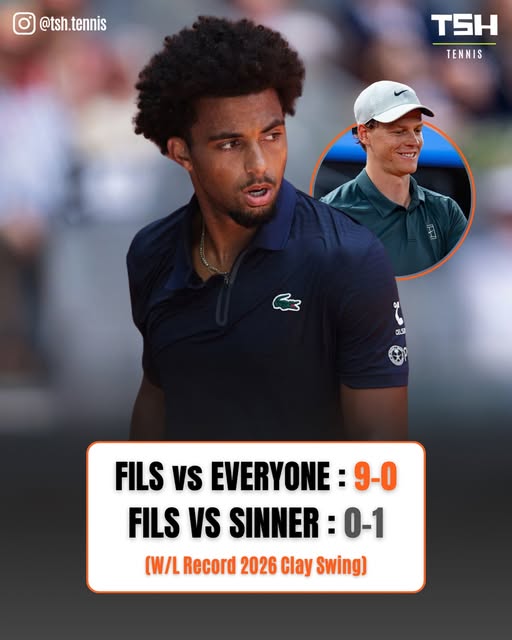
In tennis, certain matches don’t just determine who advances—they define careers. If Arthur Fils were to defeat Jannik Sinner, especially on a stage like the Madrid Open, the impact would go far beyond a single result.
It would force the tennis world to ask a serious questione:
Is Fils just having a strong season—or is he becoming the next major force in men’s tennis?
From a USA high-performance coaching perspective, the answer lies deeper than the scoreboard.
The Context: “Unbeatable on Clay” Meets the Standard of Excellence
Let’s be clear about the narrative.
Arthur Fils has built a reputation this season as a dominant presence on clay. His physicality, heavy groundstrokes, and aggressive court positioning have made him extremely difficult to beat. Many players struggle to match his intensity over long rallies.
But then comes the reality check:
To truly rise, you don’t just beat good players—you beat the best.
And right now, that standard is defined by players like Jannik Sinner.
Sinner represents:
- Elite consistency
- Tactical discipline
- Mental resilience under pressure
If Fils crosses that barrier, it changes everything.
What a Win Over Sinner Would Actually Mean
A victory here is not just symbolic—it is structural.
1. Validation at the Highest Level
Fils has shown promise, but beating Sinner confirms he can execute against one of the most complete players in the game.
2. Transition From Prospect to Contender
There’s a difference between “rising talent” and “dangerous opponent.”
A win like this pushes Fils into the second category immediately.
3. Psychological Breakthrough
Confidence in tennis is not theoretical—it’s built through results.
Once a player proves they can beat the elite, their entire mindset shifts.
Technical Breakdown: Why This Matchup Matters
From a coaching standpoint, this is a fascinating contrast in styles.
Arthur Fils: Explosive and Aggressive
- Heavy forehand with high RPM and depth
- Willingness to step inside the baseline
- Physical dominance in extended rallies
Jannik Sinner: Precision and Control
- Clean ball striking with minimal errors
- Ability to redirect pace effortlessly
- Exceptional point construction
If Fils wins, it means he successfully:
- Disrupted Sinner’s rhythm
- Controlled baseline exchanges
- Managed unforced errors under pressure
That’s a complete performance—not just a hot streak.
Clay Court Identity: Built for the Surface
Clay exposes weaknesses more than any other surface.
It demands:
- Patience
- Movement efficiency
- Tactical construction
Fils has shown he thrives here. His ability to generate heavy topspin and push opponents deep behind the baseline gives him a natural advantage.
But beating Sinner on clay would signal something bigger:
He’s not just surface-specialized—he’s adaptable at elite level.
The “Rising Star” Question: Is Fils Next?
Let’s address the central question directly.
Would beating Sinner make Arthur Fils the next rising star in tennis?
Short answer: No.
Because he already is one.
But it would redefine his ceiling.
Current Status
- Recognized as a high-potential young player
- Dangerous on clay
- Still developing consistency
Post-Victory Status
- Legitimate threat in major tournaments
- Player others prepare specifically to face
- Candidate for deep runs at Grand Slams
That’s a major shift.
The Reality Check: One Win Is Not a Career
Here’s where many narratives go wrong.
One big win does not guarantee long-term success.
We’ve seen players:
- Break through once
- Struggle to replicate performance
- Fade under increased expectations
For Fils, the real test begins after the win.
What He Must Do Next to Become Elite
From a coaching lens, three areas will determine his future.
1. Consistency Across Matches
Top players don’t peak occasionally—they perform every round.
2. Tactical Maturity
He must learn when to:
- Attack
- Defend
- Reset points
3. Physical Endurance
Winning one big match is different from sustaining performance across a full tournament.
Comparing Trajectories: Fils vs Sinner
This is where perspective matters.
Jannik Sinner didn’t become elite overnight.
He built his game throughe:
- Incremental improvements
- Losses that refined his strateegy
- Consistent exposure to top competition
If Fils wants to follow that path, he must:
- Treat a win as a benchmark, not a destination
- Continue evolving technically and mentally
The Intangible Factor: Belief
The biggest transformation after a win like this is internal.
Before:
- “I can compete with top players.”
After:
- “I can beat them.”
That shift changes:
- Shot selection
- Risk tolerance
- Match approach
It’s often the difference between top 20 and top 5.
Madrid Open Implications
At the Madrid Open, momentum matters.
A win over Sinner would:
- Open the draw psychologically
- Increase Fils’ confidence in later rounds
- Make opponents adjust their game plans specifically for him
This is how tournament runs are built.
Final Coaching Verdict
If Arthur Fils defeats Jannik Sinner, it is not just an upset.
It is a signal.
A signal that:
- His game translates to elite competition
- His mindset can handle pressure
- His development is ahead of schedule
But becoming the next great star is not decided in one match.
It is built through repetition, discipline, and sustained excellence.
Closing Insight
Tennis doesn’t reward hype—it rewards consistency.
Arthur Fils has shown he can dominate on clay.
But to truly establish himself, he must prove he can do it against the very best—again and again.
If he beats Sinner, the conversation changes.
Not to “Can he rise?”
But to:
“How far can he go?”