
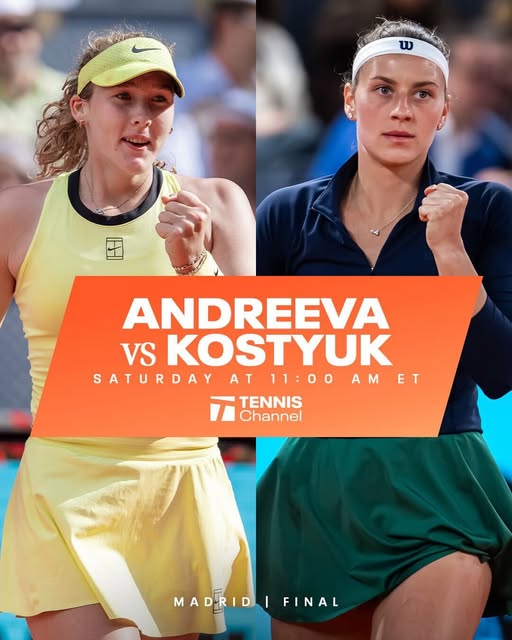
A first‑time Madrid champion will be crowned. And with it, one of the most remarkable teenage runs in women‘s tennis history could reach a historic climax.
As the Spanish capital prepares for Saturday’s showpiece, all eyes are on 19‑year‑old Mirra Andreeva. A victory over Marta Kostyuk in the Mutua Madrid Open final will etch the Russian’s name into a record book that has remained untouched for more than a quarter of a century—since the era of Martina Hingis.
Stream Andreeva vs. Kostyuk in the Madrid final live Saturday on the Tennis Channel App. The match is scheduled for May 2 at 5:00 p.m. local time on the iconic Manolo Santana Stadium.
Here is the complete data‑driven breakdown: the records at stake, the statistical battle lines, and what the numbers reveal about the two women who will fight for the title.
Part One: The Record That Stands Between Andreeva and History
Mirra Andreeva has already written herself into the Madrid Open history books by reaching the final, becoming the second‑youngest finalist in the tournament’s history, behind only Caroline Wozniacki (who was also 19 when she finished runner‑up in 2009).
But the bigger prize awaits with a victory. If Andreeva lifts the trophy on Saturday, she will achieve something that no teenager has accomplished since the WTA 1000 format was introduced in 2009: winning three WTA 1000 titles before turning 20. She already claimed back‑to‑back crowns at Dubai and Indian Wells in 2025, becoming the youngest WTA 1000 champion since the tier began. A Madrid title would complete a teenage trilogy unprecedented in the modern era.
To understand the magnitude of this achievement, consider the names she would surpass. Since 2009, only three teenagers have won a WTA 1000 event: Caroline Wozniacki (2009, at 19), Bianca Andreescu (2019, at 19), and Andreeva herself (2025, at 17‑18). No teenager has ever won three such titles. Andreeva is one win away from being alone at the top of that list.
More broadly, a Madrid triumph would place Andreeva in the same conversation as Martina Hingis. The Swiss prodigy, who dominated the late 1990s, holds the all‑time record for most Tier I/WTA 1000 wins before turning 19 with 84 victories. Andreeva entered Madrid with 44 such wins——the fourth‑highest total in history, trailing only Hingis, Maria Sharapova (48) and Jennifer Capriati (47). Every victory in Madrid extends that total, and a title would push her career WTA 1000 count toward territory that no teenager has reached since Hingis herself.
The historical parallels are impossible to ignore. Andreeva is the youngest player to reach three WTA 1000 finals since the current format was introduced. She leads the WTA Tour in clay‑court wins in 2026 with 12, having lost just one match on the surface all season. And she has not dropped a single set in her Madrid campaign entering the final——a testament to her relentless consistency.
But Saturday is not simply about rewriting record books. It is about confirming that this teenage prodigy has transitioned from one‑season wonder to genuine, sustained force. A third WTA 1000 title would cement her status as the most successful teenager of her generation – and arguably the most successful since Hingis.
Part Two: Mirra Andreeva – The Data Behind the Dominance
| Number | Value | Insight |
|---|---|---|
| Clay‑court wins in 2026 | 12 (most on WTA Tour) | Leads all players on the surface |
| Madrid campaign sets dropped | 0 | Has not lost a set en route to the final |
| Season wins (tour‑wide) | 26 | Elite win total for a teenager |
| WTA 1000 finals (career) | 3 | First teenager to reach this mark |
| Guaranteed ranking after Madrid | No. 7 | Regardless of final result |
Serve Dominance
Against Hailey Baptiste in the semi‑finals, Andreeva produced one of the most statistically dominant serving performances seen at the Caja Mágica. In the opening set, she landed 77% of her first serves and remarkably won 100% of those points——an almost perfect serving display. At one stretch, she reeled off 15 consecutive points on her own serve, leaving the American completely unable to find any rhythm.
For the match, Andreeva won 20 of 22 service points in the first set, an efficiency rate of 91%. She faced only one break point throughout the entire semi‑final and saved it with composure. In the round of 16 against Panna Udvardy, Andreeva was not broken once, saving both break opportunities that came her way while converting three of her four break chances.
Mental Resilience Under Pressure
The statistics that perhaps best define Andreeva’s run in Madrid, however, are not the points where she dominated——but the moments where she should have lost.
In the second‑set tiebreak against Baptiste, Andreeva found herself down 4‑0. The American then reached 6‑4, holding two set points that would have forced a decisive third set. Andreeva saved both. At 6‑7, she faced a third set point——and erased it with an ace. She then converted her third match point to close out the victory.
Across the entire tournament, Andreeva has saved three set points in the semi‑final alone, plus multiple break points in earlier rounds. Her ability to find her best tennis when staring at defeat is a hallmark of the sport‘s elite——and at 19, she already possesses it.
Clay‑Court Pedigree
Andreeva’s 2026 clay‑court campaign has been nothing short of exceptional. She claimed the title in Linz, came within one match of the Stuttgart final, and has now reached the Madrid final. Her 12 clay wins lead the WTA Tour, and her 12‑1 record on the surface is the best among all players.
Moreover, Andreeva has now won 11 career matches at the Madrid Open, tying Roland Garros as the tournament where she has recorded the most victories at any WTA‑level event. She is also the teenager with the most wins in Madrid since the tournament began in 2009——a record she continues to extend with every passing round.
Part Three: Marta Kostyuk – The Ukrainian Challenger Arrives
Marta Kostyuk arrives at her first WTA 1000 final having already announced herself as a legitimate force on the women‘s tour. The 23‑year‑old Ukrainian entered Madrid ranked No. 23 in the world, but her performances in the Spanish capital have suggested a player poised to break into the top 15. A title on Saturday would lift her even higher.
| Number | Value | Insight |
|---|---|---|
| WTA ranking (entering Madrid) | No. 23 | Career‑high territory |
| Season titles (2026) | 1 (Rouen, WTA 250) | First WTA 1000 final appearance |
| Consecutive main‑draw wins | 10 | Best stretch of her career |
| Madrid semifinal duration | 1 hr 36 min | Overcame second‑set collapse |
| Brisbane win over Andreeva (Jan 2026) | 7‑6(7), 6‑3 | Holds the H2H advantage |
The Semi‑Final Roller‑Coaster
Kostyuk’s path to the final was far from smooth. In her semi‑final against Austrian lucky loser Anastasia Potapova, the Ukrainian produced a match of extreme statistical variance. She dominated the first set 6‑2, winning it in 35 minutes behind two breaks of serve. But she then suffered a complete blackout in the second set: Potapova raced to a 5‑0 lead, and Kostyuk recorded only 48% first‑serve accuracy while winning just 18% of points behind her second delivery. She dropped the set 6‑1 in just 29 minutes.
The final set, however, belonged entirely to Kostyuk. She raced to a 4‑0 lead, saved three break points in the fifth game with a notable presence at the net, and closed out the victory 6‑1. The 1‑hour‑36‑minute contest showcased both her vulnerabilities and her resilience, a duality that will be tested against Andreeva‘s more consistent baseline game.
Impressive Scalps Along the Way
Before her semi‑final, Kostyuk had dismantled three seeded players in impressive fashion. In round three, she demolished world No. 5 Jessica Pegula 6‑1, 6‑4 in a performance that announced her as a genuine contender. She followed that with a 6‑2, 6‑3 victory over Caty McNally, and then a commanding 7‑6(1), 6‑0 win over 13th‑seeded Linda Noskova, the latter of which was arguably the most dominant performance of her career.
It is worth noting that Kostyuk has now won 10 consecutive main‑draw matches at WTA level, the best stretch of her career. She also won the WTA 250 event in Rouen on April 19, meaning she enters the Madrid final having claimed a title just two weeks ago.
The Ukrainian Historical Context
Kostyuk has already made history for her nation by reaching this final. She becomes the first Ukrainian player to reach the Madrid Open final since the tournament‘s inception in 2009. More significantly, she is the first Ukrainian woman to compete for a WTA 1000 title since Elina Svitolina, who reached the finals at Toronto, Rome and Indian Wells in 2017–2018. However, unlike Svitolina – who has represented Ukraine with distinction for years – Kostyuk is writing her own story on her own terms.
The match carries additional layers beyond sport. Kostyuk has consistently refused to shake hands with Russian and Belarusian opponents since Russia’s invasion of Ukraine. She declined to shake the hand of Potapova after their semi‑final, despite Potapova now representing Austria, and it is almost certain that there will be no handshake with Andreeva at the net on Saturday.
Kostyuk has openly stated her position on the matter: she maintains that as long as Russian athletes continue to compete under their national flag while the war persists, she will not extend the traditional post‑match gesture. Andreeva, for her part, has kept her comments limited to the tennis court.
Part Four: Head‑to‑Head – The Brisbane Blueprint
| Number | Value |
|---|---|
| Matches played | 1 |
| Kostyuk wins | 1 |
| Andreeva wins | 0 |
| Venue of only meeting | Brisbane International (hard court) |
| Scoreline | 7‑6(7), 6‑3 |
| Date | 9 January 2026 |
The only prior meeting between these two women came in Brisbane earlier this season. In the quarter‑finals, Kostyuk prevailed 7‑6(7), 6‑3 to book her place in the semi‑finals of that tournament.
That match, played on hard courts, offers some instructive clues for the Madrid final. Kostyuk won because she was the more aggressive player from the baseline, hitting 27 winners to Andreeva‘s 18. She also won the crucial points in the first‑set tiebreak – converting two mini‑breaks to seal the set 7‑1 in the tiebreak – and then carried that momentum into the second set.
But the Madrid final will be played on clay, not hard courts. Andreeva has never lost on clay this season – her record stands at 12‑1. Kostyuk has also been impressive on the surface, but her 2026 clay campaign includes a runner‑up finish in Stuttgart and now a final in Madrid. Moreover, her 4‑6 career record against Potapova overall included a 1‑0 advantage on clay, suggesting she has adapted well to the surface.
The surface change significantly alters the tactical equation. Clay slows the ball down, rewards patience, and gives Andreeva more time to construct points. It also amplifies the importance of movement and sliding – areas where Andreeva‘s athleticism gives her a clear edge. Conversely, Kostyuk‘s flat ball‑striking – so effective on hard courts – loses some of its sting on the slower Madrid clay.
Part Five: Key Match‑Up Statistics
To understand how this final might unfold, we must examine the key statistical battlegrounds.
Serving Efficiency on Clay (2026 Season)
Andreeva has served superbly throughout Madrid. In her first set against Baptiste, she won 100% of points behind her first serve. In the quarter‑final, Andreeva‘s first serve percentage was 77%, and she never faced a break point in the match she won against Fernandez.
Kostyuk‘s serving has been more variable. Against Potapova, she recorded only 48% first serves in the second set, a figure that nearly cost her the match. If she repeats that inconsistency against Andreeva, she will pay a heavy price.
Return of Serve
This is where Andreeva may hold the decisive advantage. She has broken opponents‘ serves with regularity throughout the tournament. Andreeva broke Udvardy three times, Galfi four times, Bondar twice, Fernandez once, and Baptiste once. Her ability to attack second serves – she often stands inside the baseline to receive – disrupts opponents‘ rhythm and creates pressure.
Kostyuk, by contrast, has relied more heavily on holding her own serve and then pouncing when opponents‘ levels drop. Against Noskova, she was clinical. Against Pegula, she was relentless. But Potapova broke her twice in the second set, exposing a vulnerability that Andreeva will certainly target.
Rally Length and Shot Selection
On Madrid‘s quick clay – the altitude makes the ball fly faster through the air than at Roland Garros – point construction is key. Andreeva has demonstrated a mature ability to vary her shot selection: she uses the slice to keep the ball low, the lob to push opponents back, and the drop shot to test movement forward.
Kostyuk’s game is flatter and more linear. She hits through the court with pace, but she can be forced into errors when the rally extends beyond seven or eight shots. If Andreeva can consistently extend rallies – something clay facilitates – she may draw errors from Kostyuk’s racquet.
Part Six: The Prediction – What the Numbers Say
Based on the available data, Andreeva enters the final as the statistical favorite.
Clay‑court win percentage (2026):
-
Mirra Andreeva: 92% (12‑1)
-
Marta Kostyuk: data suggests strong form but more variable
WTA 1000 final experience:
-
Andreeva: 2‑0 (Dubai 2025 champion, Indian Wells 2025 champion)
-
Kostyuk: 0‑0
Set‑point conversion (Madrid 2026):
-
Andreeva: saved 3 of 3 set points in semi‑final; clutch under pressure
-
Kostyuk: second‑set collapse demonstrates vulnerability
The most reliable statistical projection suggests Andreeva wins in three sets.
Part Seven: Beyond the Final – What the Numbers Mean
Regardless of Saturday‘s outcome, both women have already achieved career milestones in Madrid.
For Kostyuk, this final represents validation of years of incremental progress. She has won two WTA titles (Austin 2023, Rouen 2026) and has now reached her first WTA 1000 final. A victory would be the biggest title of her career and would almost certainly propel her into the top 18 of the world rankings. Moreover, it would end Andreeva’s perfect 12‑1 clay‑court season and announce Kostyuk as a genuine contender for Roland Garros.
For Andreeva, a victory would complete a teenage resume that may never be matched again. She would join an exclusive club of teenagers who have won three WTA 1000 titles – a club whose sole member is, currently, no one. She would become the youngest Madrid Open champion in history, surpassing Caroline Wozniacki‘s record from 2009. And she would head to Roland Garros as one of the favorites, with 13 clay‑court wins already in her pocket.
The numbers tell a story of two trajectories. Kostyuk is ascending – a late bloomer finally fulfilling her potential at 23. Andreeva has already arrived – a phenomenon rewriting the parameters of teenage success before our eyes.
A first‑time Madrid champion will be crowned.
**
Sat, May 2 at Manolo Santana Stadium.
Stream Andreeva vs. Kostyuk in the Madrid final live on the Tennis Channel App.
For tennis fans, this is appointment viewing. For the record books, it could be a night that echoes for another 26 years – just as Hingis’s achievements have echoed since 1999. One victory stands between Mirra Andreeva and immortality. On Saturday, she will have the chance to take it.