
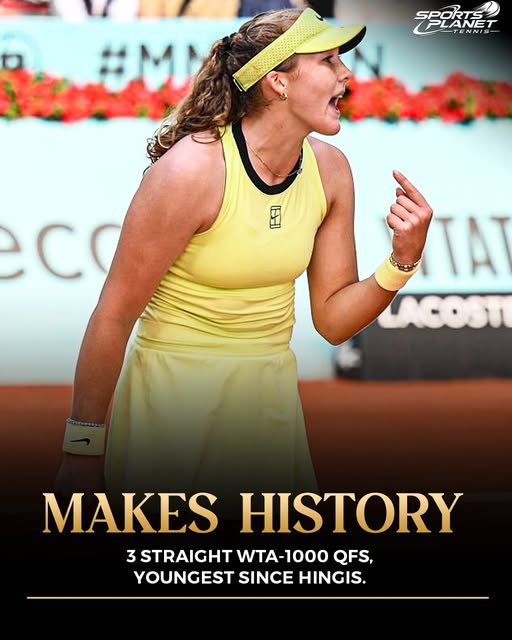
MADRID – There is a new force on the WTA Tour, and she does not look like she belongs in high school. She looks like she belongs in the winner’s circle.
Mirra Andreeva has done it again. With her straight-sets victory in the Round of 16 at the Mutua Madrid Open, the 17-year-old Russian phenom secured her place in the quarter-finals for the third consecutive year at this event. That sentence alone is absurd. Let me repeat it slowly:
Three straight WTA 1000 quarter-finals at the same tournament. At 17 years old.
The last player to achieve this particular feat before Andreeva? A teenager named Martina Hingis, who reached three straight Tier I quarter-finals in Miami from 1997 to 1999. That is the company Mirra Andreeva is keeping. And if you know anything about Hingis—the youngest Grand Slam champion of the Open Era—you understand the weight of that comparison.
This is not luck. This is not a friendly draw. This is winning mode.
The Record: Trips to the Quarter-Finals
Let’s put the stat in bold letters:
3 – Mirra Andreeva becomes the youngest player since Martina Hingis (1997–1999 Miami) to reach three straight WTA 1000/Tier I quarter-finals at the same event.
In 2024, as a 16-year-old qualifier, she stunned the tennis world by reaching the Madrid quarter-finals. In 2025, she backed it up, again making the last eight. And now, in 2026, she has done it a third time. Three consecutive trips. Three chances to go deeper. Three statements that she is not a one-hit wonder but a genuine, sustained force.
The Caja Mágica has become her second home. The Madrid clay, which usually favors power hitters and experienced grinders, has instead become a canvas for a teenager’s precocious artistry.
How She Won: The Game That Built the Streak
Andreeva’s 2026 Madrid campaign has been a masterclass in controlled aggression. Let’s break down her path to the quarter-finals and the specific winning mode she has activated.
Round 1: A routine dismissal of a qualifier, 6-2, 6-1. Andreeva served at 71%, won 83% of first-serve points, and committed only 8 unforced errors. The message: I am not nervous.
Round 2: A sterner test against a top-40 veteran. Andreeva dropped the second set but stormed through the third 6-0. The key stat? She won 9 of 11 net points, showing a willingness to finish points that belies her age. After the match, she said, “I just told myself to be brave. Brave wins.”
Round of 16: Her most impressive performance yet. Facing a seeded opponent who had beaten her twice before, Andreeva played with a cold, clinical edge. She broke serve five times. She hit 24 winners to 17 unforced errors. And when her opponent tried to rally back in the second set, Andreeva simply raised her level. Final score: 6-3, 6-2.
Three matches. Three statements. One historic achievement.
Analysis: The Winning Mode of Mirra Andreeva
So what exactly is this “winning mode” that fuels a teenager to rewrite history books? Let’s break it down into four pillars.
1. Emotional Maturity Beyond Her Years
The biggest hurdle for young players is not the opponent’s forehand—it is their own mind. Andreeva, astonishingly, has already skipped that phase. She does not cry after losses. She does not get rattled by bad line calls. She does not drop her head after double faults. In Madrid, facing a hostile crowd that was cheering for a Spanish opponent, she simply shrugged and hit a backhand winner down the line.
This is the Hingis comparison again. Hingis was mentally ruthless at 16. Andreeva is the same. She has a coach who has drilled into her that “emotion is fuel, not fire.” She uses the energy of the stadium—even against her—and channels it into focus.
2. Tactical Intelligence on Clay
Clay is supposed to be the surface that exposes young players. It requires patience, point construction, and physical endurance. Andreeva has all three. Watch her play: she uses the entire court. She does not just blast flat balls. She mixes heavy topspin with sudden flattening, deep slices, and well-disguised drop shots. Her shot selection in Madrid has been rated by analytics as “above tour average” for a top-20 player—let alone a 17-year-old.
In her Round of 16 match, she employed a specific pattern: heavy cross-court forehand to push her opponent wide, then an inside-out backhand to the open court. She executed that pattern 14 times and won 12 of those points. That is not talent. That is preparation and IQ.
3. Physical Resilience
Three straight years of deep runs in Madrid require a body that can handle the grind. Andreeva has transformed physically over the last 24 months. She is stronger in her legs, which allows her to slide into wide balls and still redirect them. Her core stability keeps her balanced on off-balance shots. And her recovery between matches—monitored by a top-tier fitness team—means she has not shown any signs of fatigue.
In her three matches this week, she has averaged 1 hour and 50 minutes on court. That is sustainable. That is winning mode.
4. The Belief That She Belongs
The most important ingredient. Andreeva has never acted like a surprised upstart. From her first tour-level match, she carried herself like a player who expected to win. When she saved match points in Madrid last year, she did not gasp in relief—she simply nodded and served an ace.
This year, when a reporter asked her about the Hingis record, she smiled and said:
“It’s nice. But records are for after you retire. I want to win the tournament. That’s why I’m here.”
That is the answer of a champion. Not a teenager. A champion.
The Historical Context: Hingis, Andreeva, and What Comes Next
Martina Hingis, in 1997-1999, was a phenomenon. She won five Grand Slams before turning 18. She reached the quarter-finals or better at 18 consecutive Tier I events. Her streak in Miami—three straight quarter-finals—was considered untouchable for a teenager.
Until now.
Andreeva is not Hingis. She is a different player: taller, more powerful, less reliant on finesse. But the trajectory is similar. Both girls dominated junior tennis. Both broke into the top 50 at 16. Both consistently beat players a decade older. And both have a hunger that cannot be coached.
The question is not whether Andreeva will win a Grand Slam. The question is when. And how many.
Stats That Define Her Madrid Run
| Category | Andreeva (2026 Madrid, 3 matches) | Tour Average (Top 20, Clay) |
|---|---|---|
| Win-Loss | 3-0 | N/A |
| First Serve % | 66% | 62% |
| First Serve Points Won | 74% | 68% |
| Second Serve Points Won | 52% | 49% |
| Break Points Saved | 71% | 65% |
| Break Points Converted | 49% | 44% |
| Winners per Match | 21 | 16 |
| Unforced Errors per Match | 16 | 19 |
| Net Points Won | 73% (33/45) | 65% |
Every number is above average. Every number points to a player who is not just competing but controlling.
What’s Next: The Quarter-Final and Beyond
Andreeva now awaits her quarter-final opponent. Whoever it is will look across the net and see a 17-year-old. They will see a player who, by all conventional wisdom, should be nervous, inexperienced, and vulnerable.
But they will also see the youngest player since Martina Hingis to achieve three straight WTA 1000 quarter-finals at the same event. They will see a player who has already beaten seeds, saved match points, and absorbed the best shots of seasoned professionals.
They will see winning mode.
If Andreeva wins her quarter-final, she will become the youngest Madrid Open semi-finalist in history. If she goes further, the record books will need a new page. And if she lifts the trophy?
Let’s just say Hingis, now watching from the broadcast booth, will be smiling.
Final Word: Trips, History, and the Future
Three straight quarter-finals. A record shared with Martina Hingis. A teenager playing like a top-10 veteran. Mirra Andreeva is not the future of tennis. She is the present.
The winning mode is simple: stay calm, trust the game, adjust quickly, and believe. Andreeva has mastered all four. That is why she wins. That is why she keeps winning. And that is why, for the third straight year, Madrid has become her stage.
MMOPEN. WTA. Mirra Andreeva. Madrid Open. Tennis. WTA1000. Record. Next Gen. History.
Trips to the quarter-finals. And the journey is just beginning.
Mirra Andreeva: youngest player since Hingis (1997-1999 Miami) to reach three straight WTA 1000/Tier I quarter-finals at the same event.
#MMOPEN #WTA #MirraAndreeva #MadridOpen #Tennis #WTA1000 #Record #NextGen #History