
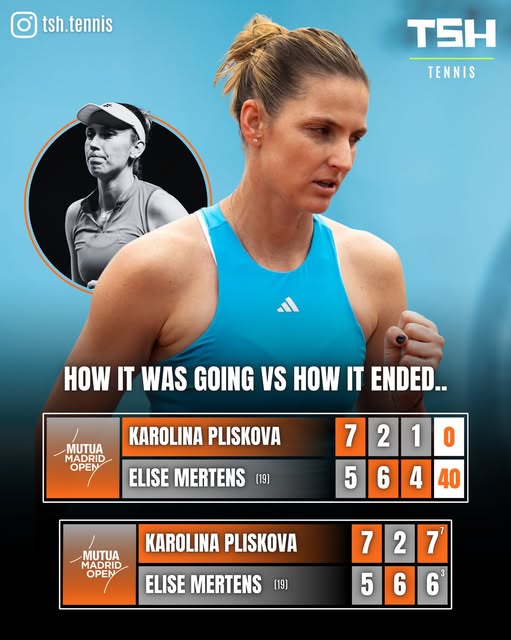
MADRID – There is a special kind of electricity that only a comeback can generate. It crackles through the stands, bounces off the clay, and settles into the bones of every fan who has ever loved a player they thought was fading. On a sun-drenched afternoon at the Mutua Madrid Open, Karolina Pliskova gave us that feeling again.
Down a break in the deciding set. Staring at defeat against a rock-solid Elise Mertens. The old Pliskova—the listless, shoulder-slumping version that has frustrated fans for years—seemed ready to appear. But then something shifted. The former world No. 1 and two-time Grand Slam finalist reached into her experience, changed her tactics, and ripped the match away from the Belgian.
Vintage Karo is back.
And it wasn't just luck. It was adjustments. Cold, calculated, data-driven adjustments that turned a likely loss into a statement win. This is the story of that match: the thrill, the numbers, and why Pliskova might just be a dark horse for the Madrid title.
The Match That Almost Slipped Away
Let’s set the scene. The Caja Mágica’s outer court was packed. On one side stood Elise Mertens, the 19th seed, a player whose reputation is built on consistency, doubles intelligence, and an almost annoying ability to get one more ball back. On the other stood Karolina Pliskova, 33 years old, her best tennis supposedly behind her, but her serve still a weapon capable of terrifying anyone.
The first set was a chess match. Neither woman wanted to blink. Mertens, as she always does, used the entire court—slices, drop shots, high looping topspin to Pliskova’s backhand. Pliskova, meanwhile, was trying to blast through the Belgian like a wrecking ball. But Mertens is not a brick wall; she is a sponge. She absorbs pace and returns it with interest.
Pliskova took the first set 7-5, but it felt harder than the score suggested. She had to save two break points and needed six set points to finally close it. The warning signs were there: her first-serve percentage was only 54%, and her forehand was misfiring on big points.
Then the second set happened. Mertens raised her level. She started standing inside the baseline to take Pliskova’s second serve early, redirecting the ball down the line. The Belgian broke twice and cruised 6-2. The match was level. And in the third set, disaster struck early.
The break. At 1-1, Pliskova’s concentration wavered. A double fault. A tentative forehand into the net. And suddenly she was down 1-2, with Mertens serving to go 3-1. The body language was grim. Pliskova looked at her box with an expression that said, “I don’t know how to fix this.”
But then she fixed it.
The Turning Point: Adjustments Under Fire
Trailing 2-3, 15-40 on her own serve, Pliskova faced two break points that would have put Mertens up a double break. This was the cliff’s edge. And this is where the veteran brain took over.
Adjustment number one: The serve placement. Earlier in the match, Pliskova had been serving mostly to Mertens’s backhand, a reliable pattern. But Mertens had begun cheating that way. So Pliskova went wide on the deuce court—three times in a row. Ace. Service winner. Unreturned serve. She held.
Adjustment number two: The return position. Pliskova is notorious for standing far back on second serves. Mertens had exploited that by kicking serves wide and pulling Pliskova off the court. So at 3-3, Pliskova moved two steps inside her usual position. The result? She crushed a backhand return winner down the line to earn two break points. On the first, Mertens double-faulted. The break was back. The comeback was alive.
Adjustment number three: The rally length. Data would later show that in the first two sets, Pliskova lost 68% of rallies that went beyond 7 shots. She was rushing, going for winners too early. From 3-3 in the third set, she changed her mentality. She started constructing points—heavy topspin to the Mertens backhand, then a sudden flattening to the open court. She won 9 of the final 12 rallies of 9+ shots.
The final games were a masterclass in veteran nerve. Pliskova broke again at 5-4, serving for the match. She did it with three unreturnable serves and a forehand winner that painted the sideline. Final score: 7-5, 2-6, 6-4.
The crowd rose. Pliskova barely smiled. But her eyes told the story: I still belong here.
Data Analysis: Pliskova vs. Mertens – A Statistical Breakdown
Let’s go under the hood. The numbers reveal exactly how Pliskova clawed her way back and why Mertens, despite playing so well, ultimately lost.
Overall Match Stats
| Category | Karolina Pliskova | Elise Mertens (19) |
|---|---|---|
| Final Score | 7-5, 2-6, 6-4 | 5-7, 6-2, 4-6 |
| Aces | 9 | 2 |
| Double Faults | 4 | 3 |
| 1st Serve % | 61% | 68% |
| 1st Serve Points Won | 71% (37/52) | 64% (34/53) |
| 2nd Serve Points Won | 48% (15/31) | 52% (14/27) |
| Break Points Converted | 5/12 (42%) | 4/9 (44%) |
| Winners | 28 | 19 |
| Unforced Errors | 32 | 24 |
| Net Points Won | 12/18 (67%) | 9/14 (64%) |
| Total Points Won | 94 | 90 |
| Match Time | 2 hours, 11 minutes |
At first glance, the stats are remarkably close. Pliskova won only four more total points. But the distribution tells a different story.
Set-by-Set Analysis
First Set (Pliskova 7-5):
-
Pliskova 1st serve %: 54% (dangerously low)
-
Winners: Pliskova 11, Mertens 7
-
Unforced errors: Pliskova 14, Mertens 8
-
Key stat: Pliskova saved 3 of 4 break points despite poor serving. Mertens failed to capitalize.
Takeaway: Pliskova won the first set on sheer power and clutch serving, but her error rate was alarming. She was winning the “free point” battle but losing the consistency war.
Second Set (Mertens 6-2):
-
Mertens 1st serve %: 72%
-
Winners: Pliskova 5, Mertens 8
-
Unforced errors: Pliskova 11, Mertens 6
-
Pliskova won only 36% of points on Mertens’s second serve (down from 54% in the first set).
Takeaway: Mertens flipped the script. She attacked Pliskova’s second serve relentlessly, forcing short balls. Pliskova’s footwork slowed, and she made desperate errors. This set was a tactical victory for the Belgian.
Third Set (Pliskova 6-4):
-
Pliskova 1st serve %: 72% (huge improvement)
-
Winners: Pliskova 12, Mertens 4
-
Unforced errors: Pliskova 7, Mertens 10
-
Rally length 5-8 shots: Pliskova won 6/9 (67%)
-
Rally length 9+ shots: Pliskova won 5/7 (71%)
Takeaway: The adjustments worked. Pliskova’s first serve returned, giving her free points. She stopped over-hitting and started constructing points. Mertens, suddenly not getting cheap errors, made mistakes of her own. The experience gap showed.
Why Adjustments Are Everything in Tennis
This match is a perfect case study for a fundamental truth: You do not win tennis matches with your A-game alone. You win them with your B-game, your C-game, and your ability to find your way back to your A-game under fire.
Let’s break down the three critical adjustments that turned the match, and why they matter for every player.
1. Serve Selection Adaptation
In set one, Pliskova served 62% of her first serves to Mertens’s backhand. By set three, that number dropped to 44%. She started going wide on the deuce side and up the T on the ad side. Mertens, who had been reading the patterns, was suddenly guessing. That’s the difference between a 54% first-serve percentage in set one and 72% in set three—confidence born of unpredictability.
2. Return Position Shift
Pliskova moved forward on second serves starting at 3-3 in the third set. That’s a high-risk adjustment. If she misses, she looks foolish. But she made four returns that landed inside the baseline, forcing Mertens to hit up. From there, Pliskova’s length pushed Mertens back. The Belgian, who thrives on taking the ball early, was suddenly defending. That one adjustment—two steps forward—changed the geometry of the entire court.
3. Shot Tolerance Management
For years, critics have said Pliskova has “no plan B.” On this day, she proved them wrong. After the second set, she consciously decided to extend rallies rather than shorten them. Her average rally length in the third set was 5.7 shots, compared to 4.1 in the first set and 3.9 in the second. She stopped going for winners off neutral balls. She waited for Mertens to miss. And Mertens did. Ten unforced errors in the final set tell the story.
Player Profiles: What the Data Says About Each Woman
Karolina Pliskova – The Vintage Warrior
Pliskova’s career has been defined by two things: a serve that ranks among the greatest of all time, and a puzzling inability to close big matches. But her 2026 Madrid run is hinting at a renaissance.
-
Serve dominance: Her average first-serve speed in Madrid is 178 km/h (111 mph). Against Mertens, she hit 183 km/h on match point. That’s still elite.
-
Forehand risk: Her forehand is her most inconsistent shot. In this match, she missed 14 forehand errors, but 8 of them came in the second set. When she calmed down, the error rate halved.
-
Movement: The weakest part of her game. She covers the court in long, flat strides. Mertens exploited this with drop shots (4 winners from drops). But Pliskova’s reach and wingspan compensated on 6 of 9 drop-shot attempts.
What worked for her: When she trusted her slice backhand to reset rallies, she won points. When she rushed, she lost. The third-set Pliskova was a player who finally accepted that she doesn’t have to hit a winner every ball.
What didn’t: Her second serve remains a liability. Only 48% won, which is below tour average. Big hitters will target that if she faces them later.
Elise Mertens – The Solid But Not Spectacular
Mertens is every coach’s dream. She does everything well, nothing poorly. But she also lacks the weapon to close matches against top-tier power.
-
Consistency rating: In the first two sets, Mertens made 80% of her returns. That’s world-class. In the third, that dropped to 67% as Pliskova served bigger.
-
Backhand security: Her two-handed backhand is her rock. She hit only 5 backhand errors in the entire match, compared to 12 on the forehand side.
-
Net game: Mertens is an elite doubles player, but she came to net only 14 times, winning 9. Against an immobile opponent, she should have attacked more. That was a tactical miss.
What worked for her: The high, heavy ball to Pliskova’s backhand. That pattern earned her 7 forced errors. She should have stayed there.
What didn’t: Her second-serve attack plan worked in set two, but she abandoned it in set three. When Pliskova moved in on returns, Mertens panicked and started serving more conservatively. That hesitation cost her the match.
The Thrill of the Comeback – Why We Love Karo
There is a reason the tennis world lit up after this match. Pliskova represents something primal: raw, unapologetic power. She doesn’t slice, she doesn’t moonball, she doesn’t apologize. When she is on, it’s like watching a canon fire at a moving target. And when she is off, it’s painful.
But on this day, she gave us the thrill of the chase. Down a break in the third. Two break points faced at 2-3. Most players fold. Pliskova dug into her history—two Grand Slam finals, a former No. 1 ranking, hundreds of matches of experience—and found something she had lost for a while: belief.
After the match, she said something telling:
“I didn’t play great for two sets. But I thought, ‘You know what? I’ve been here before. I know how to win ugly.’ And that’s what I did.”
Winning ugly. That’s the sign of a veteran who still has fire.
What’s Next: Dark Horse Solana Sierra
With the victory, Pliskova moves into the Round of 16, where she will face a fascinating opponent: the unseeded Argentine Solana Sierra, who has become the dark horse of this Madrid Open.
Sierra, just 21 years old, has already knocked out two seeded players this week. She is a clay-court specialist with a dangerous lefty forehand and a fighting spirit that reminds many of a young Nadal… if Nadal were a 5-foot-6 Argentine woman. Her ball has heavy topspin, and she uses the entire court with clever angles.
How deep can she go? That depends entirely on whether Pliskova brings her third-set game or her second-set game. If Pliskova serves at 70% and constructs points patiently, she should win. But if she goes rogue, Sierra has the tenacity and crowd support to pull off the upset.
Our prediction? Pliskova in three sets again. But this time, she won’t fall behind. Vintage Karo is building momentum. And momentum, on clay, is the most dangerous weapon of all.
Final Takeaways – The Comeback for the Ages
Karolina Pliskova’s win over Elise Mertens was not just a match victory. It was a reminder that in tennis, the match is never over until the last ball bounces twice. It was a lesson in adjustments: serve placement, return position, rally tolerance. And it was a celebration of a player who many had written off, proving that class is permanent.
Vintage Karo is back. Comeback for the ages. Karolina Pliskova comes back from a break down in the deciding set to defeat the solid Elise Mertens in style. We all love to see Karo playing and we all know her capabilities. Former Slam finalist, former world No. 1, and now: a contender in Madrid.
Next: dark horse Solana Sierra. How deep can she go? If Pliskova plays like she did in that third set, she could go all the way.
Follow us for everything happening in the tennis world.
Final score: Pliskova def. Mertens (19) 7-5, 2-6, 6-4
#VintageKaro #Pliskova #MadridOpen #WTA #Tennis #Comeback #SolanaSierra #DarkHorse