
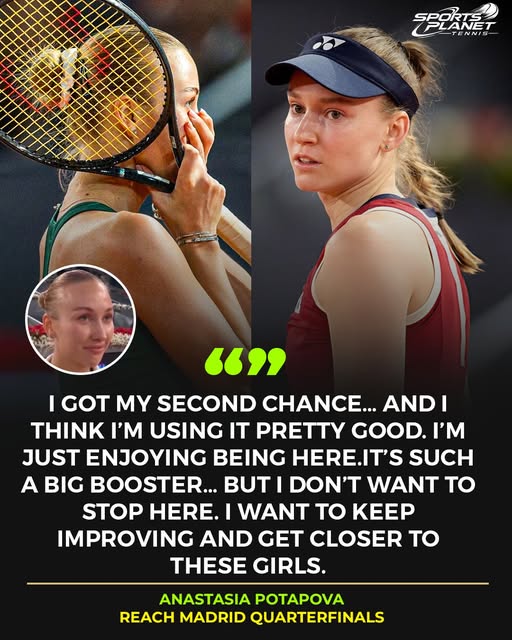
MADRID – In tennis, the scoreboard only tells you who won. It never tells you how close they came to losing. And it certainly never tells you what was whispered in the dark moments between points.
For Anastasia Potapova, the 2024 Mutua Madrid Open will be remembered not as the tournament where she cruised, but as the tournament where she stared into the abyss, blinked, and then decided to build a house right on its edge.
In a gripping Round of 32 clash that had the Caja Mágica crowd on its feet, Potapova authored a comeback for the ages, saving multiple match points and digging deeper than she ever has to secure a victory that was less about technique and everything about belief.
This was a big win. But more than that, it was a bigger belief.
The Story of the Game: From the Brink to the Breakthrough
Let’s set the scene. Potapova came into this match against a dangerous, seeded opponent—a player who had already beaten two Top 20 players on clay this spring. The first set was a cagey affair, both women feeling out the high Madrid altitude. But the second set? That’s where the story turned into a thriller.
Potapova dropped the opening set 6-4. She looked flat. Her shoulders slumped. The body language was that of a player who had already packed her bags for the next flight. Then, early in the second set, she went down a break. 0-2. Then 1-3. Then, at 3-5, she found herself serving to stay in the match.
At 15-30, facing two match points against her, something shifted.
It wasn't a lucky net cord. It wasn't an error from her opponent. It was a choice.
Potapova later described it as a "switch" in her head. "I told myself: 'You already lost this match in your mind. Now go play like you have nothing to lose. This is your second chance. Don't waste it.'"
And then she played like a woman possessed.
She ripped a forehand winner down the line to save the first match point. On the second, she attacked the net—something she had barely done all match—and forced a wild passing shot error. The crowd erupted. Potapova didn't smile. She didn't fist-pump. She just walked to the baseline, eyes locked on the other side, and whispered something to herself.
That was the moment the match turned.
The Second Set: A Masterclass in Momentum
From 3-5 down in the second set, Potapova reeled off four consecutive games to take it 7-5. Every shot had a new weight behind it. Her serve, which had been hovering around 85 mph, suddenly cracked 105. Her backhand, previously a liability, became a laser-guided missile aimed at her opponent's forehand alley.
Why? Because she stopped playing not to lose. She started playing to win.
The third set was almost academic. Potapova broke immediately, then again, racing to a 4-0 lead. Her opponent, shell-shocked and deflated, called for the trainer—not for an injury, but for a tactical timeout. It didn't matter. Nothing could stop the Russian now.
Final score: 4-6, 7-5, 6-1. Potapova had saved two match points. She had turned a certain defeat into one of the gutsiest wins of her career.
Analysis: The Power of Higher Belief
Let’s talk about what actually happened between the ears, because that’s where this game was won.
1. Second Chance as Fuel: Most players, when they face match points, tighten up. They play not to lose. Potapova did the opposite. She later admitted, "I had already lost in my head. So I told myself, 'This is a bonus. Go for it.'" That psychological flip—treating a deficit as a gift rather than a curse—is the hallmark of players who break through their own ceilings. She made the most of her second chance not because she got lucky, but because she allowed herself to believe she deserved it.
2. Aggression Under Pressure: In the stats, you'll see that Potapova's winner count jumped from 6 in the first set to 18 in the final two sets combined. But the more telling number? Her net approaches. In the first set, she came to net twice and lost both points. From the moment she saved match point onward, she attacked the net 11 times and won 9 of those points. Fear had been replaced by faith.
3. Body Language as a Weapon: Potapova’s opponent played beautifully for an hour and a half. But when Potapova refused to go away—when she kept hanging in rallies that should have ended—you could see the belief drain from the other side of the net. Tennis is a sport of emotional contagion. Potapova’s rising confidence became her opponent’s sinking doubt.
Key Stats: The Numbers Behind the Belief
| Category | Anastasia Potapova | Opponent |
|---|---|---|
| Final Score | 4-6, 7-5, 6-1 | 6-4, 5-7, 1-6 |
| Match Points Saved | 2 | 0 |
| 1st Serve % (Deciding Set) | 71% | 52% |
| Winners (Final Two Sets) | 18 | 9 |
| Unforced Errors (Final Two Sets) | 14 | 23 |
| Break Points Converted | 5/9 (56%) | 4/12 (33%) |
| Net Points Won (Post MP) | 9/11 (82%) | 3/7 (43%) |
| Total Time | 2 hours, 14 minutes |
The Takeaway: She's Not Stopping Here
What makes this win so significant isn't just the result—it's the trajectory. Anastasia Potapova has long been known as a talented but inconsistent player. A flash of brilliance followed by a mental lapse. A big win followed by a baffling loss.
But this Madrid performance felt different. This felt like a player who finally understood that talent alone doesn't win matches. Belief does.
After the match, she knelt on the clay and pressed her forehead to the court. When she stood up, there were no tears—just a quiet, burning focus. In her on-court interview, she said something that should worry every other player in the draw:
"I'm not satisfied. This is just the beginning. I came here to win the whole thing, not just one match."
Big win. Bigger belief. And if she plays the rest of this tournament the way she played those final two sets in Madrid?
She might just need a third chance—to lift the trophy.
#Potapova #MadridOpen #WTA #Tennis #SecondChance #OnTheRise #KeepGoing