A scoreboard can tell you who won.
But it cannot tell you why it mattered.
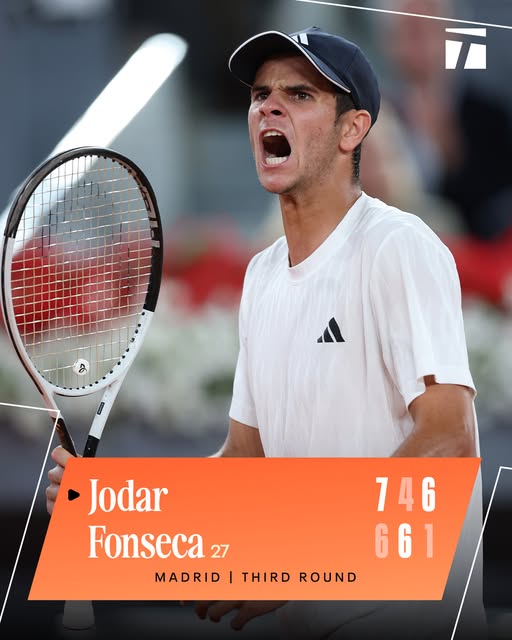
At the Madrid stage, a 19-year-old Spaniard—Jodar—announced himself with authority. In his first-ever meeting against Joao Fonseca, he didn’t just compete—he endured, adapted, and conquered.
The final scoreline: 7–6, 4–6, 6–1.
But the real story?
A young player discovering the edge between talent and identity.
The Thrill of the Game: Where Pressure Creates Identity
Tennis is not played in highlights.
It is forged in tension.
This match had everything:
- Momentum swings
- Emotional spikes
- Tactical adjustments
- Physical endurance
The first set was a test of nerves.
The second, a test of resilience.
The third, a declaration.
And in that final set, Jodar transformed from a contender into a controller.
This is where the thrill lives—not in the winner, but in the shift.
First Set (7–6): Learning to Breathe Under Pressure
The opening set was tight, volatile, and mentally demanding.
Fonseca brought intensity early:
- Aggressive baseline hitting
- Quick point construction
- Willingness to dictate
Jodar responded with:
- Defensive awareness
- Smart shot tolerance
- Composure beyond his age
The tiebreak became a battlefield of micro-decisions:
- Who commits first
- Who hesitates
- Who believes
Jodar didn’t overpower.
He outlasted.
That distinction matters.
Second Set (4–6): The First Real Test
Young players often shine early—but struggle when the match shifts.
This was Jodar’s moment of truth.
Fonseca adjusted:
- Increased aggression on return
- More depth to push Jodar back
- Faster pace between points
Jodar’s level dipped slightly:
- Shorter balls under pressure
- Less conviction in transitions
- A few rushed decisions
He lost the set—but not control of himself.
And that’s where the future reveals itself.
Third Set (6–1): The Emergence of a Competitor
This was not just a set.
It was a statement.
Jodar came out with:
- Higher intensity
- Clearer patterns
- Stronger belief
What changed?
Not his technique.
His intent.
Tactical Shift
- Stepped inside the baseline earlier
- Targeted weaknesses with precision
- Controlled rally tempo
Psychological Shift
- Played forward, not reactive
- Embraced pressure instead of managing it
- Refused to let the match drift
Fonseca, meanwhile, faded—not in effort, but in clarity.
Jodar didn’t give him space to recover.
That is how matches are closed at a high level.
Hunger: The Engine Behind the Rise
Talent introduces you.
Hunger defines you.
Jodar’s game carries a visible urgency:
- Every point matters
- Every rally has purpose
- Every mistake is processed, not repeated
This is not desperation.
It is direction.
The difference between players who stay and players who rise is simple:
Consistency of hunger.
And Jodar shows signs of sustaining it.
Technical Breakdown: Why His Game Translates to the Next Level
1. Forehand Structure: Controlled Aggression
His forehand is not reckless—it’s built:
- Heavy topspin for margin
- Depth to push opponents back
- Angle creation to open the court
He doesn’t force winners.
He constructs them.
2. Backhand Stability: The Anchor
In high-pressure exchanges, Jodar’s backhand holds:
- Compact mechanics
- Reliable direction control
- Ability to absorb pace
This allows him to reset rallies and re-establish patterns.
3. Movement on Clay: Natural Efficiency
Being Spanish, clay is not just a surface—it’s a language.
Jodar shows:
- Smooth sliding
- Balanced recovery
- Intelligent positioning
He moves with intent, not reaction.
4. Competitive Mindset: The Separator
At 19, the most impressive element is not physical—it’s mental.
He demonstrates:
- Emotional control after errors
- Tactical awareness mid-rally
- Willingness to suffer in long exchanges
These are not common at this age.
The Spanish Blueprint: Legacy and Expectation
Spain produces fighters.
From academy systems to cultural identity, players are taught:
- Patience
- Discipline
- Endurance
Jodar fits this lineage—but adds something modern:
- Faster decision-making
- More proactive court positioning
- Willingness to accelerate play
He is not just following a blueprint—he is evolving it.
The Next 1–2 Years: Projection of Growth
If development continues on this trajectory, the outlook is clear.
Short-Term (6–12 Months)
- Consistent Challenger and ATP 250 results
- Improved physical conditioning
- Increased exposure to higher-ranked opponents
Mid-Term (1–2 Years)
- Entry into Top 100
- Deep runs in ATP tournaments
- Potential breakout at a major event
But growth is not automatic.
It depends on:
- Injury management
- Scheduling discipline
- Continued hunger
What He Must Improve to Accelerate His Rise
Even in victory, gaps remain.
Serve Consistency
- Needs higher first-serve percentage
- More variation in placement
- Better second-serve protection
Transition Game
- Finishing at the net with more confidence
- Recognizing shorter balls earlier
Match Management
- Avoiding dips after winning tight sets
- Maintaining intensity across momentum swings
These are normal at his stage—but critical for the next level.
The Psychological Edge: Why This Win Matters
This wasn’t just about beating Fonseca.
It was about:
- Winning a first meeting
- Handling a three-set battle
- Closing with authority
These moments build internal belief.
And belief changes behavior.
A player who believes:
- Steps in earlier
- Hits with more conviction
- Recovers faster from setbacks
This is how rankings change—not just through points, but through identity shifts.
The Thrill Revisited: Why This Match Resonates
Fans remember matches like this not for perfection—but for transformation.
You saw:
- A young player struggle
- Adjust
- Return stronger
That arc is the essence of sport.
The thrill is not in dominance.
It is in becoming.
Final Reflection: A Star in Motion
Jodar is not finished.
He is forming.
This victory shows:
- He can endure
- He can adapt
- He can close
The hunger is real.
The structure is developing.
The trajectory is upward.
In the next 1–2 years, if he continues to build with the same discipline and fire, the ranking will follow.
Not because he chases it—
But because his game will demand it.
Closing Thought
The difference between a talented player and a rising star is simple:
One plays the game.
The other lives inside the battle.
Jodar, at 19, is already choosing the second path.
And that is why this win feels bigger than the scoreline.
It’s not just a victory.
It’s a beginning.