
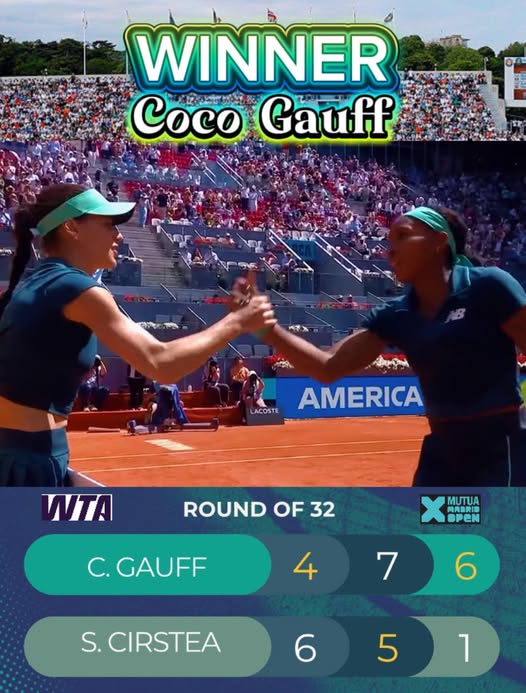
INDIAN WELLS — There is a moment in every grueling three-set match when the body sends a withdrawal notice and the mind has to override it. For Coco Gauff on Tuesday night, that moment arrived midway through the second set, with her stomach churning, her energy flagging, and Sorana Cirstea just two games away from a straight-sets upset.
Gauff had dropped the first set 4-6. She was sluggish, uncharacteristically flat, and visibly battling something more than just Cirstea’s crisp ball-striking. Later, we would learn it was an illness that had been nagging her since the night before. But in the heat of the Stadium Court battle, there were no excuses—only the choice between finding a way or fading away.
She found the way. Not with a sudden explosion of winners, but with a slow, deliberate recalibration of her mindset. The final score: 4-6, 7-5, 6-1. And the final set was a masterclass in mental dominance.
The First Set: When the Body Fails the Plan
To understand the thrill of this comeback, you have to start with the struggle. Cirstea, a veteran who has troubled top players for years, came out aggressive and clean. She stepped inside the baseline, took Gauff’s second serve early, and redirected cross-court with precision. Gauff, meanwhile, looked a step slow. Her first-serve percentage hovered below 50 percent in the opening set. Her footwork, usually her superpower, was heavy.
What you couldn’t see from the stands was what Gauff was managing internally. A tennis player’s body under illness is a compromised engine—less explosive, quicker to fatigue, prone to fuzzy decision-making. After losing the first set, Gauff took a long medical timeout, disappeared into the tunnel, and came back with towels wrapped around her neck. The cameras caught her grimacing between points.
That was the low point. And that is where the mindset story really begins.
The Turning Point: One Point at a Time
In her on-court interview after the match, Gauff revealed the internal shift that turned the tide. “I just told myself, ‘You can’t control how you feel, but you can control what you do on each point,’” she said. That sounds simple. In practice, against a player like Cirstea, who attacks relentlessly, it is extraordinarily difficult.
Down 3-2 in the second set, Gauff faced two break points. She saved them not with aces, but with extended rallies that forced Cirstea to hit one extra ball. She grunted louder on each shot. She started taking the ball earlier, not to overpower Cirstea, but to shorten the points and conserve whatever energy she had left. That’s the veteran adjustment—the kind of tactical shift that comes from a clear head, not a panicked one.
The critical game came at 5-5. Gauff held serve with a sequence of first serves and deep forehands, then immediately broke Cirstea to take the set 7-5. The roar from the crowd was as much for the grit as for the scoreline. Coco didn’t look healthy—she looked determined.
The Third Set: When Mindset Becomes Momentum
By the time the third set began, the match had transformed. Cirstea, who had played nearly flawless tennis for an hour and a half, began to feel the pressure of a missed opportunity. Her unforced errors crept up. Her first-serve percentage dipped. Gauff, on the other hand, was feeding off survival.
The final set score of 6-1 tells you everything about the mental gulf that had opened. Gauff broke early, consolidated, and never looked back. She moved Cirstea from side to side, then dropped a perfect short angle to finish a rally. She celebrated not with wild fist pumps but with quiet nods—a champion conserving energy, but not belief.
Here is the key insight for any player watching: Gauff did not win because she suddenly felt better physically. She won because she stopped checking in with how she felt. The hallmark of elite mindset is the ability to focus on process rather than sensation. Every point became its own match. Every breath became intentional. She ignored the dizziness, the fatigue, the easy excuse of “I’m not 100 percent.”
What This Win Teaches Us About Tennis Mentality
As a U.S. tennis expert who has watched Coco Gauff grow from a 15-year-old phenom into a Grand Slam champion, I can say this: her most impressive weapon is no longer her forehand or her movement. It is her capacity to solve problems in real time, even when her body is working against her.
This match against Cirstea was a textbook case of mindset winning over circumstance. Three specific mental skills were on display:
-
Acceptance without surrender – Gauff acknowledged she felt unwell, but she did not use it as a reason to coast. She accepted reality and then asked, “What can I still control?”
-
Compartmentalization – She lost the first set, but she did not lose the plot. She broke the match into smaller chunks: hold this service game, win this return point, get to 5-5. That prevented the deficit from feeling insurmountable.
-
Energy management as a tactical weapon – Instead of chasing every ball with reckless effort, Gauff picked her spots. She played safer on Cirstea’s service games and went bigger on her own. She used the crowd, the time between points, even the medical timeout, to reset.
The Road Ahead
Coco Gauff advances to the next round not as the freshest player in the draw, but perhaps the most mentally resilient. If she can beat a seasoned opponent while under the weather, what can she do with a clean bill of health? That question looms over the rest of the tournament.
But for one night, the thrill of the game was not about perfect tennis. It was about imperfect circumstances and a mindset sharp enough to overcome them. Gauff didn’t just win a match. She reminded everyone watching—from juniors in Florida to weekend warriors at public courts—that the most important muscle in tennis sits between your ears.
Keep fighting. Keep believing. One point at a time.