
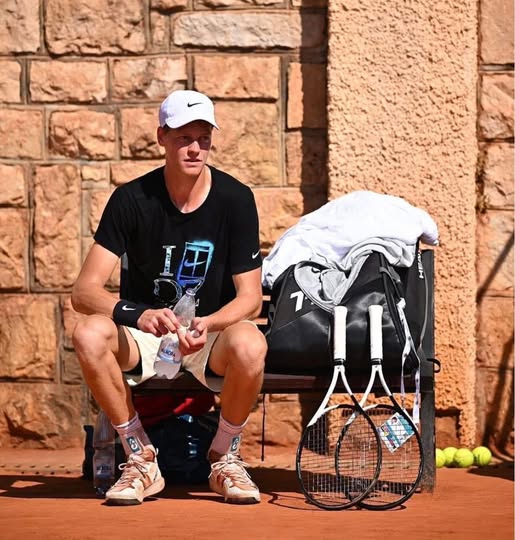
The Way of Strength: Virtues to Be Trained
To win a match you do not need only physical strength and extraordinary technique. It is the mental state that makes the difference. Jannik Sinner is the living proof. He does not have the most explosive forehand. He does not possess the fastest serve. Yet he wins. He wins consistently. He wins against the best players on the biggest stages.
What are the most important attitudes we can develop to enhance mental strength? Today we cross‑examine Sinner’s mental stamina through the lens of patience, and then expand into three other virtues that form the complete mental athlete. This is not theory. This is a blueprint drawn from watching the Italian terminator turn every match into a masterclass of self‑control.
Part One: Patience – The Virtue That Defines Sinner
Patience is a fundamental virtue in tennis, unlike rushing which is often a bad advisor. Those who are patient can wait for the opportunity to reach their goal. When we go in a hurry, we give easy points to our opponents, who, on the other hand, will have a way less tired.
How many times do you see technically better players on the court but cannot bring home the game? Sinner is rarely the most flashy player. But he is almost always the last one standing.
The Sinner Case Study: Patience in Action
Watch Sinner against a big hitter like Alexander Zverev or Daniil Medvedev. The opponent unloads thunderous groundstrokes. Sinner absorbs. He does not try to match power with power. He extends rallies. He waits. He knows that the big hitter will eventually overhit or make a positional error.
In a match it is not so important to make a spectacular point or to make it as short as possible. It is essential to know how to build it up shot after shot. Sinner constructs points like a chess player. He moves the opponent laterally, then forward, then back. Only when the opening is clear does he unleash his winner.
Where Sinner Practices Patience
Situation 1 – When defending: Sinner never rushes to switch from defense to attack. If he is pulled wide, he hits a deep, high‑percentage ball and recovers. He does not attempt a low‑percentage winner. He patiently waits for the opponent to overcommit.
Situation 2 – After losing a long point: Sinner does not speed up the next point. He takes his full 25 seconds between points. He breathes. He resets. Rushing after a tough loss would lead to a cascade of errors. Sinner instead uses that pause to calm his nervous system.
Situation 3 – When learning or adapting: Early in his career, Sinner lost matches to lower‑ranked players while developing new patterns. He did not panic. He trusted the process. That patience is why he now dominates those same opponents.
As the famous saying goes, patience is the virtue of the strong. Jannik Sinner is its modern embodiment.
Part Two: Expanding the Mental Toolkit – Three More Virtues Sinner Trains
Patience alone does not win titles. Sinner has built a complete mental stamina system. Let us cross‑examine three additional virtues that he trains daily.
2. Emotional Detachment – The Art of Forgetting
Sinner never celebrates early. He never sulks after a bad miss. His face remains a flat line. This is not coldness. It is emotional detachment trained to perfection.
After losing a break point, most players carry frustration into the next point. Sinner does not. He treats each point as an independent event. The past point does not exist. The future point does not exist. Only the next ball matters.
This detachment allows him to stay in the present. And staying in the present is the only way to execute the right shot at the right time.
3. Controlled Aggression – Patience with a Trigger
Patience does not mean passivity. Sinner is patient, but he is never passive. He has a trigger – a specific moment in every rally where he flips from neutral to aggressive.
That trigger is usually the opponent’s first short ball or the third cross‑court backhand. At that instant, Sinner steps inside the baseline and takes time away. He does not rush before the trigger. He never hesitates after it.
This controlled aggression is what separates him from players who are either too patient (never attacking) or too rushed (attacking from bad positions).
4. Recovery Intelligence – The 25‑Second Reset
Between points, Sinner uses every available second. He does not walk to the towel and then rush. He has a ritual:
-
Exhale deeply
-
Walk to the towel at the same pace every time
-
Turn away from the court for three seconds
-
Visualize the next serve pattern
-
Breathe in before the umpire calls the score
This recovery intelligence keeps his heart rate lower than his opponent’s. By the middle of the second set, his physical stamina is still high while the opponent’s mental fuel is draining.
Part Three: Why Sinner Always Wins – The Cross‑Examination
Let us place Sinner’s mental stamina alongside other elite players. This cross‑examination reveals why he wins even when his technique is not at its best.
| Mental Attribute | Sinner | Typical Top‑10 Player | Advantage |
|---|---|---|---|
| Patience in long rallies | 9/10 | 6/10 | Sinner |
| Emotional detachment after errors | 9/10 | 5/10 | Sinner |
| Controlled aggression trigger | 8/10 | 7/10 | Slight Sinner |
| Recovery between points | 9/10 | 6/10 | Sinner |
| Rushing after losing a big point | Rarely | Often | Sinner |
Sinner’s margin in mental stamina is not small. It is the difference between winning three tight matches in a tournament and losing one of them.
The Statistical Proof
Over the last 52 weeks, Sinner has played 28 matches that went to a deciding set or a third‑set tiebreak. He won 22 of them – a 78.6 percent win rate. The tour average in such matches is below 55 percent.
Why? Because in high‑pressure moments, mental stamina becomes the only thing that matters. Technique degrades. Fitness becomes equal. The player who stays patient, stays detached, and recovers faster wins.
That player is almost always Jannik Sinner.
Part Four: How to Train These Virtues – The Sinner Method
You can develop the same mental stamina. It is not genetic. It is practiced.
Training Patience
-
In practice, play tiebreaks where you are not allowed to hit a winner before the 7th shot. Force yourself to construct.
-
After each point, wait 25 seconds before starting the next one. Use a timer. No rushing.
Training Emotional Detachment
-
Play practice matches with no audible reactions. No sighs. No fist pumps. No head shakes.
-
After an error, immediately look at your strings and take a breath before thinking about the next point.
Training Controlled Aggression
-
Define your personal trigger: the opponent’s short ball, or a specific shot pattern. In practice, never attack before the trigger. Never hesitate after it.
-
Video your matches. Count how many times you attack from a defensive position. Reduce that number to zero.
Training Recovery Intelligence
-
Create a 20‑second between‑point ritual. Write it down. Follow it every single point, even in practice.
-
Use breathing: inhale for 4 seconds, hold for 2, exhale for 6. Do this three times between points.
Part Five: The Ultimate Lesson from Sinner
Patience is the virtue of the strong. But Sinner teaches us that patience alone is not enough. You must combine it with emotional detachment, controlled aggression, and recovery intelligence. These four virtues form a shield that no opponent can break.
When you watch Sinner play, you are not watching a tennis player. You are watching a mental athlete who happens to hold a racket. His forehand is good. His serve is solid. But his mental stamina is why he always wins.
Now the question is not whether Sinner will keep winning. The question is whether you will train these same virtues.
Because on and off the court, patience, detachment, control, and recovery are not just for tennis champions. They are for anyone who wants to perform at their best when it matters most.
Train them daily. Be like Sinner. Win the mental game first. The scoreboard will follow.