
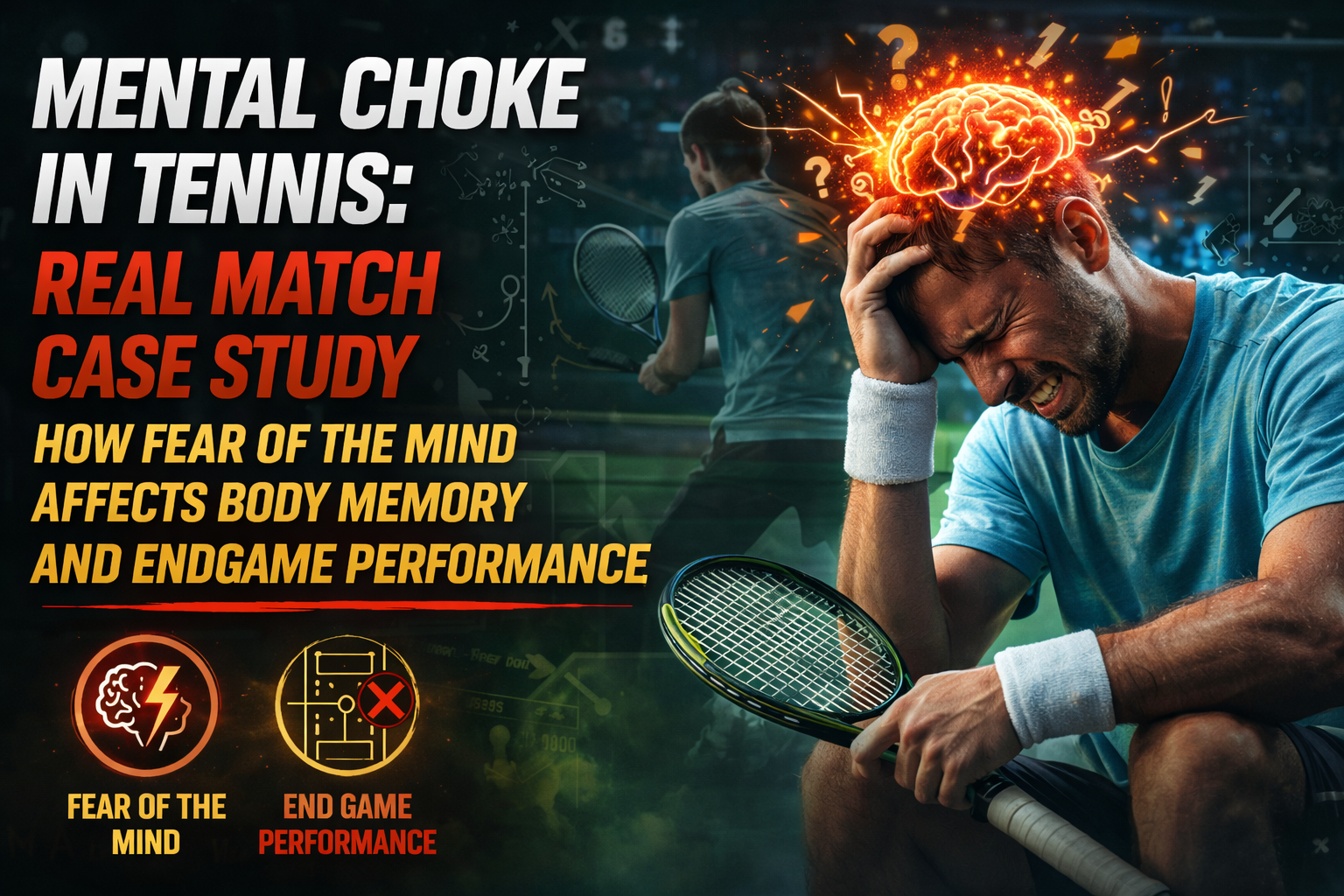
Introduction: When the Mind Takes Over the Body
Tennis is not just physical execution—it is deeply neurological.
In high-pressure moments, the brain can override trained muscle memory. This is what we call a mental choke.
The match between Alex Eala and Jelena Ostapenko provides a real-world example.
At 5–1, Eala was in control.
Moments later, execution dropped, rhythm disappeared, and the match slipped away.
This is not coincidence. This is brain-body interference under pressure.
The Science: How Fear Disrupts Body Memory
Under normal conditions:
- The brain relies on automatic motor programs
- Movements are fluid and unconscious
Under pressure:
- The brain shifts to conscious control
- Overthinking interrupts natural motion
This creates:
- Tight swings
- Late contact points
- Reduced timing accuracy
This phenomenon is known as “de-automation” of skills.
What Happened in the Match (Neuro-Tactical Breakdown)
Phase 1: Automatic Flow State
At 5–1, Eala was:
- Playing instinctively
- Executing patterns naturally
- Maintaining rhythm
Her body memory was in control.
Phase 2: Fear Activation
As the finish line approached:
- Pressure increased
- Outcome awareness entered
The brain shifted to:
- “Don’t miss”
- “Don’t lose this lead”
This triggered:
- Muscle tension
- Slower reactions
- Hesitation
Phase 3: Breakdown of Execution
Visible changes:
- Shorter shots
- Less aggressive swings
- Reduced depth and pace
This is not a loss of skill.
This is interference from fear overriding trained movement patterns.
Tactical Consequences of Mental Choke
When the mind interferes, tactics also collapse.
1. Loss of Pattern Recognition
- Player stops following structured play
- Decisions become reactive
2. Reduced Shot Commitment
- Half-committed strokes
- Increased unforced errors
3. Passive Court Positioning
- Moving backward instead of forward
- Giving control to opponent
4. Tempo Mismanagement
- Playing at opponent’s pace
- No reset between points
Why Ostapenko Benefited
Jelena Ostapenko applied constant pressure.
- Increased pace
- Took early ball timing
- Played aggressively without hesitation
Against a player experiencing mental interference:
- Aggression amplifies errors
- Speed removes recovery time
- Pressure compounds fear
Innovation Concept: Brain-Body Interference Model (BBIM)
This match introduces a powerful concept for your content platform.
Brain-Body Interference Model (BBIM)
Measures:
- Gap between trained skill and actual execution
- Timing breakdown under pressure
- Change in shot quality during key moments
Indicators:
- Drop in depth
- Increase in short balls
- Hesitation before contact
This can become a signature analysis system for cebutennis.com.
Game Adjustment: How to Prevent Mental Choke
1. Trust-Based Training
Train players to:
- Trust repetition
- Avoid technical thinking during matches
Focus on:
- Feel, not mechanics
2. Pressure Repetition Drills
Simulate:
- Serving at 5–4
- Break point situations
- Match point scenarios
Goal:
- Normalize pressure
3. External Focus Technique
Instead of thinking:
- “Fix my swing”
Think:
- “Hit deep crosscourt”
This keeps the brain focused on outcome, not mechanics.
4. Breathing Reset System
Between points:
- Slow breathing
- Lower heart rate
- Reset neural state
This helps restore automatic execution.
5. Pre-Defined Endgame Strategy
At closing moments:
- Increase clarity
- Reduce decision-making
Example:
- Commit to 1–2 patterns only
- Execute without hesitation
Game Adoption: Turning Weakness into Strength
For Alex Eala, this match is not failure—it is data.
Adoption strategy:
- Identify pressure triggers
- Build automatic responses
- Train closing scenarios repeatedly
This is how elite players evolve.
Key Insight: Fear Is Not the Enemy—Mismanagement Is
Fear is natural.
But in tennis:
- Fear must not control execution
- The body must remain dominant over the mind
The best players:
- Feel pressure
- But still trust their game
Final Analysis
Mental choke is not weakness.
It is a temporary disconnection between mind and body.
At 5–1:
- Skill was present
- Opportunity was real
But:
- Fear altered decisions
- Decisions altered execution
- Execution changed the result
Content Innovation Ideas for Your Site
- Brain vs Body Performance Analysis in Tennis
- Why Players Choke Under Pressure (Data Breakdown)
- Closing Performance Index (CPI)
- Real Match Case Studies (Eala, Gauff, Sabalenka)
Closing Thought
Tennis is not won by the best strokes.
It is won by the player who can trust those strokes when it matters most.