
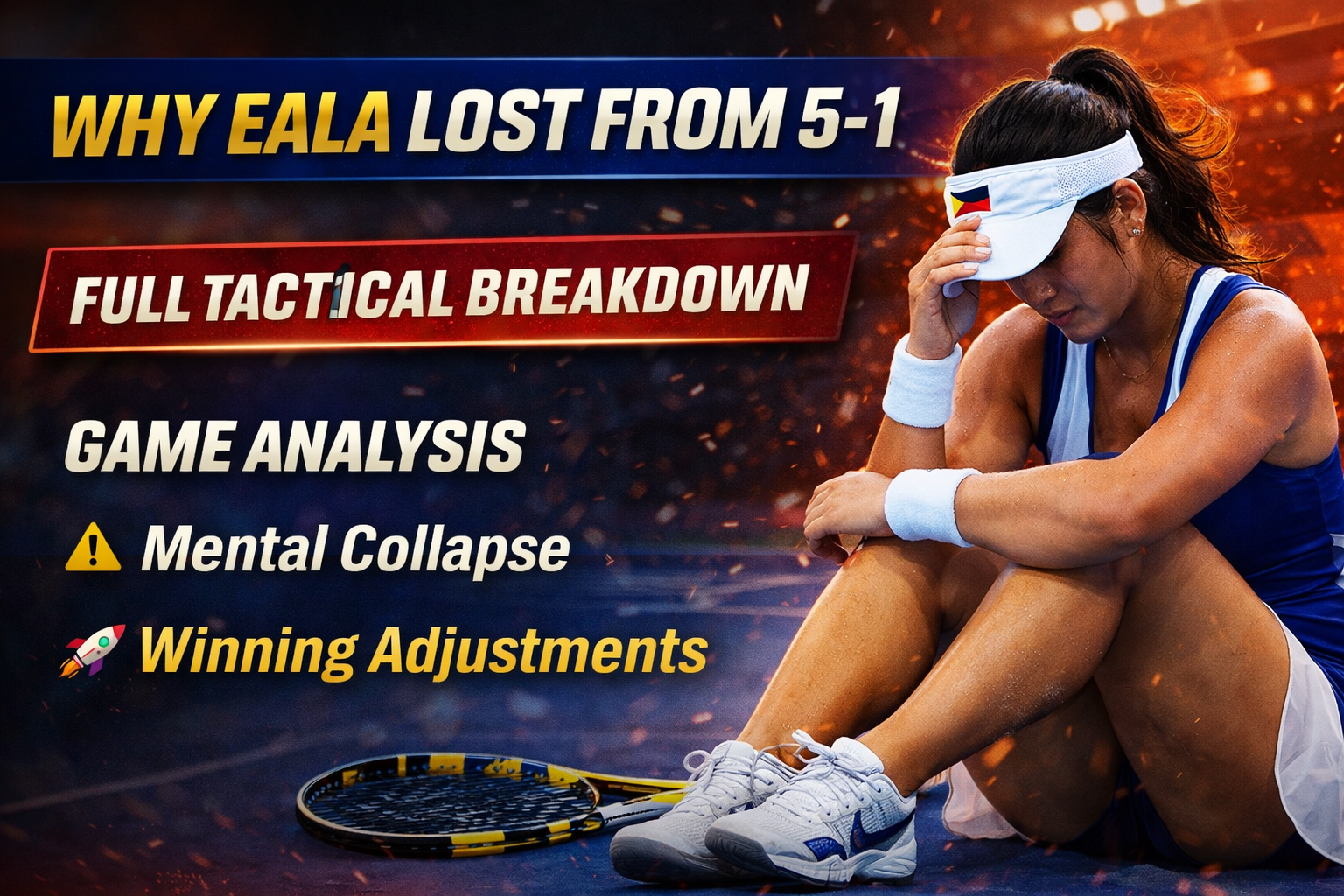
Match Context: One Step Away from a Decider
Alex Eala was in full control.
Leading 5–1 in the second set against Jelena Ostapenko, she was one game away from forcing a third set.
Then momentum shifted completely.
Ostapenko won six straight games to close the match.
The Turning Point: From Control to Collapse
At 5–1, Eala had:
- Momentum
- Tactical clarity
- Emotional advantage
But her game changed:
Before:
- Controlled aggression
- Deep, consistent shots
- Clear rally patterns
After:
- Safer shots
- Shorter balls
- Hesitation in key moments
This is where fear began to influence decision-making.
The Core Issue: Fear-Based Endgame
This was not just technical—it was mental.
Fear in tennis affects execution in subtle but critical ways:
- Reduced swing commitment
- Slower decision-making
- Playing not to lose instead of playing to win
At 5–1, the mindset likely shifted from:
- Finish the set
to:
- Protect the lead
That shift alone can change the entire outcome.
Tactical Breakdown: What Went Wrong
1. Loss of Tempo Control
Eala allowed the pace of the match to increase.
Ostapenko thrives in fast exchanges and early ball striking.
Missing adjustment:
- Slow down between points
- Reset rhythm and breathing
2. No Pattern Discipline
Earlier success came from structured rally construction.
Under pressure:
- Patterns disappeared
- Shot selection became inconsistent
Top players rely on:
- 1–2 trusted patterns under pressure
- Repetition instead of improvisation
3. Playing Into Opponent Strength
Ostapenko’s strengths:
- Flat hitting
- Early timing
- Aggressive baseline play
Eala continued:
- Neutral rallies
- Baseline exchanges
Correct adjustment:
- Add height and spin
- Use variation (slice, high topspin)
- Disrupt timing
4. No Closing Strategy
Closing a set requires a different approach.
Eala maintained the same style instead of shifting gears.
Effective closing requires:
- Shorter points
- Early aggression
- Clear intent to finish
Why Ostapenko Took Control
Jelena Ostapenko made a decisive shift:
- Increased aggression
- Took the ball earlier
- Accepted higher risk
This forced Eala into defensive positions and increased pressure with every point.
Innovation Concept: Fear Index in Tennis
This match highlights a key performance metric opportunity.
Fear Index (FI) can measure:
- Drop in shot aggression
- Increase in passive play
- Error patterns under pressure
- Change in rally dynamics
Eala’s performance at 5–1 shows a clear spike in hesitation and reduced control.
This can be developed into a unique analysis tool for match breakdown content.
Game Adoption: How Eala Can Improve
Pressure Simulation Training
Practice serving for sets repeatedly under simulated pressure conditions.
Pre-Defined Closing Patterns
Use automatic patterns such as:
- Wide serve followed by open-court finish
- Heavy topspin to force short ball, then attack
Mental Reset Routine
Between points:
- Controlled breathing
- Focus cue word
- Clear visualization of next play
Mindset Adjustment
Shift from:
- Protecting the lead
to:
- Finishing the match
Top players increase aggression at the finish instead of becoming passive.
Key Lesson: Matches Are Won at Critical Moments
This match shows that overall performance is not enough.
Winning depends on:
- Execution under pressure
- Tactical adjustment
- Mental clarity in key moments
Alex Eala demonstrated the ability to compete at a high level.
The next step is learning how to close.
Final Analysis
The difference between winning and losing at 5–1 is not skill level.
It is:
- Decision-making under pressure
- Tactical flexibility
- Mental strength
Against a player like Jelena Ostapenko, even a small drop in intensity or clarity leads to immediate consequences.
This match is not just a loss—it is a blueprint for improvement.