
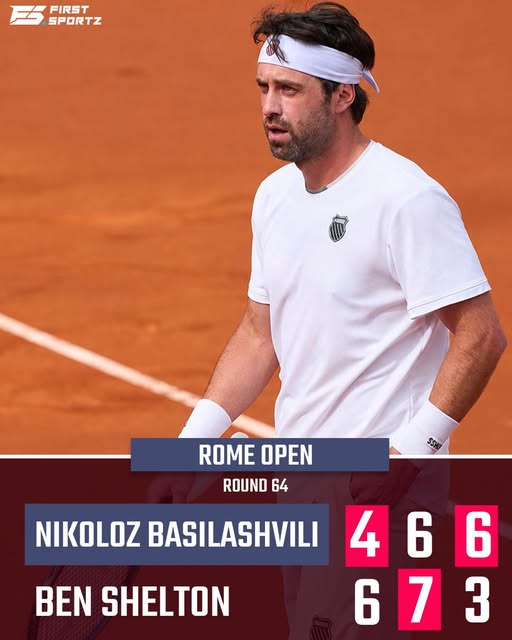
When Nikoloz Basilashvili walked off the court after defeating Ben Shelton in a brutal three-set Rome battle, the scoreline told only part of the story.
4-6, 7-6, 6-3.
On paper, it looked like a normal comeback victory.
But inside the match, this became a fascinating war between two explosive power systems:
- Shelton’s athletic left-handed aggression,
- against Basilashvili’s fearless flat-ball acceleration.
The match evolved into something much deeper than shotmaking.
It became:
- a psychological endurance test,
- a tactical adjustment battle,
- and a demonstration of how emotional control can slowly shift momentum in elite ATP competition.
After losing the first set and surviving a tense second-set tiebreak, Basilashvili eventually discovered something critical:
he stopped trying to overpower the match emotionally.
Instead, he began organizing chaos.
And once that happened, Shelton’s explosive rhythm slowly started breaking apart.
From an ATP coaching perspective, this match became one of the most interesting tactical battles of the tournament’s early rounds.
Because it showed how experience, emotional patience, and point construction can eventually neutralize raw athletic firepower.
The Opening Set: Shelton’s Explosive Tempo
Early in the match, Shelton controlled emotional momentum beautifully.
The young American immediately imposed:
- aggressive serving,
- explosive first-strike forehands,
- and emotional intensity.
That combination created pressure on Basilashvili quickly.
Shelton’s game style is built around attacking time.
His left-handed serve naturally drags opponents wide, opening massive forehand space immediately afterward. Once he gets forehand control early, his athleticism allows him to dictate rallies aggressively.
In the opening set, Basilashvili struggled with several issues:
- rushed return positioning,
- inconsistent depth,
- and unstable rally patience.
Instead of constructing points carefully, he often attempted low-percentage acceleration too early.
That fed directly into Shelton’s preferred rhythm:
fast, emotional, explosive tennis.
The result?
Shelton captured the first set 6-4.
Why Ben Shelton Is So Dangerous
From an ATP coaching perspective, Shelton presents one of the hardest modern matchups physically.
Why?
Because he combines:
- left-handed geometry,
- elite athletic explosiveness,
- heavy serve pace,
- emotional energy,
- and fearless acceleration.
Many players struggle because Shelton does not merely hit hard.
He injects emotional speed into matches.
Everything feels fast:
- movement,
- reactions,
- point tempo,
- and crowd energy.
Against emotionally reactive opponents, this becomes dangerous quickly.
Early in Rome, Basilashvili looked slightly trapped by Shelton’s emotional pace.
The Turning Point: Basilashvili Slowed the Match Mentally
The most important adjustment Basilashvili made was psychological.
Not technical.
Psychological.
After losing the first set and falling behind emotionally, he stopped trying to match Shelton’s explosive emotional energy directly.
Instead, he began:
- slowing between points,
- organizing breathing,
- resetting posture,
- and controlling tempo internally.
This matters enormously.
Young explosive players often feed off emotional chaos.
Veterans survive by reducing chaos.
Basilashvili gradually forced the match into more structured exchanges instead of emotional firefights constantly.
That subtle shift changed momentum slowly.
The Return Position Adjustment Was Huge
One of the smartest tactical changes Basilashvili made involved return positioning.
Early:
- Shelton’s lefty serve pushed him too far wide,
- creating immediate defensive pressure.
Later:
- Basilashvili adjusted slightly deeper,
- giving himself more reaction time,
- and stabilizing return contact quality.
This reduced Shelton’s free first-ball aggression significantly.
Many fans underestimate this adjustment.
But against huge servers, one extra half-second changes everything.
Once Basilashvili started neutralizing returns better, rallies became more playable.
And playable rallies favored his experience.
The Forehand Became More Disciplined
At his best, Basilashvili owns one of the flattest and most dangerous forehands on tour.
But earlier in the match, he forced acceleration recklessly.
This created:
- rushed misses,
- short momentum swings,
- and emotional frustration.
During the second set, his forehand changed subtly:
- more shape,
- better spacing,
- and smarter timing selection.
Instead of trying to finish immediately, he started building pressure gradually before final acceleration.
That tactical patience became critical.
Against athletic defenders like Shelton, one-shot tennis rarely works consistently.
Pressure must accumulate first.
Basilashvili eventually understood this perfectly.
The Second Set Tiebreak Was Pure Mental Warfare
The tiebreak became the emotional center of the match.
Both players understood its importance.
If Shelton won:
the match likely ends quickly.
If Basilashvili survives:
momentum shifts completely.
This is where experience became visible.
Shelton still played aggressively, but small signs of emotional impatience began appearing:
- slightly rushed forehands,
- overforced acceleration,
- and occasional shot-selection gambling.
Meanwhile Basilashvili became calmer.
Not passive.
Calmer.
That difference matters enormously in tiebreaks.
Elite ATP coaches constantly teach:
“Controlled aggression wins pressure moments.”
Basilashvili embodied that concept beautifully during the breaker.
When he captured the second set, the emotional balance of the match changed instantly.
Shelton’s Energy Drop in the Third Set
Young explosive players often face one major challenge:
emotional energy management.
Shelton invests enormous intensity into every point.
That creates excitement and pressure —
but it also burns emotional fuel quickly.
After losing the tiebreak, Shelton’s emotional explosiveness dropped slightly.
Not dramatically.
Slightly.
At ATP level, slight changes become huge.
Suddenly:
- footwork slowed marginally,
- recovery steps became less sharp,
- and forehand timing became inconsistent.
Basilashvili sensed this immediately.
Experienced players recognize emotional fatigue quickly.
And he attacked it.
Basilashvili’s Backhand Became the Stabilizer
One underrated element in the comeback was Basilashvili’s backhand discipline.
His two-handed backhand:
- absorbed pace well,
- redirected crosscourt pressure,
- and stabilized neutral exchanges.
This became critical against Shelton’s lefty patterns.
Instead of panicking against heavy forehand attacks, Basilashvili increasingly used his backhand to:
- redirect pace,
- slow emotional momentum,
- and reset court balance.
This frustrated Shelton gradually because immediate forehand domination became harder.
Why Flat Ball Striking Hurt Shelton Eventually
Shelton’s athleticism thrives against players who give height and rhythm.
Basilashvili eventually did the opposite.
His flatter acceleration:
- rushed Shelton’s preparation,
- reduced reaction windows,
- and forced uncomfortable contact points.
Flat hitters become dangerous on clay when they maintain depth consistently.
Late in the match, Basilashvili’s depth control improved dramatically.
Now Shelton had less time to unleash explosive offense comfortably.
That was a huge tactical victory.
The Mental Difference Between Young Fire and Veteran Survival
This match beautifully illustrated a classic ATP dynamic:
young emotional fire versus veteran emotional survival.
Shelton attacked emotionally.
Basilashvili adapted emotionally.
In early stages, Shelton’s fire dominated.
Later, Basilashvili’s experience organized the chaos better.
This is why veteran players remain dangerous despite rankings or inconsistency.
They understand momentum management.
Young players often try to win points.
Veterans often try to control emotional patterns.
That difference appeared clearly in Rome.
What Basilashvili Did Brilliantly in the Third Set
The final set showcased several elite adjustments:
Better Rally Tolerance
He stopped overforcing early.
This allowed cleaner opportunities later in rallies.
Improved Court Positioning
He stepped slightly closer inside the baseline during neutral exchanges.
This robbed Shelton of reaction time.
Smarter Forehand Selection
Instead of permanent maximum acceleration, he chose moments carefully.
That increased efficiency dramatically.
Emotional Neutrality
Perhaps most importantly:
he stopped emotionally reacting after mistakes.
That calmness stabilized his shotmaking.
Why Shelton Still Remains Dangerous
Despite the loss, Shelton showed why he remains one of the most exciting young players in tennis.
His strengths remain elite:
- explosive serve,
- athletic movement,
- emotional fearlessness,
- and huge forehand acceleration.
Very few players can inject physical intensity into matches as quickly as Shelton.
But this match also highlighted his next developmental challenge:
emotional pacing.
At the highest level, constant emotional explosiveness can become exhausting over long matches.
The next evolution of Shelton’s game may involve:
- calmer energy management,
- smarter point construction,
- and emotional efficiency.
The Hidden Importance of Breathing and Tempo
One fascinating detail from ATP coaching philosophy involves breathing control.
Veteran players often regulate breathing intentionally between points to:
- reduce emotional spikes,
- improve clarity,
- and reset tension.
Basilashvili appeared to improve this gradually after the first set.
That matters.
Controlled breathing:
- stabilizes movement,
- improves timing,
- and slows emotional panic.
Tennis at elite level is deeply connected to nervous system regulation.
This match showed that beautifully.
Why Clay Court Tennis Exposed Everything
Clay courts magnify emotional and tactical weaknesses.
Because points last longer:
- impatience gets punished,
- positioning matters more,
- and emotional endurance becomes critical.
On faster hard courts, Shelton’s explosive patterns may have overwhelmed Basilashvili earlier.
But clay rewarded:
- patience,
- rally discipline,
- and recovery positioning.
That allowed Basilashvili time to solve problems gradually.
Lessons Young Players Should Learn
This match offers important lessons for younger athletes.
Winning tennis is not only about:
- power,
- speed,
- or highlight shots.
It also requires:
- emotional adaptation,
- tactical adjustment,
- breathing control,
- and point construction intelligence.
Basilashvili did not suddenly become physically stronger during the match.
He became emotionally clearer.
That clarity changed everything.
The Veteran Mindset Matters
One reason older ATP players remain dangerous is because they trust ugly tennis sometimes.
Young players often panic when matches become messy emotionally.
Veterans survive ugly moments.
Basilashvili accepted discomfort instead of emotionally collapsing after the first-set loss.
That survival mindset became the foundation of the comeback.
Final Thoughts: Basilashvili Won the Mental Chess Match
Nikoloz Basilashvili did not defeat Ben Shelton simply through harder hitting.
He won through:
- emotional adaptation,
- tactical patience,
- smarter return positioning,
- and organized aggression.
After losing the opening set and surviving a brutal tiebreak, he slowly transformed the emotional structure of the match.
Shelton’s explosive fire remained dangerous throughout.
But Basilashvili eventually reduced the chaos and controlled the rhythm better.
That is high-level ATP survival.
The match reminded tennis fans of something important:
experience still matters enormously in professional tennis.
Because when momentum becomes unstable…
when pressure starts rising…
when emotional intensity explodes…
the player who stays mentally organized often survives.
And in Rome, Nikoloz Basilashvili survived brilliantly.