
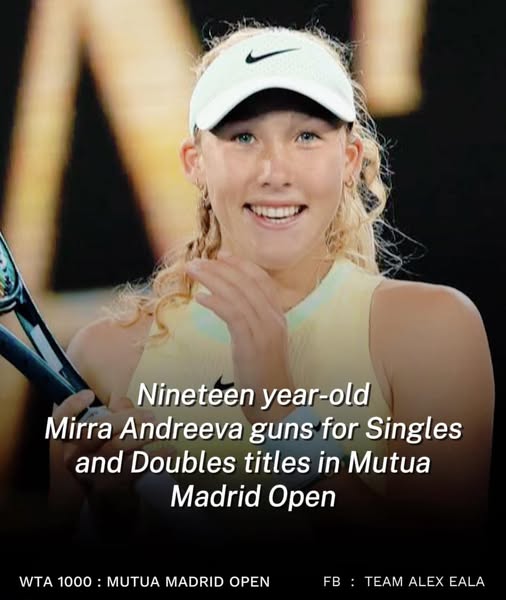
At just 19 years old, Mirra Andreeva is stepping into a moment that defines careers—not just seasons. The stage is the Mutua Madrid Open, one of the most physically demanding and tactically complex clay-court events in the world. The mission is rare: win both singles and doubles titles in the same week.
This is not just about lifting trophies. This is about vision, belief, and execution under pressure. As a USA-based tennis coach, I’ll say this clearly—what Andreeva is attempting separates talent from legacy. Dreaming is easy. Taking full, relentless action is where greatness is forged.
Today, she faces Marta Kostyuk, World No. 23, in the singles final. And tomorrow, she returns to center court alongside Diana Shnaider in the doubles final against the experienced pairing of Katerina Siniakova and Taylor Townsend.
If she completes the sweep, it will be her first double-title achievement at a single tournament—and a signal to the entire tennis world: a new era is arriving.
The Mindset of a Champion at 19
Let’s start with something most fans overlook: mindset maturity. At 19, players typically fluctuate between brilliance and inconsistency. They’re still learning how to manage expectations, crowd energy, and internal pressure.
Andreeva is different.
She competes with clarity. Her decision-making under stress is not reactive—it’s intentional. That’s a rare quality even among top-10 players. Watching her matches this week, what stands out is her ability to stay within patterns that win points, rather than chasing highlight shots.
From a coaching standpoint, this tells me she understands three key principles:
- Point construction over emotion
- Discipline over impulse
- Process over outcome
That’s what allows a young player to survive deep into tournaments—especially on clay, where patience is tested every rally.
Tactical Breakdown: Andreeva vs. Kostyuk
Facing Marta Kostyuk is no easy task. Kostyuk brings explosive baseline power, early ball striking, and the ability to redirect pace aggressively.
So how does Andreeva approach this matchup?
1. Neutralizing Early Ball Striking
Kostyuk thrives when she takes the ball early and dictates. Andreeva must disrupt timing by:
- Mixing heavy topspin with flatter drives
- Changing height over the net
- Using crosscourt angles to push Kostyuk wide
This forces Kostyuk out of her strike zone and into defensive positioning.
2. Extending Rallies Strategically
On clay, longer rallies favor the player with better patience and shot tolerance. That’s Andreeva’s strength.
Expect her to:
- Build points through 6–10 shot exchanges
- Target backhand stability zones
- Wait for high-percentage finishing opportunities
3. Serve Placement Over Power
Andreeva doesn’t rely on raw serving power. Instead, she uses:
- Wide serves to open the court
- Body serves to jam rhythm
- Precise second-serve placement
Against a returner like Kostyuk, placement matters more than speed.
The Physical Challenge of a Double Run
Let’s be real—playing both singles and doubles deep into a WTA 1000 event is brutal.
Clay courts demand:
- Longer rallies
- Greater lateral movement
- Higher endurance levels
By the time a player reaches both finals, fatigue becomes a silent opponent.
Andreeva’s ability to manage this comes down to:
Recovery Discipline
- Ice baths
- Proper nutrition
- Sleep optimization
Energy Management in Matches
- Shortening points when possible
- Avoiding unnecessary physical exchanges
- Smart shot selection under pressure
Emotional Control
Fatigue amplifies frustration. Champions stay composed.
This is where Andreeva’s maturity shines again. She doesn’t panic when tired—she simplifies.
Doubles Final: A Different Battlefield
Partnering with Diana Shnaider, Andreeva enters a completely different tactical environment.
Doubles is not just singles with two players—it’s a separate sport.
Their opponents, Katerina Siniakova and Taylor Townsend, are one of the most dangerous combinations on tour:
- Siniakova: elite net instincts and positioning
- Townsend: lefty serve and aggressive net play
Keys for Andreeva/Shnaider
1. First Serve Percentage
Doubles punishes weak second serves immediately.
2. Net Positioning
They must:
- Close the net decisively
- Cut off angles early
- Communicate constantly
3. Return Strategy
Against Townsend’s lefty serve, positioning becomes critical:
- Anticipate wide serves on the ad side
- Block returns low to force upward volleys
The Rare Double: Why It Matters
Winning both singles and doubles titles in one tournament is rare—especially at a high-level event like the Mutua Madrid Open.
Why?
Because it demands:
- Physical endurance across multiple match formats
- Tactical adaptability between singles and doubles
- Mental resilience under continuous pressure
This isn’t just about talent. It’s about capacity—the ability to sustain high performance across different demands.
If Andreeva completes this sweep, she joins a select group of players who have proven they can dominate across disciplines.
Technical Strengths Behind Andreeva’s Rise
Let’s break down her game from a coaching lens:
1. Backhand Stability
Her backhand is one of her most reliable weapons:
- Consistent depth
- Minimal unforced errors
- Ability to redirect pace
2. Court Awareness
She reads the game exceptionally well:
- Anticipates opponent patterns
- Adjusts positioning mid-rally
- Recognizes scoring moments
3. Shot Selection IQ
Young players often overhit. Andreeva doesn’t.
She chooses:
- High-percentage targets
- Smart transitions to the net
- Controlled aggression
Areas Still Developing
No player is complete at 19—even one as advanced as Andreeva.
Serve Power
While placement is excellent, adding more pace will:
- Create free points
- Shorten service games
- Reduce physical load
Net Confidence in Singles
She’s improving, but more aggressive net play could:
- Finish points earlier
- Apply additional pressure
- Expand tactical options
Handling Big Moments
She’s composed—but finals are different. Managing:
- Break points
- Momentum swings
- Crowd energy
…will define whether she wins today.
The Psychological Edge: Dream + Action
Let’s go back to the core theme:
Dreams are nothing without action.
Andreeva represents a rare blend:
- She believes in her ceiling
- She backs it up with daily execution
Too many players talk about goals. Few commit to the grind required to achieve them.
What sets her apart is:
- Consistency in preparation
- Willingness to stay uncomfortable
- Focus on improvement, not validation
That’s the blueprint every aspiring player should study.
What This Means for Women’s Tennis
The rise of Mirra Andreeva signals a shift.
We are entering a generation where:
- Tactical intelligence is accelerating
- Physical conditioning is improving earlier
- Young players are mentally sharper
If she wins both titles, it’s not just a personal milestone—it’s a statement:
The future is already competing in the present.
Match Prediction (Coach’s Perspective)
Singles Final
- If Andreeva controls rally lengthe and neutralizes Kostyuk’s early aggression → Andreeva wins in 2 tight sets
- If Kostyuk dictates with first-strike tennis → match becomes unpredictable
Doubles Final
- Experience favors Siniakova/Townsend
- Momentum and chemistry favor Andreeva/Shnaider
If Andreeva manages energy well, they have a real shot—but this will likely go to a deciding set.
Final Thought: This Is Bigger Than a Trophy
Moments like this define careers—not because of the result, but because of what they reveal.
At 19, Andreeva is showing:
- She belongs on the biggest stages
- She can handle elite pressure
- She is willing to chase greatness fully
Whether she completes the double or not, one thing is cleare:
She is no longer a rising star. She is a contendeer.
And if she lifts both trophies at the Mutua Madrid Open, the message to the tennis world is simple—