
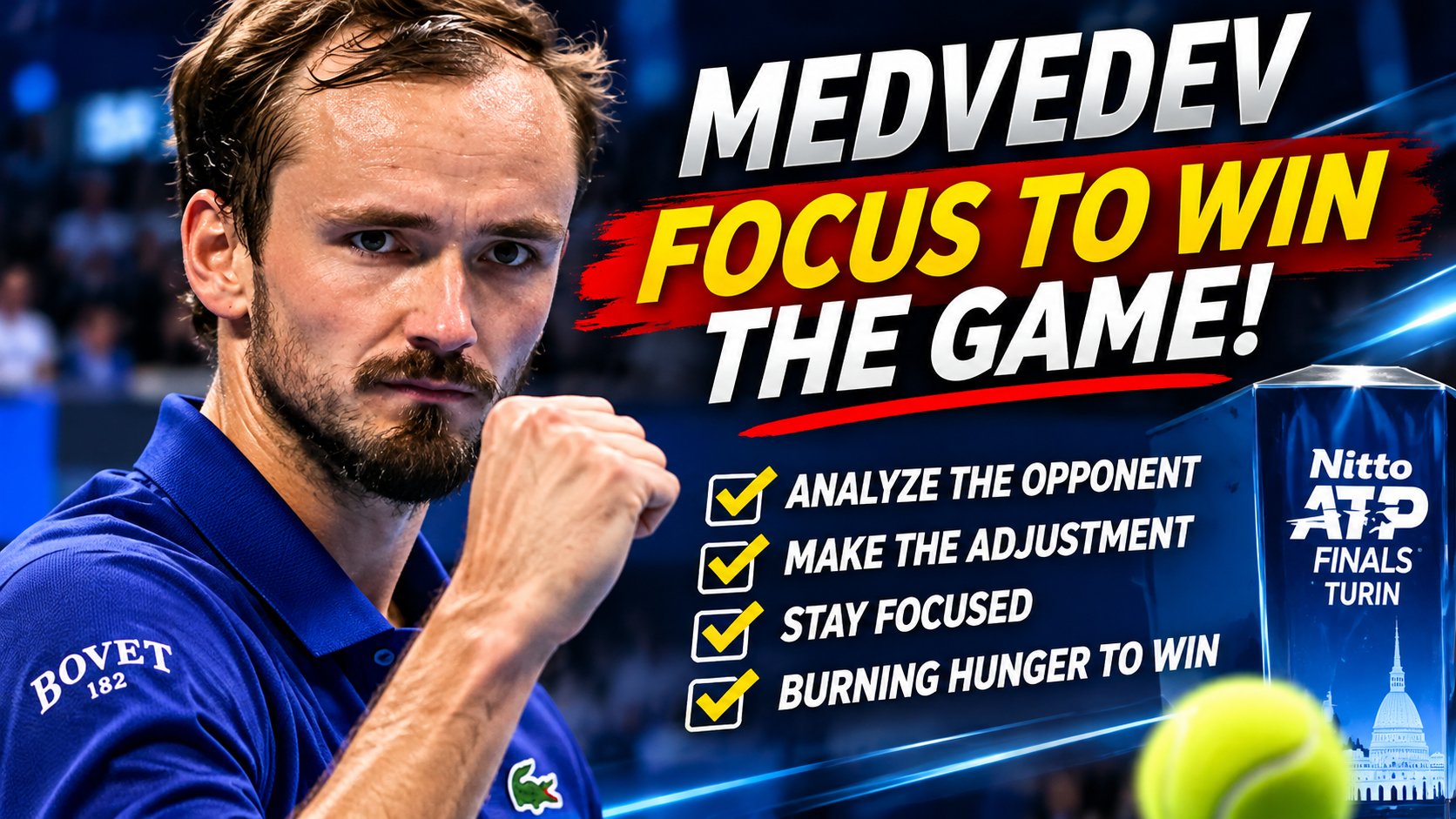
Daniil Medvedev defeats Flavio Cobolli 7–6, 6–3 in straight sets at the ATP Finals.
Sometimes winning a tennis match is not about producing the most spectacular shots. It is about controlling emotions, understanding the opponent, making intelligent adjustments, and maintaining concentration when the pressure becomes intense.
Daniil Medvedev delivered an impressive performance against Flavio Cobolli in Turin, winning in straight sets. His victory demonstrated the importance of mental discipline, tactical awareness, and the ability to remain composed in a demanding competitive environment.
The crowd may have been loud, but Medvedev's concentration remained louder.
1. The Burning Hunger to Win
Champions need more than technical ability. They need an internal hunger that pushes them to compete even when the match becomes uncomfortable.
Medvedev is known for his unconventional playing style, exceptional court coverage, deep baseline positioning, and ability to disrupt an opponent's rhythm.
His competitive mentality is built around one important principle: stay in the match, understand the situation, and find a way to win.
The burning hunger to compete is what separates simply participating from fighting for every opportunity.
2. First-Set Analysis: Winning the Important Moments
The opening set finished 7–6, demonstrating how closely contested the first part of the match was.
Against a younger and ambitious opponent like Cobolli, Medvedev needed patience and discipline.
A tight first set can become a mental battle. Players must avoid becoming frustrated when their opponent refuses to surrender easy points.
Medvedev's experience in high-pressure situations helped him navigate the opening set.
The lesson: You do not need to dominate every game. You need to perform when the most important opportunities arrive.
3. Tactical Adjustments: Understanding the Opponent
One of Medvedev's greatest strengths is his ability to change the rhythm of a match.
He does not always rely on overwhelming power. Instead, he uses positioning, depth, timing, and consistency to make opponents uncomfortable.
Important tactical components include:
-
Deep baseline returns: Making it difficult for the opponent to attack comfortably.
-
Court positioning: Using his reach and movement to cover difficult angles.
-
Changing the rhythm: Mixing pace, direction, and depth to disrupt timing.
-
Patience in rallies: Waiting for the right opportunity instead of forcing unnecessary winners.
-
Strategic serving: Using placement and variation to protect service games.
These elements can gradually shift control toward Medvedev.
A great player does not simply repeat the same strategy throughout a match. He observes, evaluates, and adjusts.
4. Second Set: Turning Momentum Into Control
The second set finished 6–3 in Medvedev's favor.
After surviving the tight opening set, the challenge was to maintain intensity and prevent Cobolli from gaining momentum.
This is where mental discipline becomes extremely important.
Players sometimes relax after winning a difficult first set. Champions understand that the match is not finished until the final point.
Medvedev continued applying pressure and converted his advantage into a straight-sets victory.
Winning the first set creates an opportunity. Winning the second requires continued concentration.
5. The Mind Game: Focus Beyond the Noise
Playing in Turin means competing in front of a passionate tennis audience.
Crowd reactions, pressure, expectations, and emotional moments can influence a player's concentration.
However, elite competitors must learn to separate external distractions from their responsibilities on court.
The mental game involves:
-
Forgetting the previous point.
-
Preparing mentally before every serve.
-
Recognizing the opponent's patterns.
-
Staying calm after mistakes.
-
Maintaining confidence during difficult rallies.
-
Focusing on execution rather than the crowd.
Medvedev's composed approach illustrates the value of emotional control.
The crowd can influence the atmosphere, but the player must control the decisions.
6. What Developing Tennis Players Can Learn
Medvedev's performance offers valuable lessons for recreational and competitive tennis players.
Do not depend entirely on power. Develop consistency, court positioning, anticipation, and intelligent shot selection.
When an opponent changes tactics, do not stubbornly continue making the same mistakes.
Instead, ask yourself:
-
Is my opponent attacking my backhand?
-
Am I giving away too many short balls?
-
Should I change my return position?
-
Can I use more depth to push my opponent behind the baseline?
-
Am I becoming impatient during long rallies?
-
What adjustment can help me regain control?
These questions transform tennis from simply hitting the ball into actively thinking through the match.
7. Final Analysis: Great Champions Keep Adjusting
Medvedev's straight-sets victory over Cobolli is a reminder that championship tennis requires intelligence as much as physical ability.
The 7–6 opening set tested his patience. The 6–3 second set demonstrated his ability to maintain the advantage.
The biggest lesson is not simply about winning a match. It is about developing the mental strength to remain competitive when the situation becomes difficult.
Burning hunger. Great focus. Intelligent adjustments. Relentless execution.
A champion does not allow the atmosphere to control his game. He understands the challenge, studies his opponent, adapts his strategy, and continues fighting.
The best players are not always those who hit the hardest.
They are often the players who think faster, adjust smarter, and remain mentally strong when the match is on the line.
Silence the distractions. Trust your preparation. Make the adjustment. Finish the job.
Championship mentality is built through every difficult point, every setback, and every decision to keep fighting.