
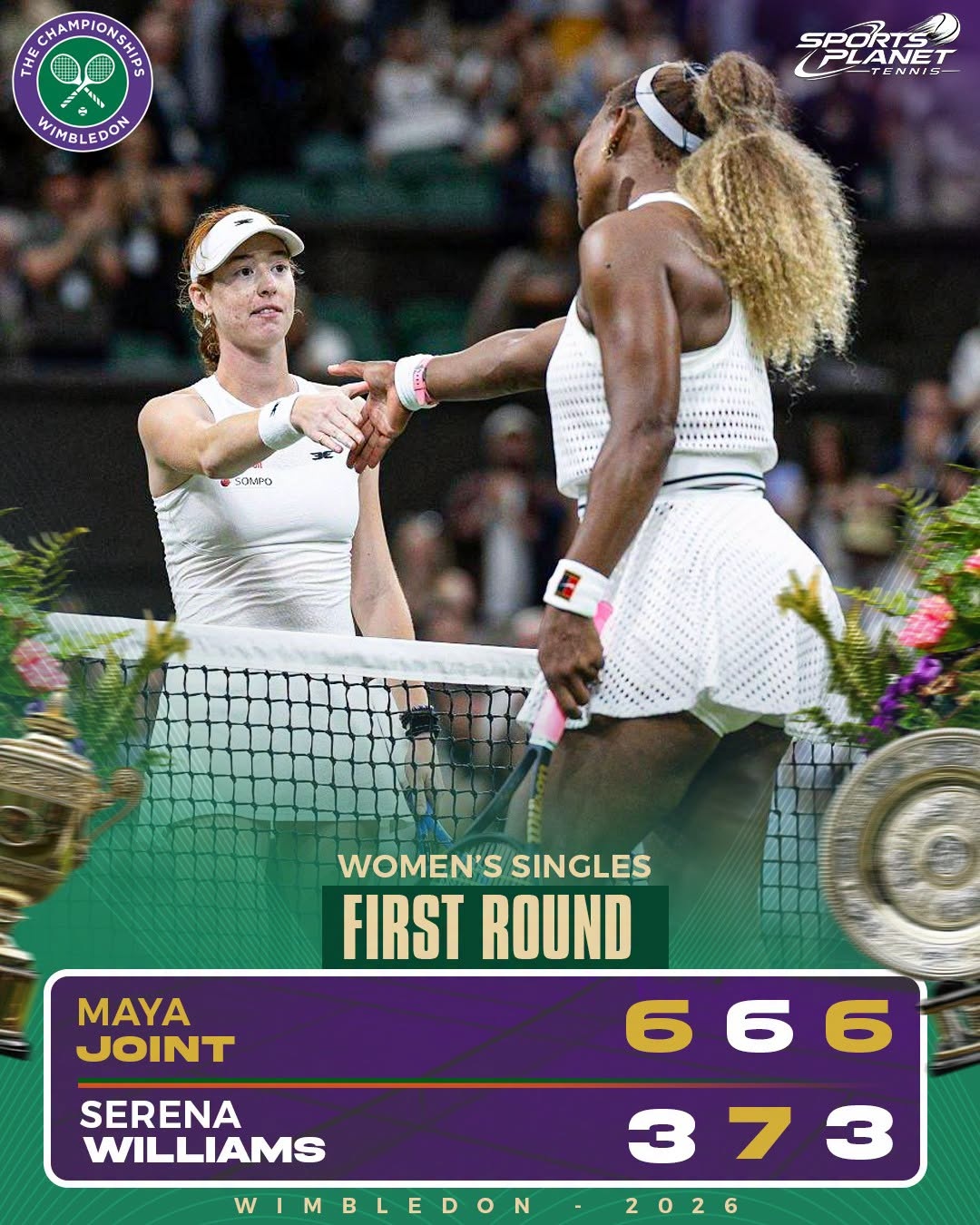
This match wasn't simply an upset. It felt like a symbolic passing of the torch between two generations separated by more than two decades. One player carried the history of the sport on her shoulders, while the other arrived carrying nothing except fearless belief. Centre Court witnessed more than a first-round match—it witnessed tennis standing at the intersection of legacy and the future.
As an ATP coach, I often tell young competitors that every generation eventually reaches a defining moment when potential transforms into reality. For Maya Joint, that moment arrived under the brightest lights tennis can offer. Facing a seven-time Wimbledon champion, twenty-three-time Grand Slam singles champion, and arguably the greatest competitor in women's tennis history could have overwhelmed almost any twenty-year-old. Instead, Joint embraced the challenge.
The scoreboard read 6-3, 6-7(6), 6-3, but those numbers only tell part of the story. They cannot fully describe the emotional weight of defeating Serena Williams on Centre Court, nor the discipline required to recover after losing a heartbreaking second-set tiebreak despite holding match point. Many young players would have allowed disappointment to become panic. Maya Joint reset mentally within minutes and reclaimed control of the deciding set. That emotional resilience was perhaps the most impressive aspect of her performance.
Every great champion eventually faces a younger opponent who refuses to be intimidated. Tennis history has repeated this pattern across generations. The sport evolves because the newcomers study the legends, absorb their lessons, and then develop their own identity. Maya Joint grew up watching Serena Williams dominate the biggest stages in tennis. Years later, she stood across the net from her childhood idol and discovered that admiration must end the moment the first ball is struck.
From the opening games, Joint demonstrated an Alpha mindset. Alpha tennis is not reckless aggression. It is controlled authority. It means dictating rallies with purpose, accepting pressure instead of avoiding it, and trusting preparation more than emotion.
Joint accomplished each of those objectives. She attacked second serves whenever opportunities appeared, stepped inside the baseline to shorten Serena's reaction time, and consistently redirected pace rather than merely defending. Her court positioning revealed remarkable maturity for a player still establishing herself on the WTA Tour.
Serena, meanwhile, reminded everyone why she remains one of the greatest competitors the sport has ever seen. Although she had not played singles in nearly four years, flashes of championship brilliance appeared throughout the match. Her first serve exceeded 120 mph, her trademark return pressure resurfaced during the second set, and she saved match point before forcing a deciding set. For stretches, Centre Court felt transported back to Serena's championship years.
That is what made Maya Joint's victory even more meaningful.
She did not defeat a passive legend simply making a ceremonial appearance.
She defeated a competitor who still believed she could win.
After Serena escaped the second-set tiebreak, momentum overwhelmingly favored the American icon. Centre Court erupted with belief. Millions watching around the world expected experience to overwhelm youth.
Instead, Maya Joint displayed elite emotional intelligence.
She slowed her breathing.
She reset between points.
She returned to the tactical patterns that had produced success in the opening set.
This is exactly how championship players behave.
The third set became a masterclass in emotional discipline. Rather than chasing spectacular winners, Joint trusted high-percentage patterns. She targeted Serena's movement, extended rallies when appropriate, and remained patient until opportunities emerged. Young players often believe confidence means hitting harder. Elite players understand confidence means making the correct decision repeatedly under pressure.
The statistics reflected this maturity. Joint finished with forty winners compared with Serena's twenty-six, illustrating that her aggression remained productive instead of reckless.
One of the most significant tactical differences involved recovery after attacking shots. Joint consistently anticipated Serena's likely responses and positioned herself early for the next ball. This allowed her to maintain offensive court position rather than retreating into defense.
Footwork often separates promising players from future champions.
Joint's movement throughout the match was exceptional.
Her split-step timing remained disciplined.
Her first explosive step consistently placed her in balanced hitting positions.
Her recovery toward the center remained efficient.
These details rarely dominate highlight reels, yet they win Grand Slam matches.
Another impressive feature was her shot tolerance.
Against Serena Williams, there is constant temptation to finish rallies too early. Generations of opponents have attempted low-percentage winners simply because Serena's presence creates psychological urgency.
Joint refused that temptation.
She accepted neutral rallies.
She accepted physical exchanges.
She trusted that disciplined pressure would eventually produce openings.
That patience reflected outstanding coaching and remarkable competitive maturity.
From an American ATP coaching perspective, this performance illustrates the evolution of modern tennis. Today's young players grow up with advanced sports science, biomechanics, video analytics, nutrition, recovery systems, and mental-performance training integrated into their development. While legends like Serena revolutionized the sport through extraordinary athleticism and relentless competitiveness, today's generation combines those qualities with increasingly sophisticated tactical preparation.
None of this diminishes Serena Williams' legacy.
Quite the opposite.
Legends create the standards that future generations chase.
Without Serena's influence, players like Maya Joint may never have developed into the competitors they are becoming today.
Every era produces its pioneers.
Every pioneer eventually inspires someone capable of continuing the journey.
This match symbolized that transition.
Perhaps the most touching moment came after the final point. Rather than celebrating wildly, Joint appeared overwhelmed by the magnitude of what she had accomplished. She later admitted she had dreamed of facing Serena since childhood and struggled to process the experience. That reaction reminded everyone that respect and fierce competition can coexist.
For Serena Williams, defeat does not erase greatness.
She remains one of the most transformative athletes in sports history.
Seven Wimbledon singles titles.
Twenty-three Grand Slam singles championships.
Countless records.
An influence extending far beyond tennis.
Even in defeat, she demonstrated why champions command respect. Saving match point, extending the contest into three sets, and producing moments of brilliance after years away from singles competition reflected extraordinary competitive character.
If anything, this match enhanced Serena's legacy by showing that her fighting spirit never disappeared.
For Maya Joint, however, this victory changes everything.
Young players often search for one defining breakthrough that convinces both themselves and the tennis world they belong among elite competition.
This was that breakthrough.
Victories over legends provide more than ranking points.
They provide belief.
Belief changes preparation.
Preparation changes expectations.
Expectations change careers.
Looking ahead, Joint will now face another rising star, Alex Eala, in what promises to be one of the most exciting second-round matches at Wimbledon. That contest will feature two members of tennis's emerging generation attempting to establish themselves on one of the sport's grandest stages.
Whether Maya Joint ultimately wins Wimbledon this year remains unknown.
What is certain is that she has announced herself to the tennis world.
Champions are rarely created overnight.
They are revealed in moments when pressure reaches its highest level.
Facing Serena Williams on Centre Court represented the greatest pressure imaginable for a twenty-year-old competitor.
Maya Joint did not merely survive that moment.
She owned it.
The future of women's tennis will feature remarkable talents from around the world, and Maya Joint has firmly placed her name among that conversation. Her performance combined technical excellence, tactical intelligence, physical resilience, and emotional composure—qualities that define Alpha competitors regardless of era.
Centre Court witnessed something larger than a first-round victory.
It witnessed one legend reminding the world why she remains unforgettable, while another star introduced herself with fearless conviction.
The scoreboard recorded a victory.
History recorded something even more significant.
A new Alpha had arrived, not by replacing Serena Williams' legacy, but by proving she was ready to build the next chapter of greatness upon the foundation that Serena helped create.