
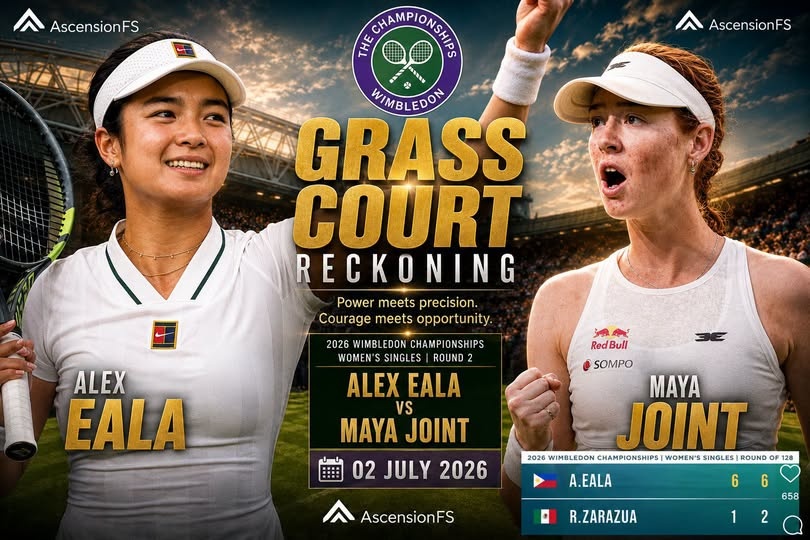
The Birth of a New Rivalry
Wimbledon has always been the stage where careers are transformed. Legends are born, champions discover themselves, and the next generation announces its arrival before a global audience.
The second-round clash between Maya Joint and Alex Eala carries all the ingredients of a future classic.
Only days ago, Maya Joint stunned the tennis world by defeating Serena Williams in one of the biggest victories of her young career. That victory instantly elevated her confidence and announced her arrival as one of the fastest-rising stars on the WTA Tour.
Standing across the net now is Alex Eala, the pride of the Philippines and one of the most intelligent young competitors in women's tennis.
From an ATP coaching perspective, this match is far more than a battle between two promising talents. It is a fascinating contest between two distinct playing identities. One player thrives by dictating rallies with aggressive first-strike tennis. The other excels by constructing points with patience, court awareness, and tactical variety.
The player who successfully imposes her preferred style will likely emerge victorious.
Two Rising Stars, Two Different Tennis Philosophies
Alex Eala has earned worldwide recognition through disciplined development, outstanding junior achievements, and steady improvement against elite competition.
Her greatest strengths include:
- Excellent anticipation
- Intelligent point construction
- Heavy left-handed topspin
- Court coverage
- Mental resilience
She rarely gives away free points.
She forces opponents to earn every winner.
Maya Joint represents another evolution of modern women's tennis.
Her strengths are different.
She prefers taking time away from opponents.
She attacks earlier.
She stands closer to the baseline.
She looks to finish points before defensive players become comfortable.
These contrasting philosophies make this matchup extremely compelling.
Why Maya Joint Enters With Momentum
Momentum is often underestimated.
Elite players understand that confidence affects everything.
Footwork becomes lighter.
Reaction time improves.
Shot commitment becomes stronger.
Decision-making becomes clearer.
Defeating Serena Williams was more than another victory.
It became proof that Maya belongs on tennis' biggest stage.
That belief changes a player psychologically.
Instead of wondering whether she can defeat elite opponents, she now expects to compete with them.
That confidence cannot be measured by statistics.
Yet it often decides Grand Slam matches.
The Alpha Mindset
As ATP coaches often explain, Alpha tennis is not about emotion.
It is about initiative.
Alpha competitors dictate.
They create pressure.
They refuse to become passive.
Maya Joint demonstrated this beautifully against Serena.
She consistently attacked second serves.
She stepped inside the baseline.
She redirected pace instead of absorbing it.
She trusted her preparation.
She accepted pressure.
These characteristics define modern attacking tennis.
Alex Eala's Greatest Weapon
Alex's greatest weapon is not one particular stroke.
It is her tennis intelligence.
She sees patterns exceptionally well.
She builds points patiently.
She recognizes opponent tendencies.
She rarely panics.
This allows her to defeat players with larger serves or greater raw power.
She understands that tennis is not won by hitting harder.
It is won by making better decisions.
Where Maya May Hold the Tactical Edge
From a coaching standpoint, Maya appears to have several potential advantages entering this match.
First Strike Tennis
Modern grass rewards players who attack first.
Maya naturally enjoys this style.
Early ball contact.
Flat acceleration.
Quick transitions.
Aggressive returns.
These qualities suit Wimbledon.
Taking Time Away
Alex prefers having enough time to organize rallies.
Maya excels at reducing available time.
Earlier contact.
Higher pace.
Shorter rallies.
Faster court positioning.
If Maya succeeds here, Alex may spend much of the match defending.
Confidence Under Pressure
Confidence often separates good players from dangerous players.
Maya enters this match believing she can defeat anyone.
That belief affects every service game.
Every return game.
Every break point.
Confidence creates freedom.
Freedom creates better execution.
Where Alex Can Turn the Match
This does not mean Alex lacks answers.
She possesses several tactical opportunities.
Extend Rallies
The longer rallies become, the greater Alex's chances.
She is one of the better point constructors among young players.
Long exchanges allow her to expose impatience.
Use Left-Handed Angles
Left-handed patterns remain one of tennis' most underrated advantages.
Wide serves.
Crosscourt forehands.
Sharp angle creation.
These patterns force right-handed opponents to constantly adjust.
Vary Pace
One mistake against aggressive opponents is supplying identical rhythm.
Alex can mix:
Heavy topspin.
Lower slices.
Moon balls.
Short angles.
Net approaches.
Variation can disrupt an attacking player's timing.
The Critical Tactical Question
Can Alex successfully slow Maya's offensive rhythm?
This is likely the single biggest tactical question entering the match.
If Maya controls rally speed, she gains a significant advantage.
If Alex controls rally structure, the match becomes much closer.
Return of Serve
This may become the deciding department.
Maya attacks second serves aggressively.
She looks immediately for offense.
Alex traditionally focuses more on neutralizing returns before building points.
Against Maya, neutral returns may not be enough.
Alex may need to attack earlier than usual.
Baseline Position
Another fascinating contrast.
Maya frequently stands on or inside the baseline.
Alex often begins slightly farther back to create reaction time.
On grass, surrendering court position can become dangerous.
The shorter bounce rewards early attackers.
Net Play
Who finishes more points at the net?
Likely Maya.
She transitions naturally after aggressive groundstrokes.
Alex certainly has capable volleys, but she traditionally prefers constructing points before approaching.
Physical Matchup
Both players move exceptionally well.
However, their movement styles differ.
Maya's movement emphasizes explosive first steps.
Alex excels at recovery movement and defensive coverage.
This difference influences rally patterns significantly.
Mental Battle
Grand Slam tennis is rarely won solely by technique.
Mental discipline determines outcomes.
If Maya wins the opening set, confidence may continue flowing from her Serena victory.
If Alex wins early, she can force Maya into questioning whether the emotional high has disappeared.
Momentum swings could become decisive.
What Each Player Must Avoid
Maya
Avoid rushing.
Avoid low-percentage winners.
Avoid becoming impatient.
Avoid emotional reactions after errors.
Alex
Avoid defending every rally.
Avoid allowing Maya to dictate pace.
Avoid predictable crosscourt exchanges.
Avoid passive second serves.
ATP Coaching Diagnosis
After studying both players' recent performances, several conclusions become clear.
Maya currently appears to possess more offensive momentum.
Her confidence level has likely reached the highest point of her career.
Her aggressive game naturally complements grass courts.
Alex remains one of the smartest tactical players of her generation.
However, against elite aggressive opponents, she sometimes benefits from making earlier adjustments in court positioning and shot selection. Whether she can adapt quickly enough during this match may be one of the deciding factors.
The first five or six games should reveal which tactical pattern is taking hold. If Maya consistently wins points inside the first four shots, she will likely control the match. If Alex extends rallies and changes pace effectively, she can make the contest much more competitive.
Coaching Keys to Victory
Maya Joint
- Dominate first-strike tennis.
- Attack second serves.
- Take the ball early.
- Maintain emotional composure after missed opportunities.
- Finish short balls decisively.
Alex Eala
- Raise first-serve percentage.
- Vary spin and pace.
- Use left-handed angles to open the court.
- Draw Maya into longer exchanges.
- Look for timely net approaches to break Maya's rhythm.
Predicted Match Outcome
Based on current form, confidence, and tactical fit for grass, Maya Joint appears to enter as a slight favorite.
The confidence gained from defeating Serena Williams could translate into more decisive shot-making and assertive court positioning. Her willingness to attack early and shorten points is well suited to Wimbledon.
Alex Eala has the tennis IQ and competitive resilience to challenge that approach. If she can extend rallies, vary the tempo, and make effective in-match adjustments, she has a realistic opportunity to shift momentum.
The margin between these players is unlikely to be large. Success will depend on execution under pressure rather than reputation.
Projected Score (opinion):
Maya Joint def. Alex Eala, 7-5, 6-4.
Final Thoughts
Regardless of the result, this match represents more than a place in the next round of Wimbledon. It showcases two young competitors who could become fixtures on the WTA Tour for years to come.
For Maya Joint, another victory would reinforce that her breakthrough against Serena Williams was not a one-match story but the beginning of sustained success.
For Alex Eala, a win would demonstrate her ability to solve one of the hottest players on tour through tactical intelligence and adaptability.
From an American ATP coaching perspective, this contest is not simply about power versus consistency. It is about who can impose her preferred style, recognize momentum shifts, and make the sharper adjustments as the match unfolds.
On grass, opportunities are brief, momentum changes quickly, and decisive choices often determine the outcome. The player who combines conviction with adaptability is most likely to leave Centre Court one step closer to a Wimbledon breakthrough.
Introduction
- Wimbledon Round 2
- Two of the brightest young stars
- Both represent the future of women's tennis
- Why this is much bigger than a second-round match
Chapter 1 – Maya Joint's Alpha Mindset
- Confidence after defeating Serena Williams
- Emotional control
- Aggressive court positioning
- Fearless decision making
Chapter 2 – Alex Eala's Strengths
- Excellent left-handed patterns
- Smart point construction
- Counterpunching ability
- Improved serve
- Competitive mentality
Chapter 3 – Why Maya May Hold the Tactical Edge
Discuss tactical reasons rather than guaranteed outcomes.
Examples:
- Higher first-strike tennis
- Bigger serve
- Earlier ball contact
- More aggressive return position
- Better transition to offense
- Stronger finishing ability inside the baseline
Chapter 4 – Where Maya Can Pressure Eala
Possible tactical targets:
- Attack second serve
- Rush Eala's forehand preparation
- Prevent Eala from extending rallies
- Constant pressure on return games
- Take time away
Chapter 5 – What Eala Must Change
Rather than saying she cannot adjust, explain what adjustments could improve her chances:
- Increase first-serve percentage
- Shorten points
- Step inside baseline more often
- Mix slice and topspin
- Vary return position
- Finish at the net more frequently
Chapter 6 – The Mental Battle
Momentum
Pressure
Confidence
Crowd influence
Grand Slam experience
Chapter 7 – ATP Coach Analysis
Explain:
Why players coming off career-defining wins often play with enormous confidence.
How defeating Serena Williams may free Maya mentally.
How confidence often translates into faster footwork and cleaner shot selection.
Chapter 8 – Tactical Keys
If Maya wins:
- Control first strike
- Dominate second serve
- Dictate tempo
- Finish points quickly
If Eala wins:
- Extend rallies
- Force extra shots
- Neutralize pace
- Make Maya uncomfortable physically
Prediction
Instead of:
Maya will destroy Eala.
A stronger coaching analysis would be:
Based on current form, momentum, and the confidence gained from defeating Serena Williams, Maya Joint appears to hold a slight tactical advantage entering this Wimbledon encounter. However, Alex Eala possesses the tennis IQ, left-handed variety, and defensive skills to change the match if she successfully disrupts Maya's aggressive rhythm and makes effective in-match adjustments.