Wimbledon 2026 Quarterfinal – Court One
Final Score
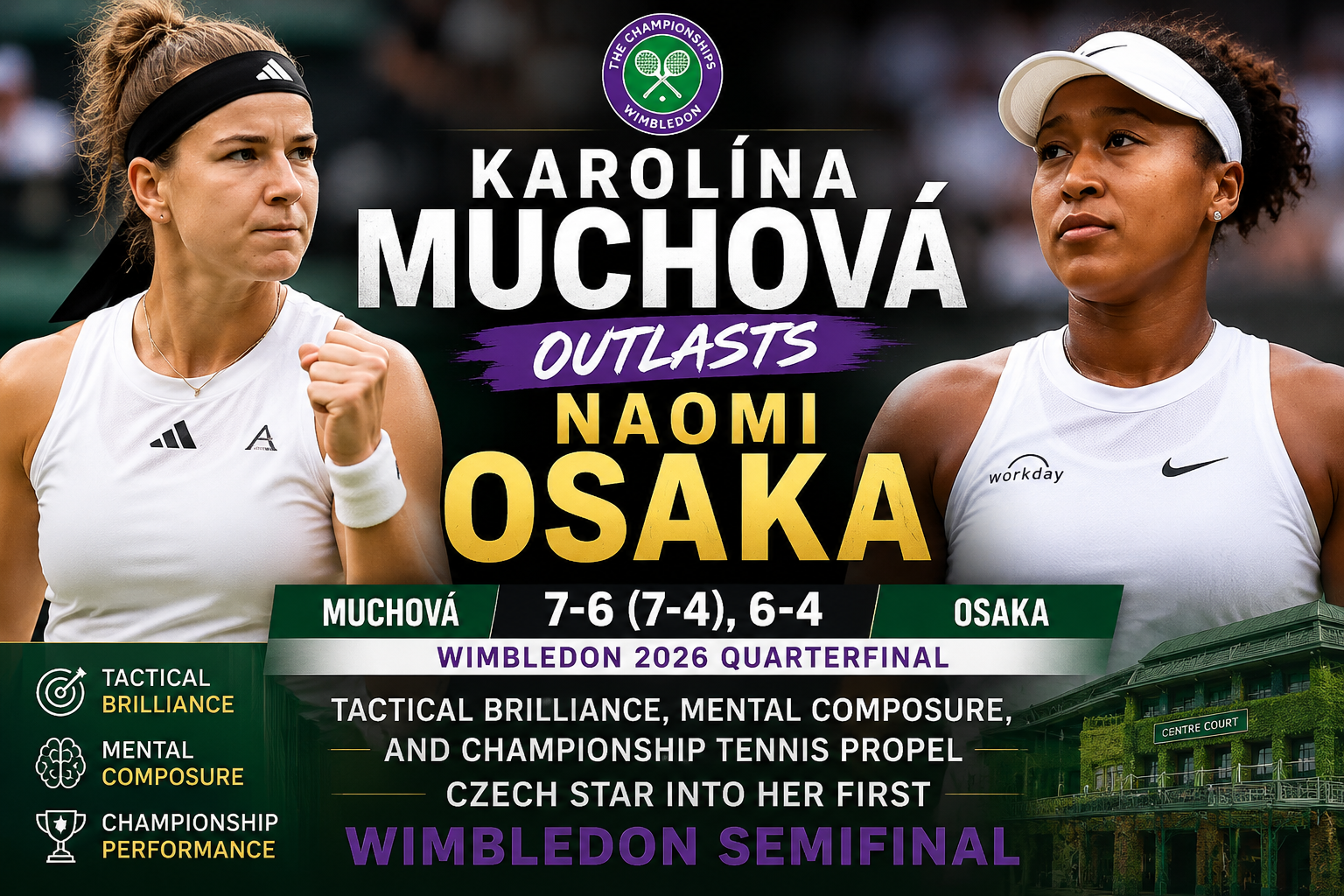
Karolína Muchová (10): 7–6 (7–4), 6–4
Naomi Osaka (14): 6–7 (4–7), 4–6
A Semifinal Earned Through Intelligence Rather Than Power
Wimbledon has always rewarded players who understand the unique demands of grass courts. While raw power can produce spectacular winners, intelligence, adaptability, and composure often decide the biggest matches.
That truth was on full display Tuesday afternoon as Karolína Muchová delivered one of the most tactically complete performances of the tournament to defeat four-time Grand Slam champion Naomi Osaka in straight sets, 7-6 (7-4), 6-4.
Although the scoreboard suggests a comfortable victory, the match itself was anything but routine.
For nearly two hours, the two stars engaged in a fascinating battle of contrasting styles—Osaka relying on explosive first-strike tennis while Muchová countered with creativity, variety, and exceptional court awareness.
By the end, it was Muchová's ability to solve problems under pressure that made the difference.
The victory sends the Czech star into her first Wimbledon semifinal, where she will face American seventh seed Coco Gauff.
The Story Before the First Serve
Naomi Osaka entered the quarterfinals enjoying one of her best grass-court tournaments in years.
Her serve had been dominant.
Her forehand had regained its explosive pace.
Her confidence appeared to grow with every round.
Across the net stood Karolína Muchová, one of the smartest tacticians on the WTA Tour.
Unlike Osaka, Muchová rarely overwhelms opponents with sheer power.
Instead, she wins by making opponents uncomfortable.
Her game is built around:
- changing pace
- disguising shots
- varying spin
- intelligent net approaches
- exceptional anticipation
It promised to be a fascinating chess match.
The contest delivered exactly that.
First Set: Neither Player Would Blink
From the opening games, both players immediately tested each other's strengths.
Osaka attacked first.
Muchová absorbed pressure.
Osaka looked to shorten rallies.
Muchová preferred extending points just enough to force difficult decisions.
The first four games featured multiple service breaks as both women searched for rhythm.
Once settled, the level of tennis rose dramatically.
Every hold required precision.
Every return game became an opportunity.
Neither player allowed momentum to last long.
Court One responded with appreciative applause after nearly every extended exchange.
ATP Expert Analysis
The opening set revealed two very different philosophies.
Naomi Osaka
Her objective was clear:
- attack immediately
- finish rallies early
- dominate with first serves
- dictate from the forehand wing
She attempted to keep rallies below five shots whenever possible.
Karolína Muchová
Her approach focused on:
- changing ball height
- mixing slice and topspin
- moving Osaka laterally
- preventing rhythm
Instead of matching Osaka's power, Muchová redirected it.
This proved to be the smarter long-term strategy.
The Tiebreak That Changed Everything
Neither player could establish separation throughout the opening set.
A tiebreak became inevitable.
Pressure immediately intensified.
Every point suddenly carried enormous weight.
The crowd grew noticeably quieter before each serve.
Muchová remained remarkably calm.
Rather than chasing spectacular winners, she repeatedly played high-percentage tennis.
Osaka, meanwhile, began pressing.
Several forehands sailed long.
Another found the net.
Muchová sensed the opening.
She patiently forced Osaka to hit one additional shot on nearly every rally.
Those extra balls proved decisive.
When Osaka's final forehand drifted beyond the baseline, Muchová captured the tiebreak 7-4.
It wasn't simply a set won.
It was a psychological victory.
Momentum Swings Toward Muchová
Losing a close tiebreak can be mentally exhausting.
The disappointment often lingers into the next set.
Osaka attempted to reset immediately.
She continued serving aggressively.
She searched for early winners.
But Muchová had already discovered the tactical blueprint.
Instead of increasing pace, she increased variation.
Grass rewards players who make opponents uncomfortable.
Muchová did exactly that.
Second Set: Pressure Slowly Built
Unlike the dramatic opening set, the second became a contest of patience.
Service games moved quickly.
Neither player created many opportunities.
Each woman understood the importance of protecting serve.
The scoreboard remained perfectly balanced.
1-1.
2-2.
3-3.
4-4.
The tension inside Court One continued building.
Everyone sensed that one service game might determine the match.
That prediction proved accurate.
The Defining Game
Serving at 4-4, Osaka suddenly experienced her most difficult service game.
Perhaps fatigue.
Perhaps pressure.
Perhaps simply the accumulation of difficult rallies.
Whatever the reason, tiny mistakes appeared.
A first serve narrowly missed.
Then another.
A double fault.
Another double fault.
Suddenly Muchová held break point.
Rather than forcing a spectacular return, she simply put another ball into play.
Osaka attempted an aggressive forehand.
It landed inches wide.
The break belonged to Muchová.
Court One erupted.
Championship opportunities rarely arrive twice.
Serving for the Match
Serving out a Wimbledon quarterfinal demands extraordinary composure.
Heart rates climb.
Muscles tighten.
Decision-making becomes more difficult.
Muchová looked unaffected.
She delivered perhaps her cleanest service game of the afternoon.
Powerful first serves.
Deep placement.
Calm body language.
Confident footwork.
She closed the match to love, sealing one of the biggest victories of her Wimbledon career.
Mental Mindset: Why Muchová Stayed in Control
Elite tennis is often decided mentally before it is decided physically.
Muchová never appeared rushed.
Even after losing points, she maintained the same routine.
She:
- walked calmly between rallies
- slowed the pace before serving
- focused on breathing
- trusted her tactical plan
This emotional stability prevented Osaka from gaining momentum.
Every point became independent from the previous one.
That mindset is characteristic of experienced Grand Slam contenders.
Naomi Osaka's Challenges
Osaka produced flashes of brilliant tennis.
Her serve remained dangerous.
Her forehand generated tremendous pace.
Her movement looked significantly improved compared to previous seasons.
Yet consistency ultimately determined the outcome.
Throughout the match, Osaka accumulated 32 unforced errors, many arriving during critical moments.
Those errors often came when attempting low-percentage winners instead of constructing points patiently.
Against a player like Muchová, that approach becomes increasingly risky.
Statistical Comparison
| Category | Karolína Muchová | Naomi Osaka |
|---|---|---|
| Match Result | ✅ Won | Lost |
| Score | 7–6(4), 6–4 | 6–7(4), 4–6 |
| First Serve Percentage | 69% | Lower than Muchová |
| First Serve Points Won | 80% | Below Muchová |
| Aces | 7 | Competitive serving but fewer impactful moments |
| Double Faults | 2 | Costly double faults at 4–4 in Set 2 |
| Unforced Errors | Low and controlled | 32 |
| Break Opportunities | Converted decisive chance | Missed key opportunities |
| Composure Under Pressure | Excellent | Inconsistent in crucial moments |
Tactical Adjustments That Won the Match
1. Variety Over Power
Muchová consistently mixed:
- slices
- topspin
- looping forehands
- flat backhands
Osaka rarely found a comfortable rhythm.
2. Intelligent Court Positioning
Rather than hugging the baseline, Muchová adjusted her position according to Osaka's serve and rally patterns, giving herself more time to neutralize powerful groundstrokes.
3. Patience During Long Exchanges
Instead of forcing winners, Muchová waited for Osaka's errors.
This proved decisive in both the tiebreak and the closing stages of the second set.
4. Superior Decision-Making
Perhaps the greatest difference between the players was shot selection.
Muchová consistently chose the higher-percentage option.
Osaka often attempted spectacular winners from difficult positions.
At Wimbledon, percentages matter.
Looking Ahead: Coco Gauff Awaits
The reward for Muchová's victory is a blockbuster semifinal against Coco Gauff.
The matchup promises another fascinating contrast in styles.
Muchová will rely on:
- tactical creativity
- variety
- net play
- disguise
- experience
Gauff will counter with:
- elite speed
- defensive coverage
- heavy topspin
- relentless athleticism
- mental resilience
Both players excel at solving tactical problems, making this one of the most intriguing semifinal matchups of Wimbledon 2026.
Final ATP Expert Verdict
Karolína Muchová's victory was not built on overwhelming power or highlight-reel winners. It was built on intelligence, discipline, and the ability to execute under pressure. She weathered Osaka's explosive shot-making, stayed composed during the pivotal first-set tiebreak, and seized her opportunity when Osaka faltered at 4–4 in the second set.
By landing 69% of her first serves, winning 80% of those points, firing seven aces, and limiting herself to just two double faults, Muchová laid a foundation of consistency that Osaka could not match. In contrast, Osaka's 32 unforced errors and two critical double faults in the closing stages ultimately proved too costly.
As Wimbledon enters its final rounds, Muchová has announced herself as a genuine title contender. If she brings the same tactical clarity, mental discipline, and all-court versatility into her semifinal against Coco Gauff, Centre Court is set for another unforgettable battle.