
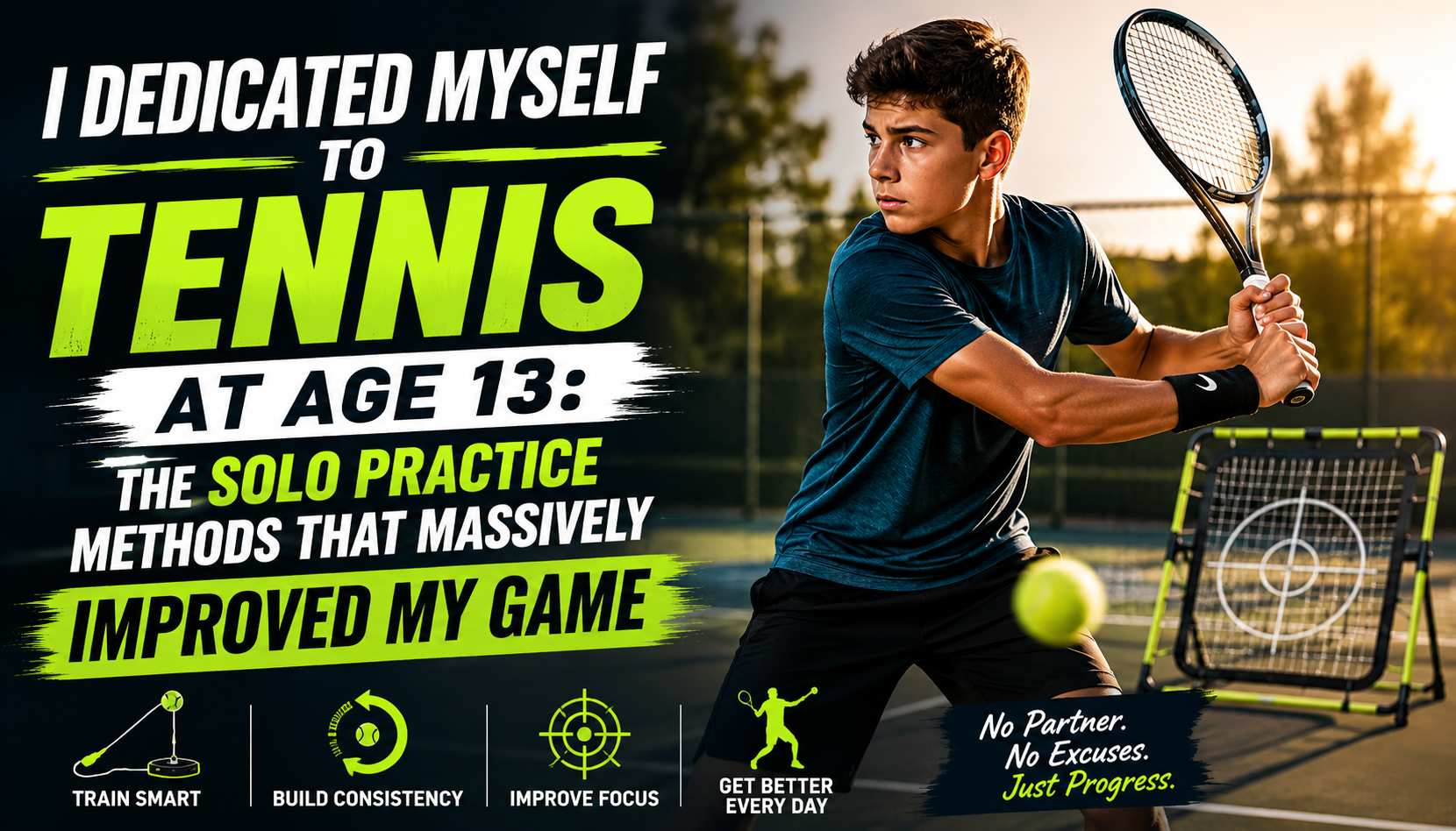
A Dream Bigger Than My Age
When I was 13 years old, I made a decision that changed my life.
While many kids spent their free time playing video games, scrolling through social media, or hanging out after school, I became completely dedicated to tennis. I wasn't the strongest player in my club. I wasn't the fastest athlete. I wasn't born with extraordinary talent.
What I did have was determination.
I dreamed of becoming a better tennis player every single day. I wanted my forehand to be heavier. I wanted my backhand to be more reliable. I wanted my serve to become a weapon. Most importantly, I wanted to improve faster than everyone around me.
The challenge was obvious.
Court time was limited.
Private coaching was expensive.
Practice partners weren't always available.
For a while, I thought improvement only happened when I was on a tennis court playing matches or training with a coach.
I was wrong.
The biggest breakthrough in my tennis journey came when I discovered the power of solo practice.
By training alone with purpose and consistency, I developed muscle memory, improved my technique, increased my confidence, and accelerated my progress faster than I ever thought possible.
Today, I want to share the exact solo tennis practice methods, equipment, and mindset that helped me massively improve my game.
If you're a young player, a beginner, or someone who wants to get better without relying on a partner every day, this guide is for you.
Why Solo Practice Is a Secret Weapon
Many tennis players underestimate solo training.
They believe improvement only comes from playing points.
While match play is important, elite athletes understand something crucial:
Repetition creates excellence.
Every great tennis stroke is built through thousands of quality repetitions.
Think about professional players.
Before they play in front of thousands of fans, they spend countless hours repeating the same movements.
The forehand.
The backhand.
The serve.
The volley.
The footwork.
Again and again.
Solo practice allows you to perform these repetitions without waiting for a partner.
You can focus entirely on your mechanics.
You can slow things down.
You can make adjustments.
You can train specific weaknesses.
Most importantly, you can build muscle memory.
When a movement becomes automatic, your body performs it naturally under pressure.
That is when real improvement happens.
The Power of Muscle Memory
At age 13, I didn't fully understand what muscle memory meant.
I just knew that some players looked effortless.
Their swings were smooth.
Their timing was perfect.
Their shots seemed automatic.
Later, I learned the science behind it.
Muscle memory develops when the brain and nervous system repeatedly perform the same movement.
Over time, those movements become more efficient.
Instead of consciously thinking about every detail, your body simply reacts.
This is extremely important in tennis.
During a fast rally, you don't have time to think:
"Should I move my feet first?"
"Where should my racket be?"
"How much topspin should I create?"
The ball is already coming.
Your body must respond instantly.
That response is built through repetition.
Solo practice provides the perfect environment to create that repetition.
Equipment That Changed My Game
One of the best things about solo tennis practice is that you don't need expensive equipment.
A few carefully chosen tools can dramatically accelerate improvement.
Let's examine the most effective options.
Ball-on-a-String Trainer: Hundreds of Repetitions Every Day
When I first used a ball-on-a-string trainer, I thought it looked simple.
It was just a tennis ball attached to an elastic cord connected to a weighted base.
How effective could it really be?
The answer surprised me.
Very effective.
The biggest advantage is repetition.
Instead of hitting one ball and then chasing it, the ball returns automatically.
This allows players to hit hundreds of forehands and backhands in a short period.
Benefits include:
- Improved hand-eye coordination
- Better timing
- Increased racket control
- Faster development of muscle memory
- Greater confidence
For younger players especially, this tool can be transformative.
Every successful contact reinforces proper technique.
Over time, consistency improves dramatically.
TopspinPro: Learning Modern Tennis
If there is one training tool that taught me how professional players generate topspin, it is the TopspinPro.
Modern tennis relies heavily on topspin.
Topspin creates control.
Topspin creates safety.
Topspin allows players to hit aggressively while keeping the ball inside the court.
The challenge is that many beginners struggle to understand the brushing motion required.
They swing too flat.
They hit through the ball instead of brushing upward.
The TopspinPro teaches the correct low-to-high swing path.
Players learn to:
- Brush the ball properly
- Generate spin naturally
- Create heavier groundstrokes
- Improve consistency
- Develop modern stroke mechanics
Many coaches consider it one of the best tennis training inventions ever created.
I can understand why.
Portable Rebound Nets: Simulating Real Rallies
Nothing feels closer to actual tennis than a quality rebound net.
You hit the ball.
The net returns it.
You hit again.
And again.
And again.
This creates a rhythm similar to a rally.
Benefits include:
- Better footwork
- Improved reaction speed
- Enhanced endurance
- Increased shot consistency
- Match-like training environment
The greatest advantage is that players learn to recover after every shot.
Recovery is one of the most overlooked skills in tennis.
Many beginners focus only on hitting.
Advanced players focus on what happens after they hit.
A rebound net teaches this naturally.
Target Training: Developing Accuracy
Power means very little without control.
One of the best habits I developed at age 13 was practicing with targets.
I would place cones, markers, or small objects on the court.
Then I challenged myself to hit them.
This simple drill transformed my accuracy.
Instead of mindlessly hitting balls, every shot had a purpose.
Professional players don't just hit hard.
They hit specific locations.
Target training develops:
- Precision
- Focus
- Tactical awareness
- Shot selection
- Court geometry understanding
Over time, you begin seeing the court differently.
You stop hitting randomly and start aiming strategically.
ServeMaster: Building a Better Serve
The serve is the most important shot in tennis.
It is also the only shot completely under your control.
No opponent influences it.
No rally affects it.
Everything depends on your mechanics.
Unfortunately, many players struggle with their serve because the movement is complex.
The ServeMaster helps players feel the correct motion.
It develops:
- Rhythm
- Fluidity
- Timing
- Shoulder rotation
- Proper swing path
By repeating the correct movement thousands of times, players develop a more efficient serve.
A better serve means more free points.
More free points mean more match wins.
My Weekly Solo Training Schedule
At age 13, I developed a simple schedule.
Monday:
20 minutes TopspinPro
20 minutes footwork
Tuesday:
30 minutes ball-on-a-string
20 minutes serve practice
Wednesday:
Recovery and stretching
Thursday:
30 minutes rebound net
20 minutes target drills
Friday:
ServeMaster training
Movement drills
Saturday:
Match play
Sunday:
Review and technique work
This schedule wasn't complicated.
The secret was consistency.
I showed up every week.
Every month.
Every year.
Small improvements accumulated.
Eventually, those small gains became major improvements.
The Biggest Mistake Young Players Make
Most young players focus on power.
They want to hit winners.
They want to impress others.
They want to hit the ball harder than everyone else.
This is a mistake.
The fastest path to improvement is mastering fundamentals.
Balance.
Footwork.
Timing.
Technique.
Consistency.
Once these foundations become strong, power develops naturally.
Professional players don't generate power by swinging harder.
They generate power through efficiency.
The better your technique becomes, the easier power feels.
The Importance of Footwork
If I could give one piece of advice to every 13-year-old tennis player, it would be this:
Train your feet as much as your strokes.
Tennis is movement.
The player who arrives at the ball in balance usually wins.
Practice:
- Split steps
- Side shuffles
- Crossover steps
- Recovery movements
- Agility ladder drills
Great footwork makes every stroke easier.
Poor footwork makes every stroke difficult.
The difference is enormous.
How Consistency Beats Talent
I have seen talented players quit.
I have seen gifted athletes lose motivation.
I have seen naturally skilled players stop improving.
Meanwhile, dedicated players continued training.
They continued learning.
They continued practicing.
Years later, many of those dedicated players surpassed the talented ones.
Why?
Because consistency wins.
Fifteen minutes every day is more powerful than three hours once a month.
Improvement compounds.
The player who keeps showing up eventually creates extraordinary results.
Final Thoughts
At age 13, I believed tennis improvement required perfect conditions.
A great coach.
Unlimited court time.
Constant practice partners.
I eventually learned a different lesson.
The player willing to practice alone can improve incredibly fast.
A ball-on-a-string trainer.
A TopspinPro.
A rebound net.
Target markers.
Serve training tools.
Combined with discipline and consistency, these simple tools can transform your game.
The goal is not perfection.
The goal is progress.
Every repetition matters.
Every practice session matters.
Every day you choose improvement matters.
One day, you'll look back and realize that those quiet hours of solo practice were the foundation of the player you became.
Start today.
Stay consistent.
Trust the process.
And keep chasing your tennis dreams.