
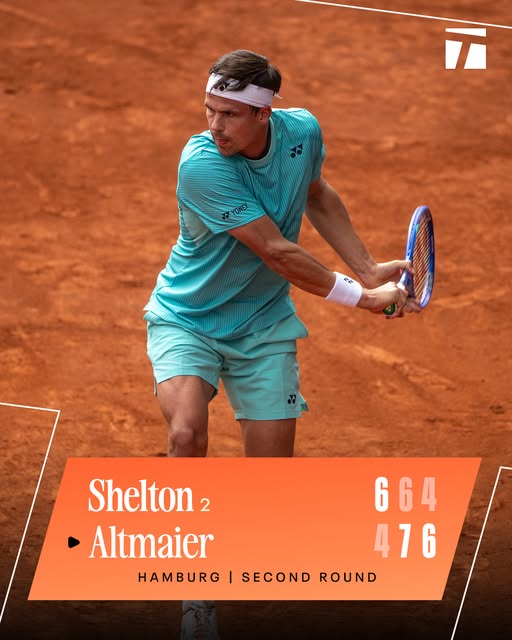
Hamburg Open Shockwave: Altmaier Stuns Shelton on German Clay
In one of the most emotional victories of the week in Hamburg, Daniel Altmaier delivered a statement win over Ben Shelton in front of a roaring German crowd.
The final scoreline told the story of momentum swings, tactical adjustments, and mental endurance:
Altmaier def. Shelton 4-6, 7-6, 6-4
At first, it looked like Shelton’s explosive power and aggressive first-strike tennis would overpower the German. But clay courts are never just about power. They expose patience, footwork, emotional control, and tactical discipline.
That is exactly where Altmaier turned the match around.
For ATP coaches in the United States watching this battle, the match became a perfect lesson in modern clay-court adaptation. Shelton brought pace and athleticism. Altmaier brought resilience, spacing, tactical intelligence, and crowd-fueled belief.
Hamburg witnessed not just an upset.
It witnessed a complete mental transformation during the match.
The Match Started on Shelton’s Terms
Shelton’s First-Set Aggression Was Elite
Early in the match, Shelton looked dangerous.
The American left-hander attacked immediately with:
- Huge first serves
- Aggressive forehands
- Fast court positioning
- Early ball striking
- Short point construction
From an ATP coaching perspective, Shelton’s opening strategy was correct.
Against a clay-court grinder like Altmaier, you do not want to:
- Extend rallies unnecessarily
- Give rhythm to the opponent
- Allow the crowd to become emotionally involved
Shelton attempted to control the center of the baseline and force Altmaier into defensive movement.
For much of the first set, it worked beautifully.
The American served with confidence and attacked second serves aggressively. His forehand acceleration through the middle of the court repeatedly pushed Altmaier behind the baseline.
When Shelton won the opening set 6-4, the momentum strongly favored him.
But clay matches are marathons of adjustment.
And Altmaier slowly began solving the puzzle.
Daniel Altmaier’s Tactical Adjustment Changed Everything
The German Stopped Playing Shelton’s Pace
One of the biggest tactical shifts came midway through the second set.
Instead of trying to match Shelton’s power shot-for-shot, Altmaier began:
- Adding heavier topspin
- Looping higher balls to Shelton’s backhand
- Extending rally tolerance
- Changing court height
- Using slower neutral balls strategically
This was a brilliant clay-court adjustment.
Many players panic against Shelton’s power and try hitting harder. That usually fails because Shelton thrives in fast exchanges.
Altmaier understood something important:
Shelton becomes less comfortable when rallies become physically and mentally complicated.
The German forced Shelton to:
- Hit extra balls
- Generate his own pace repeatedly
- Defend awkward high-bouncing shots
- Change direction under pressure
That slowly shifted the match dynamic.
ATP Coach Perspective: Why High Topspin Hurt Shelton
Clay Court Height Matters
From a USA ATP coaching viewpoint, this match highlighted a classic clay-court principle:
Height can be more dangerous than speed.
Altmaier’s topspin pushed Shelton outside his preferred strike zone.
Instead of hitting aggressive waist-high forehands, Shelton was often forced to:
- Contact balls above shoulder height
- Hit while moving backward
- Generate pace from defensive positions
That reduced the effectiveness of his natural attacking instincts.
Clay rewards players who understand geometry.
Altmaier began opening the court with heavy crosscourt forehands before redirecting down the line when Shelton’s balance weakened.
These were veteran clay-court patterns.
The Crowd Became a Real Factor
Hamburg Energy Lifted Altmaier
Tennis players often say crowds cannot hit the ball for you.
That is true.
But they can absolutely change emotional momentum.
As the match tightened, the German crowd became louder after every long rally won by Altmaier.
The energy inside the stadium visibly changed:
- Altmaier moved with more intensity
- Shelton became increasingly frustrated
- Momentum leaned emotionally toward the German
Home support matters most during pressure moments.
On clay courts, where rallies are longer and emotional endurance matters heavily, crowd support can provide critical energy reserves.
Every extended rally that Altmaier won increased the stadium’s belief.
And eventually, it increased Altmaier’s own belief too.
Shelton’s Second-Set Missed Opportunities
The Turning Point of the Match
The second-set tiebreak became the emotional center of the match.
Shelton still had chances.
In fact, the American was often the more explosive player physically. But explosive tennis alone does not always close matches on clay.
Several small details shifted the tiebreak toward Altmaier:
- Better point construction
- Safer margin over the net
- Smarter shot selection
- Improved patience under pressure
Shelton began rushing at critical moments.
That is common for aggressive players when momentum starts slipping away.
Instead of building points carefully, he occasionally attempted low-percentage winners too early in rallies.
Altmaier stayed composed.
That emotional contrast became massive.
Winning the second set gave the German:
- Physical confidence
- Tactical confirmation
- Emotional momentum
- Crowd amplification
At that point, the match completely changed.
The Third Set Became a Mental Battle
Altmaier Played Like the Freer Competitor
In the final set, Altmaier looked mentally lighter.
Shelton, meanwhile, appeared caught between aggression and caution.
This is a dangerous mental zone for attacking players.
When confidence drops slightly, aggressive players often hesitate:
- Should I attack now?
- Should I extend the rally?
- Should I go bigger?
- Should I play safer?
That half-second hesitation affects timing.
Altmaier sensed it immediately.
The German began:
- Defending more confidently
- Counterpunching with belief
- Moving Shelton side to side
- Extending physical exchanges
Shelton’s footwork also became slightly rushed late in rallies.
Clay exposes balance issues brutally.
When players tire mentally, their spacing deteriorates.
Altmaier stayed disciplined.
That discipline won the match.
ATP USA Coach Analysis: Shelton’s Learning Curve on Clay
Why This Loss Can Help Shelton Long-Term
This defeat may actually become valuable for Shelton’s development.
Young explosive players often learn more from difficult clay losses than comfortable hard-court wins.
Why?
Because clay exposes weaknesses honestly:
- Patience
- Point construction
- movement efficiency
- Emotional control
- Tactical flexibility
Shelton already possesses elite weapons:
- Massive serve
- Explosive forehand
- Athletic movement
- Competitive fire
But modern ATP tennis demands complete adaptability.
To dominate consistently on clay, Shelton must continue improving:
- Defensive transitions
- Rally tolerance
- Shot selection under pressure
- Height management
- Physical patience
The encouraging part is this:
These are coachable improvements.
Daniel Altmaier’s Mindset as a Winner
Belief Became His Greatest Weapon
The biggest difference in the match was not necessarily technical.
It was psychological.
Altmaier never looked emotionally defeated — even after losing the first set.
That mindset matters enormously on clay.
Clay rewards competitors who:
- Accept suffering
- Stay patient emotionally
- Continue building pressure
- Trust long-term patterns
Altmaier trusted that if he extended the match physically and emotionally, opportunities would come.
And they did.
The German showed:
- Calm body language
- Positive energy after long rallies
- Tactical commitment
- Emotional resilience
That is championship mentality.
Why Home Players Often Become Dangerous on Clay
Familiarity Creates Confidence
European clay specialists often become significantly stronger at home events.
There are several reasons:
- Familiar conditions
- Familiar bounce
- Familiar crowd energy
- Reduced travel stress
- Emotional motivation
Altmaier looked completely connected to the environment.
Every fist pump energized the stadium.
Every long rally increased belief.
That emotional synchronization between player and crowd became one of the hidden keys to victory.
Shelton’s Power Still Created Problems
The American Remains Dangerous Everywhere
Even in defeat, Shelton showed why he is considered one of the ATP Tour’s most explosive talents.
His serve remained a major weapon throughout the match.
When Shelton attacked early:
- Altmaier struggled defensively
- Points stayed short
- The American controlled baseline positioning
The challenge came when rallies extended beyond four or five shots.
That is where clay specialists often gain control.
Still, Shelton’s upside remains extremely high.
His athleticism and competitiveness translate to every surface.
Once his clay-court patience matures further, he can become a serious threat during the European clay season.
The Hidden Importance of Footwork
Clay Movement Decided Many Points
One subtle difference between the players was movement efficiency.
Altmaier slid naturally into shots and recovered balance smoothly.
Shelton occasionally appeared slightly upright during defensive exchanges.
On clay, balance recovery is everything.
Elite clay-court players:
- Slide efficiently
- Recover quickly
- Stay low through contact
- Maintain spacing under pressure
Altmaier’s movement economy helped him survive Shelton’s early aggression.
Over time, that physical efficiency added up.
Momentum in Tennis Is Psychological Before Technical
The Emotional Shift Was Visible
One of the clearest lessons from Hamburg was how quickly momentum can flip emotionally.
At 6-4 up, Shelton looked fully in control.
But after several long rallies and missed opportunities, emotional tension increased.
Meanwhile, Altmaier became freer and freer.
Winning tennis often comes down to emotional management during uncertainty.
The German handled uncertainty better.
That is why he survived.
ATP Coaching Lesson: Winning Ugly Is Still Winning
Altmaier Did Not Need Perfect Tennis
Many fans think winners always dominate beautifully.
That is not reality on clay.
Sometimes winning means:
- Absorbing pressure
- Extending rallies
- Staying mentally alive
- Creating frustration
- Surviving difficult moments
Altmaier’s victory was built on resilience more than brilliance.
And that is incredibly valuable.
Professional tennis is often less about spectacular winners and more about emotional endurance.
Shelton’s Future Remains Extremely Bright
Losses Like This Build Champions
Young ATP stars develop through difficult matches like Hamburg.
Shelton will likely study this match carefully with his coaching team.
The key questions will include:
- How can he maintain aggression with patience?
- How can he construct points more effectively on clay?
- How can he manage momentum swings emotionally?
- How can he defend more efficiently without overhitting?
Those lessons are critical for future Grand Slam success.
The best players evolve after painful defeats.
What Daniel Altmaier Proved in Hamburg
He Proved He Can Beat Elite Power Players
This victory was not simply about crowd energy.
Altmaier earned this win tactically.
He showed:
- Intelligent adjustment
- Emotional maturity
- Physical endurance
- Tactical patience
- Competitive courage
Against one of the ATP Tour’s biggest hitters, the German trusted his clay-court identity.
That belief carried him through.
The Match Was a Perfect Example of Modern Clay-Court Tennis
Power Alone Is Not Enough
Modern ATP clay tennis combines:
- Controlled aggression
- Movement quality
- Spin variation
- Physical endurance
- Emotional discipline
Altmaier executed those elements better over three sets.
Shelton’s power created danger.
Altmaier’s adaptability created victory.
That is the difference.
Short Story: The Locker Room Silence
After the match, the Hamburg stadium still echoed with cheers from German fans.
Inside the locker room, Shelton reportedly sat quietly for several minutes, replaying key moments in his head.
Not because he lacked effort.
But because elite athletes hate feeling close.
Close to winning.
Close to escaping.
Close to solving the puzzle.
Meanwhile, Altmaier walked through the hallway hearing the crowd still chanting his name.
For one night in Hamburg, he was not simply another ATP player.
He was the hometown fighter who refused to disappear.
And sometimes in tennis, belief combined with patience becomes stronger than raw power.
Final ATP Coach Conclusion
Why This Match Matters
Daniel Altmaier’s victory over Ben Shelton was more than an upset.
It was a masterclass in:
- Clay-court adaptation
- Emotional endurance
- Tactical adjustment
- Crowd energy management
- Competitive resilience
Shelton showed explosive talent and dangerous offensive potential.
But Altmaier showed something equally powerful:
The ability to stay calm when the match becomes uncomfortable.
That is one of the greatest skills in professional tennis.
Hamburg reminded the tennis world that on clay courts, matches are rarely won quickly.
They are earned point by point, adjustment by adjustment, emotion by emotion.
And on this night in Germany, Daniel Altmaier earned every moment of it.