
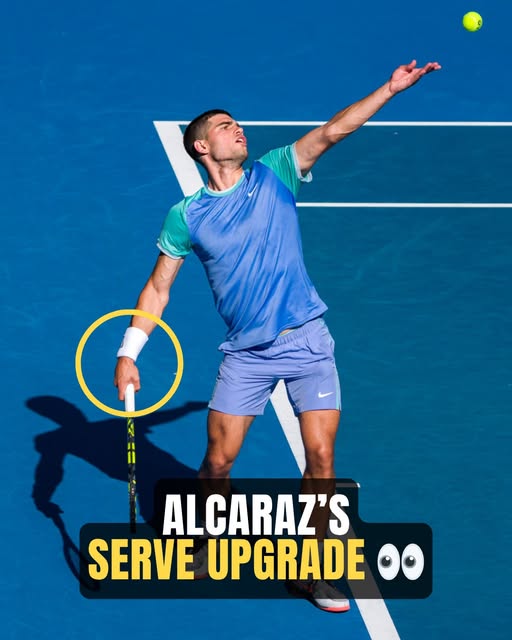
Great players don’t just hit serves, they build weapons. This is Carlos Alcaraz’s latest improvement on his serve. There is a clear detail that looks similar to Novak Djokovic. He drops the hand early and lets the racket head fall to create more whip and acceleration.
What is interesting is that Carlos made this adjustment himself. Most players are afraid to change because they might lose something. Champions think differently. They keep evolving. That is what stands out with Alcaraz. His game is never static, it is always adapting.
THE MECHANICS OF ALCARAZ SERVING EVOLUTION
The Spanish superstar has transformed his serve from a reliable starter to a genuine weapon. The key change lies in the racket drop phase. Previously, Alcaraz used a more compact motion. Now, he intentionally lowers his tossing hand earlier, which forces the racket head to fall deeper behind his back. This creates a longer lever and more stored energy, similar to the elastic motion Djokovic has used for years.
The result is higher racquet head speed at contact. Alcaraz has added several kilometers per hour to his first serve while maintaining excellent spin on his second delivery. In recent matches, his serve has been clocked consistently above 210 kilometers per hour, up from his career average of around 195.
THE THREE STEPS TO BUILDING A WEAPON SERVE
Step one is awareness. Alcaraz identified that his serve, while effective, was not yet at the level of the game's elite servers. He studied footage of Djokovic, Federer, and even his coach Juan Carlos Ferrero. He noticed that the best servers all share a loose, whippy motion rather than a forced, muscled one.
Step two is experimentation. Instead of waiting for the offseason, Alcaraz began testing the new motion in practice sessions and even in lower stakes matches. He accepted that he would miss some serves initially. He did not panic. He trusted the process.
Step three is integration. After thousands of repetitions, the new motion became automatic. Now, Alcaraz no longer thinks about his racket drop. He simply executes. The serve has become a weapon he can deploy on big points, especially out wide on the deuce side to open up the court.
THE MINDSET OF A CHAMPION
What separates Alcaraz from other young players is his willingness to change even when he is already winning. He was already a Grand Slam champion and a former world number one. Most athletes in his position would maintain what works. Alcaraz instead asks what could work better.
This mindset is rare. It requires humility to admit that a part of your game is not perfect. It requires courage to risk short term failure for long term gain. And it requires discipline to stick with the change through inevitable rough patches.
Champions do not fear change. They fear staying the same while others improve around them. Alcaraz understands that tennis is an arms race. Every opponent is studying him. If he stands still, he will be caught. So he keeps moving forward, one adjustment at a time.
THE QUESTION FOR YOU
If you could copy one shot from a professional player, which one would it be? Would you take Alcaraz's new power serve? Would you prefer Djokovic's backhand down the line, Rafael Nadal's forehand topspin, or Roger Federer's half volley? Perhaps you would choose Iga Swiatek's sliding slice or Novak's return of serve. Every great shot is the result of thousands of hours of deliberate practice and a mindset that refuses to settle. Think about your own game. What weapon would change everything for you?