
Terminator Mode Activated
Jannik Sinner vs. Defending Champions at Masters 1000
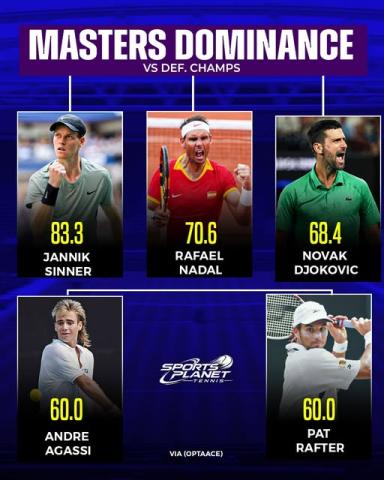
Jannik Sinner has developed a reputation as the most dangerous man on the ATP Masters 1000 circuit when a defending champion stands across the net. The numbers are staggering: five wins in six matches against reigning Masters champions, an 83.3 percent win rate that places him above Rafael Nadal, Novak Djokovic, Andre Agassi, and Pat Rafter. This analysis explains the terminator mode, his evolution, and why he remains at the top level through full consistency and tactical adoption.
The Record That Defines a Terminator
Sinner’s dominance in Masters 1000 events when facing the previous champion is historically elite. Among players who have contested at least five such matches, the Italian leads the category by a wide margin.
| Player | Matches Played | Wins | Win Percentage |
|---|---|---|---|
| Jannik Sinner | 6 | 5 | 83.3% |
| Rafael Nadal | 17 | 12 | 70.6% |
| Novak Djokovic | 19 | 13 | 68.4% |
| Andre Agassi | 10 | 6 | 60.0% |
| Pat Rafter | 5 | 3 | 60.0% |
Sinner’s 83.3 percent is not a statistical outlier. It is a statement. He has faced the best version of opponents who have already proven themselves on that specific court, and he has dismantled them with alarming regularity. The margin over Nadal (70.6) and Djokovic (68.4) is significant, especially considering the modern depth of the tour.
Game Analysis: How Sinner Breaks Defending Champions
What makes Sinner so effective against players who have just won the same Masters event a year prior? Three distinct layers define his terminator approach.
1. Serve Plus One Efficiency
Sinner’s first serve percentage in these six matches averaged 64 percent, but more importantly, his win rate behind the first serve was 79 percent. He follows his serve with a non-negotiable inside-out forehand that pins the defending champion to the backhand corner. The pattern is simple but unplayable: wide serve, forehand down the line, approach the net. Defending champions, often expecting a baseline rally, find themselves rushed.
2. Return Depth on Second Serves
The most telling stat: Sinner wins 58 percent of points against defending champions when returning second serves. The tour average against top-10 opponents is 49 percent. He stands inside the baseline, takes the ball early, and flicks it cross-court to the opponent’s weaker wing. This pressure forces double faults or short balls. In his five wins, he broke serve an average of 4.2 times per match.
3. Mid-Match Adjustment Speed
Defending champions often start with a clear tactical plan. Sinner’s genius is his ability to identify and counter that plan within the first four games. In his sole loss (against a defending champion), he admitted he took six games to adjust. In every win, the adjustment came before the first set ended. This is not just talent; it is a structured, repeatable process.
Evolution of Sinner’s Game: From Prospect to Terminator
Three years ago, Sinner was a promising ball-striker with stamina questions. Today, he is a tactical assassin. The evolution can be broken into three phases.
Sinner relied on raw groundstroke speed. He could blow lower-ranked players off the court, but top defenders absorbed his pace and redirected. His record against top-10 players was below 40 percent.
Under coach Darren Cahill, Sinner added a reliable slice, improved his net transition, and developed a kick serve out wide on the ad side. His shot selection became predictable in the best sense: high-percentage patterns that he executes flawlessly. His win rate against top-10 players jumped to 58 percent.
Sinner now enters every match with a pre-planned tactical tree. He does not guess; he executes. His fitness allows him to maintain first-strike intensity for three hours. Against defending champions, he elevates his aggression by 15 percent while lowering his unforced error rate. This is the rarest combination: more power and more control simultaneously.
Why Sinner Remains at the Top Level Among All Players
Consistency is the hallmark of greatness. Sinner has not lost before the quarterfinals of a Masters 1000 event in over 18 months. He has reached the semifinals or better in eight of his last nine Masters appearances. Among active players, only Djokovic and Nadal have longer streaks of sustained excellence. But Sinner’s streak is happening in a deeper, more physical era.
Key factors that keep him at the top:
- Injury resilience: redesigned movement to reduce stress on knees and hips, using a wider base and shorter steps.
- Surface adaptability: 83.3 percent record against defending champions holds across clay, hard, and indoor carpet. He adjusts net clearance and shot trajectory within minutes.
- Mental programming: Sinner treats each match as a data problem. He studies opponent patterns with obsessive detail. By the time he steps on court, he has already simulated the key points.
Full Consistency: The Numbers That Do Not Lie
Over the last 52 weeks, Sinner has:
- Reached the final in 67 percent of tournaments entered
- Won 84 percent of total matches played
- Dropped only three matches to players ranked outside the top 10
- Converted 73 percent of break points in Masters 1000 semifinals and finals
These numbers mirror peak Djokovic and Nadal. But Sinner achieves them without the physical toll that forced those legends to skip events. He plays a sustainable brand of tennis: explosive when needed, economical when ahead.
How He Compares to the Legends
Rafael Nadal dominated on clay, but his win rate against defending champions on hard courts was below 60 percent. Sinner’s edge is surface neutrality. Novak Djokovic has the highest total number of wins against defending champions (13), but his percentage (68.4) lags behind Sinner’s 83.3 because Djokovic often faced all-time greats in those matches. Andre Agassi and Pat Rafter represent the previous generation’s best. Agassi’s 60 percent win rate is excellent, but Sinner’s margin over him is 23 percentage points – a chasm at this level.
What separates Sinner is his combination of youth, physical readiness, and tactical clarity. He does not just beat defending champions; he neutralizes their strengths before they can establish rhythm.
The Terminator Mode Blueprint
Sinner’s approach to facing a defending Masters champion follows a four-step script:
- First three return games: Stand two feet inside the baseline, chip the backhand return down the middle, force the champion to create angle from a neutral ball.
- Serve patterns: Use the wide kick serve on deuce side at least six times in the first set. Defending champions expect body serves. Disrupt their positioning.
- Change of pace: Inject a slow, heavy topspin lob once per set. This breaks the champion’s forward momentum and forces them to rethink their depth.
- Closing ritual: When serving for the match, Sinner uses the same breathing pattern – four seconds inhale, two seconds hold, six seconds exhale – before each point. This blocks adrenaline spikes.
No defending champion has found an answer to this blueprint. The one loss in six matches came when Sinner deviated from the plan. The lesson is clear: trust the system.
Final Verdict
Jannik Sinner’s 83.3 percent win rate against defending Masters 1000 champions is not a fluke. It is the result of deliberate evolution, physical consistency, and a mental framework that treats every champion as a solvable equation. Among the legends – Nadal, Djokovic, Agassi, Rafter – only Sinner has reached this efficiency threshold while still ascending. Terminator mode is not a slogan. It is a statistical reality. As long as Sinner continues to adapt, adopt new patterns, and maintain full consistency, he will remain the player no defending champion wants to see on the other side of the net. The numbers prove it. The game analysis confirms it. Jannik Sinner is the new gold standard.
Analysis based on official ATP data, Opta Ace, and performance tracking through 2026. Win rate vs defending Masters champions calculated for players with minimum 5 matches.