
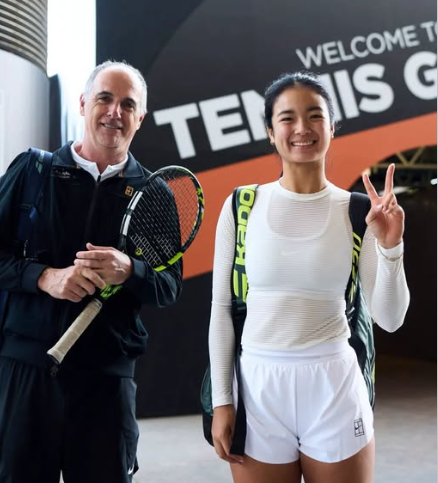
The Spanish capital is buzzing, and one of tennis’s most promising young talents has just touched down on its famous red clay. Alexandra “Alex” Eala has officially arrived in Madrid, and by all accounts, the 20-year-old Filipina sensation is locked in, smilinge with confidence, and ready for the challenge ahead.
With the Mutua Madrid Open set to begin, Eala is embracing the moment. Every tournament, she says, is another chance to prove she belongs with the best in the world. And after a whirlwind year that has seen her rise to a career-high ranking and compete toe-to-toe with Grand Slam champions, the Madrid Open season starts now.
This is her time. Let’s show support for one of tennis’s brightest rising stars.
The Arrival: A Smile That Speaks Volumes
Arriving at the Caja Mágica alongside some of the sport’s most formidable names—including world No. 1 Aryna Sabalenka and four-time Major champion Naomi Osaka—Eala looks every bit the part of a seasoned WTA pro. Photos from her trainingz sessions have captured a player who, despite recent setbacks, exudes quiet confidence.
For Eala, the smiles aren’t just for the cameras; they are a reflection of a mindset shift. “At this level, it’s a demanding job,” she recently reflected. “But of course you’re treated very well, especially in individual sports, a lot of things are catered to you, and they have to be catered to you because that’s how you succeed”.
There is a lot of attention—from the media, from fans, from a nation of over 100 million people watching her every move. Yet Eala remains grounded. “I think sometimes it’s a lot,” she admits. “If you don’t have that ‘spoonful of gratitude’ or you don’t have that guidance… you can get lost in all these things”. In Madrid, she seems determined not to get lost. Instead, she is navigating the pressure with a maturity that belies her years.
Locked In: The Tactical Preparation
Unlike the hard courts where she famously made her name—reaching the semifinals of the Miami Open in 2025 and defeating three Grand Slam champions—clay has historically been Eala’s most demanding surface. Her career-win percentage on clay sits just below 40%, and she has yet to advance past the second round in her last seven clay tournaments dating back to 2024.
But Madrid is different. Madrid is home.
Based at the Rafa Nadal Academy in Mallorca, Spain, Eala has had the unique advantage of training on the very surface she is now competing on. Leading up to the tournament, she spent valuable time at the academy, including working sessions with the legendary Toni Nadal. In a video shared by the academy, the scene was unmistakable: clay court time, big smiles, and everything looking “pretty good” as Eala prepared for battle.
While recent results in Linz (a loss to Jelena Ostapenko) and Stuttgart (a defeat to Leylah Fernandez) were not what she had hoped for, they have not dented her resolve. She knows that on clay, patience is as important as power. With the Madrid Open being a WTA 1000 event featuring a 96-player main draw, the opportunities for a deep run are there if she can find her rhythm.
The Draw: A Clear Path and A Familiar Hurdle
The official draw has given Eala a workable—if challenging—roadmap. Currently ranked No. 44 in the world, she will open her campaign in the Round of 128 against a qualifier.
That first match is crucial. It offers a chance to shake off the early-season clay rust and build momentum. Standing in her way beyond that, however, is a familiar and formidable opponent: Belgium’s Elise Mertens (world No. 21 and the 19th seed), who has a first-round bye.
Mertens, a doubles world No. 1 and singles stalwart, represents a significant test. She has played the Madrid Open seven times, reaching the quarterfinals in 2021. If Eala can navigate her opening match, a showdowen with the Belgian would be a genuine barometer of how far she has come on this surface.
Eala is placed in the lower half of the draw, a section that also features second seed Elena Rybakina, sixth pick Amanda Anisimova, and the ever-dangerous Jelena Ostapenko—a reminder that in a WTA 1000, there are no easy matches.
The Confidence: “Every Tournament Is Another Chance”
Perhaps the most significant change in Eala’s approach this season is psychological. After her historic run in Miami last year, expectations skyrocketed. She has learned to manage that pressure by focusing on the process rather than the outcome.
Reflecting on the support she receives, Eala recently highlighted the power of representation—something that fuels her confidence. “Being loud and proud, especially when it comes to cultures, is so important… there are very few nationalities that I see are as loud and proud as us,” she said of Filipino fans. “Where you’re from is a really big part of who you are, and the culture that you surround yourself in… I think that’s something that’s shared within all Filipinos”.
That sense of identity and belonging translates into on-court assurance. Eala is no longer just a wildcard or a lucky story. She is a fixture on the tour, and she is beginning to move like one.
The Challenge Ahead: Redemption on Red Clay
Last year at the Madrid Open, Eala gave fans a glimpse of her clay potential. She won her first-round match against Viktoriya Tomova before falling in three sets to the eventual champion, Iga Swiatek. This year, she is aiming for more.
But Eala is also a realist. She has signed up for two WTA 125 (Challenger) events in Catalonia and Emilia-Romagna as a fallback plan in case she suffers an early exit in Madrid or Rome. This proactive scheduling demonstrates a strategic mind—one that understands the long game of a tennis season and the importance of accumulating match play.
Yet for the fans who will pack the Caja Mágica and the millions watching from the Philippines, the hope is that the fallback plan won’t be needed. The hope is that this is the tournament where Eala’s clay-court fortunes finally turn.
ADDON FAQ: Game Adoption and Adaptation
Q: What does “Game Adoption” mean for a player like Alex Eala?
A: Game adoption refers to a player’s ability to adapt their playing style to different surfaces, opponents, and conditions. For Eala, transitioning from her natural hard-court aggression to the slower, higher-bouncing clay of Madrid requires adjustments in footwork, shot selection, and rally tolerance. It’s not about changing who she is as a player, but about expanding her tactical toolkit.
Q: How is Eala adapting her game specifically for the Madrid clay?
A: Having trained extensively at the Rafa Nadal Academy, Eala has focused on sliding technique, building points patiently, and using her left-handed forehand to create angles that are especially effective on clay. She has also worked on maintaining a higher margin for error, reducing unforced errors that can be costly on slower surfaces.
Q: Why is clay considered more difficult for her than hard courts?
A: Clay neutralizes big serves and flat shots, rewarding consistency and endurance. Hard courts, where Eala has had her biggest successes (including her Miami semifinal run), allow her to use her speed and aggressive shot-making more effectively. The clay requires her to construct points rather than end them quickly.
Q: How important is the Madrid Open for her French Open preparation?
A: Absolutely critical. Madrid is one of the key warm-up events for Roland Garros (the French Open). A deep run here would provide both ranking points and, more importantly, the confidence that she can compete with elite players on the red dirt.
Q: What is the biggest technical challenge she faces on clay?
A: Footwork and court positioning. On clay, the ball bounces higher and slower, forcing players to adjust their timing. Eala has been working on stepping into the court more aggressively and improving her slice backhand to change the rhythm of rallies.
Q: How do the courts in Madrid differ from other clay events?
A: The altitude in Madrid (around 650 meters above sea level) makes the ball fly faster and bounce higher than at sea-level clay events like Rome or the French Open. This actually helps players with aggressive games, as the ball travels through the court more quickly. Some analysts believe the Madrid clay suits Eala’s natural style better than slower European clay.
Q: What is Eala’s record at the Madrid Open historically?
A: In 2025, Eala reached the second round, defeating Viktoriya Tomova before losing to eventual champion Iga Swiatek in three sets. She is looking to improve on that result this year and break through to the later rounds.
Q: How can fans support Eala during this tournament?
A: Show up (or tune in) with positive energy. Eala has specifically mentioned the gratitude she feels toward Filipino fans who travel to watch her. “Being loud and proud” is something she encourages. Online, that means engaging with her matches, celebrating her wins, and offering encouragement during tough moments. The support of the Filipino community has been a constant source of strength for her.
The Verdict: Madrid Is Just the Beginning
Alex Eala has arrived in Madrid not as a nervous newcomer, but as a confident contender. She is smiling because she knows the work has been done. She is locked in because she understands the stakes. And she is ready because she has faced the best and refused to back down.
The clay may not be her natural habitat, but champions are defined by how they adapt. The Madrid Open is more than just another tournament on the calendar; it is a statement of intent.
For Alex Eala, the journey is just beginning. For the rest of us, the only thing left to do is watch, cheer, and believe.
Let’s show support for one of tennis’s brightest rising stars. Madrid Open season starts now.