
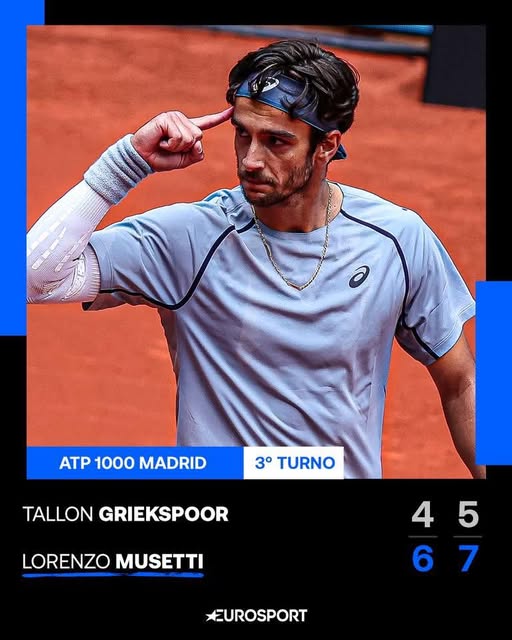
As an Italian tennis expert who has closely followed the growth of our talents on clay and beyond, I can tell you there is a common thread linking the great champions who have made the history of this sport. It is not just the forehand or the serve. It is the ability, when the match is on a knife's edge, to take a deep breath, read the situation, and change gear. It is the art of "scaling your game" and making tactical adjustments.
And in this, Lorenzo Musetti, the talent from Carrara, is undergoing a maturation that should be studied in tennis clubs across Italy. I am not talking about his one-handed backhand, which is a work of art. I am talking about his head. I am talking about how he has transformed pressure from an enemy into fuel.
From Artist to Warrior: The Mindset Shift
For years, Musetti was praised as the artist of the racket, the "bastion of beauty, elegance, and grace." A player capable of igniting the imagination, but who at times seemed more concerned with aesthetics than the final result. He himself admitted it: "I have always been a player attentive to the aesthetic aspect of the game, someone who enjoyed having a beautiful and elegant style of tennis."
Well, that version is dead. The "new Lorenzo" has understood the most brutal and important truth of this sport. His words are a lesson for every young player dreaming of becoming a professional: "But anyone who wants to be a great champion must find ways to have simple, basic game patterns to fall back on in moments of low confidence or bad feelings. I understood that it is much better to win playing badly than to lose playing well."
This is the mindset shift. The renunciation of the external in favor of substance. This is the first fundamental step that allowed him to "scale" his own game, starting from a base of uncertainty to reach performance peaks in the moments that matter. Unsurprisingly, Musetti emphasizes that with his staff he focuses on breathing, taking more time, not rushing in difficult situations, trying to think and have a plan before starting to serve.
Tactics That Withstand Pressure: The Key Matches
But theory, without practice on the world's toughest courts, is worthless. And Lorenzo has provided overwhelming evidence on the edge of pressure. Let's talk about a few examples that should be teaching material for our tennis schools.
The Comeback in Turin: Heart and Tactics Against De Minaur
Let's go back to November 2025, at the Nitto ATP Finals in Turin. Musetti, in his round‑robin debut, finds himself down 3‑5 in the third set against Alex De Minaur, one of the most physical and frustrating opponents on the circuit. Under pressure, in his first appearance at such a prestigious event. What happens? The young man from Carrara does not collapse; he reacts. Down 3‑5, he stages a stunning comeback, winning the set 7‑5 and the match 7‑5, 3‑6, 7‑5 in front of his home crowd.
Here is what he said afterwards: "I was really struggling physically because Alex raised his level and intensity, and I was having trouble finding the solution. But in the end, with a big heart and a great passion for this game, I don't know from where, I started to feel better and play better." Then the sentence that struck me most: "I am a warrior. I have improved a lot on the mental side, and I am pushing myself to the limit."
But it wasn't just heart. It was a masterpiece of adjustments. After losing the second set, Musetti changed gears, hammering his forehand from the left side – a shot that his coach Simone Tartarini has always indicated as fundamental for dictating points. He stopped playing catch‑up and started dictating the pace, changing the match's momentum.
The 2026 Australian Open: The Five‑Set Testing Ground
If there is one place where psychological pressure reaches its peak, it is the Slams. At the 2026 Australian Open, in the third round, Musetti found himself stuck in a 4‑hour‑and‑25‑minute battle with Czech Tomas Machac. The final score: 5‑7, 6‑4, 6‑2, 5‑7, 6‑2 – a true roller coaster. Machac raised his level in the fourth set, forcing Lorenzo back to square one. And there, where many would have melted like snow in the sun, Musetti produced a fierce reaction. Physical condition ultimately made the difference, but it was his ability not to yield and to restructure his game when needed that opened the doors to his first quarterfinal appearance in Melbourne.
Musetti's "Q‑Learning": The Serve and Aggression
What areas of his game has he worked on in order to manage and even triumph under pressure? The numbers and tactical changes speak clearly.
Serve Improvement: The serve is often the shot most affected by tension. Musetti and his long‑time coach, Simone Tartarini, worked hard to modify it, changing his foot placement to avoid shifting his weight backward. And the results have come. In 2025, his first‑serve percentage rose to 54% (from 49% in 2024), and more importantly, his second‑serve points won percentage jumped to 24.5% (from 20.9% in 2024). A more effective serve means less pressure on your own service games.
A Simpler, Increasingly Winning Game: Musetti has understood that in hot moments you need patterns to fall back on. He has become more aggressive, moving forward to dominate more frequently with his forehand and taking more risks. He is no longer just looking for the aesthetic shot; he is looking for the winning solution for the point, whether it is a backhand down the line or a deep cross‑court ball. He has scaled his complexity to arrive at a more essential and effective game in moments when you cannot afford mistakes.
The Team That Supports the Climb
No climb is done alone. Musetti is surrounded by a trusted rope team. Simone Tartarini remains his main identity, the coach who knows his game inside out. But since the end of 2025, a luxury external consultant has been added: the Spaniard José Perlas – the man who led Carlos Moyà and Albert Costa to win Roland Garros.
The duo is perfect: Tartarini for identity, Perlas as an external voice to intervene in tactical choices, serve and return structures, and decision‑making on important points. This synergistic effort aims to reduce the inconsistency of his dazzling talent and provide him with an even sharper tactical weapon. And this is what allows him, during a match, to read the opponent, receive feedback from the game, and adapt.
Conclusion: A New Standard for Italian Tennis
Lorenzo Musetti is no longer the carefree prodigy. He has become a player who knows how to manage the match, does not crack under pressure, and has developed the mental and tactical tools to come back from seemingly impossible situations.
In his tennis, adjustment is a philosophy. He adapts immediately to an opponent's aggressive style and serve, and instead of being alarmed by his own physical condition, he finds the solution. "I was probably able to find the great reaction after the fourth game of the third set, when I was down 0‑30, I won six points in a row, I found my energy again, and I managed to break."
For us Italians – insiders and fans alike – his growth is a breath of fresh air. It shows that our tennis is not just raw talent, but is also capable of evolving, adapting, and winning. And as we watch him advance through the Madrid draw following this behavioral model, there is no doubt: Lorenzo Musetti has learned the hardest art of all – that of climbing the mountain and adjusting his course while climbing under everyone's gaze.
Forza Lorenzo! Keep making us dream, point after point.