
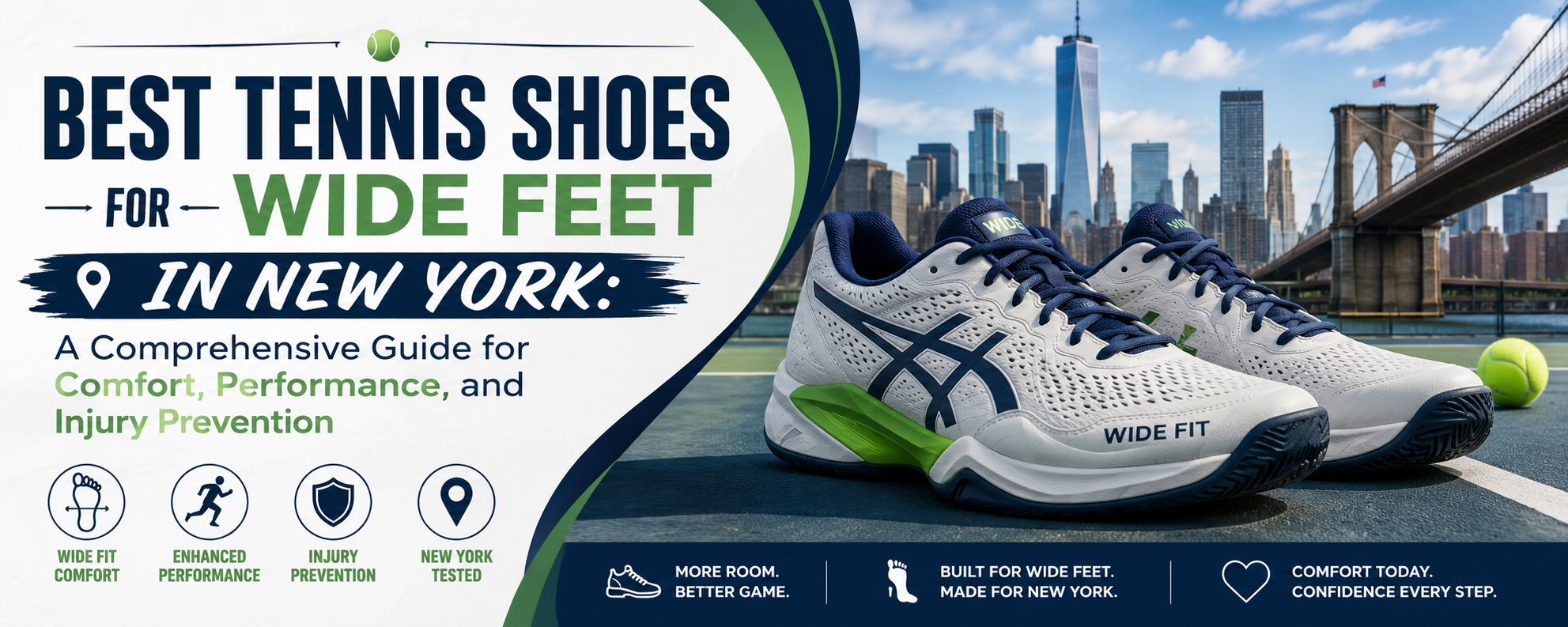
As a professional ATP tennis coach, equipment specialist, sports podiatrist consultant, and tennis journalist based in New York, I have worked with everyone from ambitious junior competitors to seasoned USTA league veterans and active senior players. While many athletes spend countless hours researching rackets, strings, and training methods, one of the most overlooked aspects of performance remains footwear.
Your feet are the foundation of every movement you make on the tennis court.
For players with wide feet, choosing the correct tennis shoe is far more than a comfort decision. It directly affects stability, movement efficiency, injury prevention, endurance, and overall confidence during competition. Unfortunately, many players unknowingly wear shoes that are too narrow because they assume discomfort is simply part of the game.
Nothing could be further from the truth.
Whether you are competing on hard courts in Manhattan, playing club tennis in Long Island, training indoors during the New York winter, or competing in USTA tournaments throughout the state, your footwear must support the unique demands of tennis.
Unlike running, tennis requires explosive multidirectional movement. Players sprint forward, recover backward, shuffle laterally, perform crossover steps, and frequently stop and start under high loads. Every one of these actions places significant stress on the feet.
When wide feet are forced into standard-width shoes, performance suffers and injury risks increase dramatically.
This guide will help you understand:
- Why standard shoes fail wide-footed players
- How to accurately measure foot width
- The best tennis shoes for wide feet in 2026
- Essential footwork drills for intermediate players
- Equipment recommendations that complement proper footwear
- Injury-prevention strategies used by competitive players
By understanding the relationship between foot health and performance, you can make better equipment decisions and enjoy more comfortable, efficient movement on court.
Why Standard Tennis Shoes Often Fail Wide-Footed Players
One of the most common mistakes recreational tennis players make is assuming all tennis shoes should feel tight.
A secure fit is important.
A restrictive fit is not.
Most tennis shoes are built around a standard-width last, which is essentially the mold used to shape the shoe. While this design accommodates average foot dimensions, it can create significant problems for athletes with naturally wider feet.
The Hidden Cost of Toe Box Compression
The toes are designed to spread naturally during athletic movement.
This natural spreading process, called toe splay, helps the body:
- Maintain balance
- Generate force
- Absorb impact
- Improve stability
- Enhance lateral control
When the toe box is too narrow, the toes cannot function properly.
The result is increased pressure on the forefoot, particularly around the fifth toe and bunion area. Over time, players often develop:
- Painful pressure points
- Black toenails
- Bunion irritation
- Neuroma symptoms
- Reduced balance
For tennis players, where split-second reactions matter, losing even a small amount of stability can affect performance.
Blisters and Hot Spots
Blisters are not merely an annoyance.
They are a warning sign.
When a shoe is too narrow, the sides of the foot constantly rub against the shoe upper during lateral movement.
This repeated friction creates:
- Hot spots
- Skin irritation
- Calluses
- Blisters
- Reduced mobility
Many New York players experience worsening symptoms during summer months because feet naturally swell during prolonged exercise and hot weather.
A shoe that feels acceptable during warm-up may become painful during the second or third set.
Impact on the Plantar Fascia
The plantar fascia is a thick band of connective tissue running along the bottom of the foot.
When footwear compresses the foot unnaturally, it alters gait mechanics and changes how forces are distributed throughout the lower extremity.
This can contribute to:
- Plantar fasciitis
- Heel pain
- Arch strain
- Achilles tendon stress
- Knee discomfort
As a sports podiatry consultant, I regularly see athletes who focus on treating symptoms while overlooking the root cause: improper footwear.
Why Sizing Up Is a Mistake
Many players attempt to solve width issues by purchasing a larger shoe size.
This approach rarely works.
Increasing shoe size adds length rather than width.
The consequences include:
- Heel slippage
- Poor arch alignment
- Reduced responsiveness
- Increased instability
- Higher injury risk
Tennis shoes are engineered around precise pivot points. When your foot sits too far forward or backward inside the shoe, those engineered support zones no longer align correctly with your anatomy.
Instead of sizing up, players should seek true wide-width options.
Understanding Tennis Shoe Width Designations
Before shopping for shoes, it is important to understand width classifications.
Men's Widths
- D = Standard
- 2E = Wide
- 4E = Extra Wide
Women's Widths
- B = Standard
- D = Wide
- 2E = Extra Wide
Many tennis players are surprised to learn they have been wearing the wrong width for years.
Proper sizing often results in immediate comfort improvements.
How to Measure Your Feet Correctly
Accurate measurements are critical.
Follow these steps:
Measure While Standing
Feet expand under body weight.
Always measure:
- While standing
- Late in the day
- Wearing tennis socks
This provides the most realistic dimensions.
Measure Both Feet
Most people have one foot slightly larger than the other.
Always fit shoes according to the larger foot.
Account for Tennis-Specific Movement
Remember that tennis involves aggressive lateral motion.
You need enough room for natural toe movement without allowing excessive internal foot movement.
The 30-Minute Diagnostic Test
One of the simplest methods I recommend to players is the 30-minute test.
Play tennis for approximately thirty minutes at moderate intensity.
Afterward, remove your shoes and inspect your feet.
Warning signs include:
- Red marks along the sides
- Numb toes
- Tingling sensations
- Pressure points
- Swelling
- Burning sensations
Any of these symptoms suggest your current shoes may be too narrow.
Characteristics of an Excellent Wide-Foot Tennis Shoe
Not all wide shoes are equally effective.
The best models combine comfort with performance-oriented design.
Spacious Toe Box
A proper toe box should allow natural toe spread while maintaining control during lateral movement.
Secure Midfoot Lockdown
The middle portion of the shoe should stabilize the foot without excessive pressure.
Strong Lateral Stability
Tennis places enormous demands on side-to-side movement.
A quality tennis shoe must prevent excessive foot rollover.
Durable Outsole
Most New York players spend significant time on hard courts.
Durability is essential.
Shock Absorption
Hard courts generate substantial impact forces.
Quality cushioning helps protect:
- Feet
- Ankles
- Knees
- Hips
- Lower back
Best Tennis Shoes for Wide Feet in New York (2026)
New Balance Fresh Foam X 1007
Best For: Maximum Cushioning
New Balance remains the leader in true wide-width tennis footwear.
Key advantages include:
- Available in widths up to 4E
- Exceptional cushioning
- Excellent comfort
- Reliable durability
- Strong support
This model is particularly popular among senior players and athletes managing plantar fasciitis symptoms.
ASICS Gel Resolution
Best For: Stability and Durability
The Gel Resolution series has long been a favorite among competitive players.
Strengths include:
- Excellent lateral support
- Durable construction
- Secure heel lockdown
- Reliable court feel
Players who move aggressively from the baseline often appreciate the stability this shoe provides.
K-Swiss Hypercourt Express
Best For: Comfort and Breathability
The Hypercourt Express offers one of the most naturally accommodating fits on the market.
Benefits include:
- Roomy forefoot
- Lightweight construction
- Excellent ventilation
- Minimal break-in period
For many recreational players, comfort is exceptional from the first session.
Why New Balance Continues to Lead
Among all major manufacturers, New Balance consistently provides the widest range of true-width options.
Players requiring 2E or 4E sizing often find the most consistent success within the New Balance lineup.
Court Surfaces and Their Impact on Footwear
New York players encounter several court types throughout the year.
Each surface places unique demands on shoes.
Hard Courts
The most common playing surface.
Requires:
- Cushioning
- Durability
- Stability
Har-Tru Courts
Popular at private clubs.
Requires:
- Controlled traction
- Support during sliding
- Stable lateral movement
Indoor Courts
Common during winter months.
Requires:
- Consistent grip
- Comfort for extended sessions
- Reliable court feel
Players who compete frequently should consider rotating multiple pairs throughout the season.