
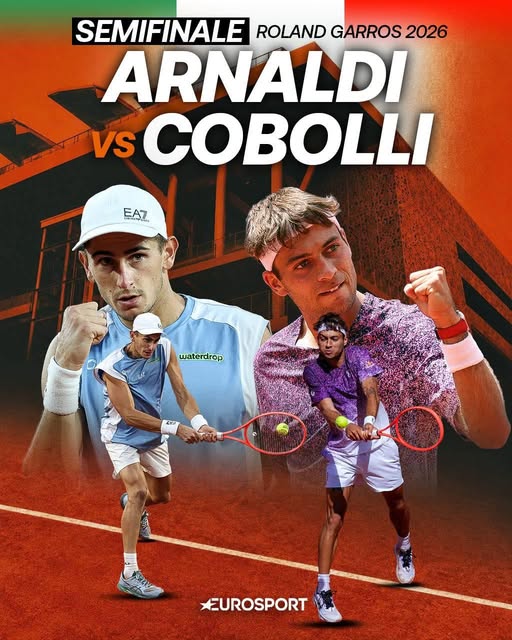
And Italy Goes Hammer — Daje!
Italian tennis continues its golden era at Roland Garros 2026.
With Matteo Arnaldi and Flavio Cobolli battling for a place in the final, Italy guarantees itself a representative in one of the biggest championship matches in tennis. For fans across Rome, Milan, Naples, Turin, and beyond, this semifinal is more than a match—it is a celebration of the depth, resilience, and evolution of Italian tennis.
"Daje!" has become the rallying cry of Italian tennis supporters, and on the clay courts of Paris, that energy has never felt stronger.
As injuries temporarily sidelined some of Italy's biggest stars, Arnaldi and Cobolli seized the opportunity. Both have survived difficult draws, adapted to changing conditions, and demonstrated remarkable maturity under pressure.
Now only one can advance.
The Road to the Semifinal
Both players arrived in Paris carrying momentum.
Matteo Arnaldi
Arnaldi's path has been built on discipline, patience, and tactical precision.
Throughout the tournament he has:
- Absorbed pace exceptionally well
- Extended rallies on clay
- Forced opponents into uncomfortable positions
- Managed pressure moments effectively
His victories have shown a player capable of adjusting game plans mid-match, a trait usually seen among established Top 10 players.
Flavio Cobolli
Cobolli has emerged as one of the breakout stories of the clay season.
His tournament has featured:
- Aggressive baseline tennis
- Improved serve placement
- Enhanced physical endurance
- Greater confidence in attacking patterns
The Italian has shown he is no longer simply a promising talent.
He is becoming a legitimate threat against elite competition.
ATP USA Expert Perspective
Many American ATP analysts have highlighted how Italy's development system continues producing versatile clay-court players.
According to several U.S.-based tennis commentators:
"Italian players are no longer one-dimensional clay specialists. They can defend, attack, transition forward, and adapt under pressure."
Arnaldi and Cobolli embody that evolution.
Both possess modern weapons:
- Heavy topspin
- Strong movement
- Tactical flexibility
- Improved serving efficiency
This semifinal may offer a glimpse of Italy's future leadership generation.
Matteo Arnaldi: Complete Strength Analysis
1. Elite Defensive Coverage
Arnaldi's movement is among his greatest strengths.
He consistently:
- Extends rallies
- Tracks difficult angles
- Forces opponents to hit extra balls
On clay this becomes especially valuable.
Many opponents become impatient after repeatedly seeing winners come back.
2. Tactical Intelligence
Arnaldi rarely panics.
Instead he:
- Changes rally height
- Alters spin
- Adjusts court position
His ability to make in-match corrections often shifts momentum.
3. Backhand Stability
The backhand wing remains one of his most dependable shots.
Benefits include:
- Crosscourt consistency
- Reliable depth
- Defensive recovery capability
Against aggressive players this stability becomes critical.
4. Physical Endurance
Five-set matches do not appear to intimidate him.
Arnaldi has shown:
- Excellent recovery
- Consistent movement
- Strong cardiovascular conditioning
Long matches often favor him.
Matteo Arnaldi Weaknesses
1. Offensive Hesitation
Sometimes Arnaldi waits too long before attacking.
This can allow opponents to:
- Recover position
- Reset rallies
- Regain confidence
Against Cobolli, delayed aggression could be costly.
2. Serve Vulnerability
His serve is effective but not dominant.
When first-serve percentages drop:
- Break opportunities increase
- Service games become longer
Cobolli may target this area aggressively.
3. Finishing Short Balls
Occasionally Arnaldi creates opportunities but fails to finish points efficiently.
Elite opponents capitalize on these missed chances.
Flavio Cobolli: Complete Strength Analysis
1. Forehand Firepower
Cobolli's forehand is his primary weapon.
The shot generates:
- Heavy topspin
- Significant pace
- Sharp angles
When operating confidently, he can dictate rallies against almost anyone.
2. Aggressive Court Positioning
Cobolli prefers taking time away from opponents.
He often:
- Steps inside the baseline
- Attacks second serves
- Redirects pace early
This style can pressure defensive players.
3. Improved Confidence
Perhaps his biggest improvement during 2026 has been belief.
Great players often separate themselves through conviction.
Cobolli appears increasingly willing to trust his game during critical moments.
4. Transition Game
His movement forward has improved dramatically.
He now:
- Approaches intelligently
- Finishes with stronger volleys
- Creates shorter points
That conserves energy during long tournaments.
Flavio Cobolli Weaknesses
1. Risk Management
Aggressive players often walk a fine line.
Cobolli occasionally:
- Pulls the trigger too early
- Attempts low-percentage winners
- Rushes points unnecessarily
Arnaldi will try to expose this tendency.
2. Emotional Swings
His passion fuels his tennis.
However, emotional fluctuations can sometimes affect consistency.
A few missed opportunities can temporarily impact decision-making.
3. Defensive Depth
While improved, his defense remains less natural than Arnaldi's.
Extended rallies generally favor Arnaldi.
Tactical Battle
If Arnaldi Wants to Win
His strategy should include:
Lengthen Points
The longer rallies become:
- The greater the chance Cobolli presses
- The greater likelihood of errors
Patience is essential.
Attack the Backhand
Repeated pressure on Cobolli's backhand can:
- Reduce forehand opportunities
- Create shorter replies
This opens the court.
Vary Height and Spin
Changing rhythm can disrupt aggressive players.
Arnaldi should mix:
- High topspin balls
- Deep defensive shots
- Sudden acceleration
This prevents Cobolli from finding rhythm.
If Cobolli Wants to Win
Take Time Away
Cobolli should avoid becoming trapped in marathon rallies.
His objective:
- Strike early
- Move forward
- Shorten exchanges
Dominate With Forehand
The forehand must be the centerpiece.
Whenever possible he should:
- Run around backhands
- Create inside-out patterns
- Attack short balls
Apply Return Pressure
Arnaldi's serve can be attacked.
Aggressive returning could generate:
- Early breaks
- Scoreboard pressure
- Momentum swings
Mental Battle
The semifinal may ultimately be decided mentally rather than physically.
Both players face:
- National expectations
- Grand Slam pressure
- Career-defining opportunity
Arnaldi's Mental Advantage
Arnaldi often appears calm under pressure.
He typically:
- Maintains emotional control
- Trusts his patterns
- Avoids panic
These traits help during long matches.
Cobolli's Mental Advantage
Cobolli carries emotional energy.
When momentum swings his way:
- Confidence rises quickly
- Aggression increases
- Opponents feel pressure
His challenge is maintaining that intensity without becoming reckless.
Pressure Point Analysis
At Roland Garros, championships are often decided by a handful of points.
Key situations include:
30-30 Games
These moments frequently determine service holds.
Whoever manages these points better gains enormous leverage.
Break Points
Arnaldi tends to:
- Extend rallies
- Force extra shots
Cobolli tends to:
- Attack immediately
- Seek initiative
Different philosophies create fascinating pressure situations.
Tiebreak Scenarios
If sets become tight:
Arnaldi's consistency offers stability.
Cobolli's aggression provides explosiveness.
The first few points of any tiebreak may determine everything.
Stamina and Endurance
Clay courts test endurance more than any other surface.
Arnaldi
Advantages:
- Efficient movement
- Defensive instincts
- Lower emotional expenditure
These factors help preserve energy.
Cobolli
Advantages:
- Improved physical conditioning
- Faster point construction
- Offensive efficiency
If he avoids excessive rallies, stamina becomes less of a concern.
Matchups Inside the Match
Arnaldi Backhand vs Cobolli Forehand
Perhaps the most important battle.
If Cobolli dominates with the forehand:
Advantage Cobolli.
If Arnaldi neutralizes that weapon:
Advantage Arnaldi.
Arnaldi Defense vs Cobolli Aggression
Classic clay-court confrontation.
Defense seeks frustration.
Aggression seeks penetration.
The player imposing his preferred style will likely win.
First Serve Percentage
A hidden statistic that could decide the semifinal.
Higher first-serve numbers:
- Protect service games
- Reduce pressure
- Preserve energy
What the Crowd Could Influence
Paris crowds appreciate:
- Long rallies
- Creativity
- Emotional moments
Both Italians may receive tremendous support.
Momentum generated from crowd energy could shift crucial games.
What This Match Means for Italy
Italian tennis has never been stronger.
Recent years have produced:
- Grand Slam contenders
- ATP champions
- Davis Cup success
- Multiple Top-level competitors
An all-Italian Roland Garros semifinal reinforces the nation's growing influence.
This is no longer a temporary surge.
It is a sustained era of excellence.
USA ATP Analyst Prediction
Several ATP observers in the United States believe the match will be extremely close because both players understand each other's tendencies.
Common expectations include:
- Long baseline exchanges
- Momentum swings
- Physical intensity
- Emotional pressure
Many analysts expect at least four sets.
Official Match Prediction
This semifinal feels like a clash between:
Arnaldi's patience and structure
versus
Cobolli's aggression and firepower
The first set will likely establish tactical direction.
If rallies become long and grinding:
Advantage Arnaldi
If points remain short and explosive:
Advantage Cobolli
The key question is whether Cobolli can consistently hit through Arnaldi's defense without accumulating errors.
Over five sets, discipline often wins on clay.
Predicted Result
Matteo Arnaldi def. Flavio Cobolli
6-4, 3-6, 7-5, 4-6, 6-3
Why?
- Superior defensive consistency
- Greater rally tolerance
- Strong emotional control
- Excellent physical endurance
However, the margin is extremely small.
Cobolli absolutely possesses the firepower to reach the final if he maintains aggressive discipline and controls unforced errors.
Final Thoughts: Daje Italia!
Regardless of the winner, Italian tennis has already achieved something remarkable.
Two young Italians standing one match away from a Roland Garros final demonstrates the extraordinary depth of the country's tennis system.
Arnaldi brings resilience, intelligence, and endurance.
Cobolli brings courage, aggression, and explosive shot-making.
One will move forward.
One will come back stronger.
And for Italian tennis fans around the world, the message remains the same:
Daje!
The future of Italian tennis is here, and Roland Garros 2026 may be remembered as the tournament where a new generation fully announced itself to the world.