
Game Analysis from a U.S. High-Performance Tennis Perspective
The Round of 16 meeting between Alex Eala and Belinda Bencic at the National Bank Open in Toronto was more than a matchup between a rising Filipina star and an experienced former Olympic champion.
It became a fascinating study of match intensity, pressure, momentum and crowd influence.
Eala entered the match carrying a seven-match winning streak and enormous support from Filipino fans in Toronto. Bencic ultimately controlled the contest, winning 6-4, 6-0, ending Eala's run in Toronto.
But the story was not simply about the score.
The atmosphere surrounding the match was extraordinary.
The Crowd Was Almost a Third Player
From a high-performance tennis perspective, crowd energy can influence the emotional environment of a match even though it cannot legally hit a ball.
Toronto had a significant Filipino contingent supporting Eala, and the atmosphere surrounding her matches had already become one of the major talking points of the tournament. Eala herself has spoken positively about the experience of playing in front of Filipino supporters in Toronto.
For Eala, hearing:
"Let's go, Alex!"
after a big point can create an enormous emotional lift.
For Bencic, however, the same environment creates a different challenge.
The opponent is not only dealing with Eala's shots.
She is dealing with:
- thousands of fans reacting to every point;
- momentum swings;
- louder celebrations after Eala winners;
- pressure during service games;
- an emotionally charged atmosphere;
- the feeling that the stadium is heavily behind the opponent.
That can increase the psychological intensity of every point.
Bencic's Post-Match Comment Says a Lot
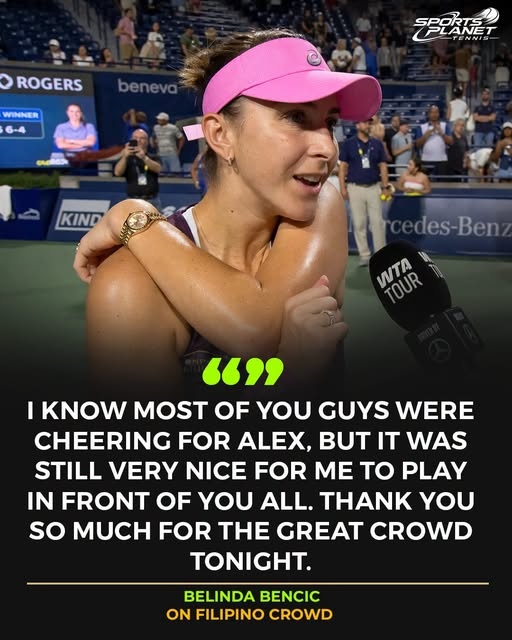
The image accompanying this analysis captures Bencic acknowledging the Filipino crowd:
"I know most of you guys were cheering for Alex, but it was still very nice for me to play in front of you all."
That is an interesting statement from a competitive perspective.
Bencic recognized that the majority of the audience was supporting Eala, but she also appreciated the atmosphere.
This is important because elite players don't necessarily fear hostile crowds—they learn to manage them.
Bencic has competed in major stadiums, Olympic competition and Grand Slam environments.
Her experience allows her to separate:
crowd emotion → point construction → execution.
That is an elite skill.
Eala's Biggest Advantage: Emotional Energy
For Eala, the crowd can provide another source of energy.
She is not simply representing herself.
For many Filipino supporters, she represents Philippine tennis on an international stage.
That creates an emotional connection rarely seen for a young player.
Her recent Washington title amplified that effect. Eala became the first player from the Philippines to win a WTA Tour-level singles title after defeating Jessica Pegula in the final.
So when she walked onto court in Toronto, she was carrying momentum from Washington and the emotional support of a large Filipino audience.
That combination can be incredibly powerful.
But there is another side.
Huge Crowd Energy Can Also Create Pressure
This is where sports psychology becomes interesting.
Crowd support can help an athlete—but it can also create expectations.
A player may subconsciously feel:
"I have to win for these people."
That is different from:
"I just need to win the next point."
The first thought creates pressure.
The second creates process.
At the highest level, coaches try to keep athletes focused on controllable variables:
- ball height;
- target;
- footwork;
- recovery position;
- serve location;
- return position;
- tactical pattern.
The crowd belongs outside that mental bubble.
First Set: Eala Was Still Fighting
The 6-4 opening set tells us something important.
Eala did not simply disappear from the match.
Bencic had to establish control.
The Swiss player used her experience, early ball striking and ability to redirect pace to prevent Eala from consistently imposing the aggressive baseline tennis that had powered her recent run.
This matchup was particularly demanding because Bencic can take time away from an opponent.
That is dangerous against a player who wants to establish rhythm.
When Bencic takes the ball early, Eala has less time to:
- recover after her previous shot;
- establish the ideal hitting position;
- construct the next attack;
- move Bencic off the court.
That creates a chain reaction.
The Second Set Became a Completely Different Match
The most revealing statistic is the 6-0 second set.
From a coaching perspective, a bagel does not necessarily mean the losing player suddenly became a poor tennis player.
Often, it means the opponent has successfully taken control of several interconnected performance variables.
Bencic's pressure could have affected:
1. Time
Eala had less time to set up.
2. Position
Bencic could force Eala into less favorable court positions.
3. Recovery
Every additional defensive movement makes the next offensive shot harder.
4. Confidence
Once several games go against a player, risk tolerance can change.
5. Shot selection
A player under pressure may attempt to end points earlier, producing additional errors.
This is how a competitive first set can turn into a one-sided second set.
The Physical Factor Cannot Be Ignored
Eala had just survived a demanding three-set battle against Caty McNally, 6-3, 5-7, 6-4, to reach the Round of 16. That match extended her winning streak to seven matches and included a physical issue involving her foot/ankle area.
From a U.S. high-performance standpoint, that context matters.
Professional tennis is not played in isolation.
The body carries accumulated load from:
previous matches + acceleration + deceleration + recovery + travel + emotional stress + tournament schedule.
Even when an athlete is medically cleared to compete, accumulated fatigue can affect movement quality.
And against someone like Bencic, small physical limitations become tactically significant.
Why Movement Matters So Much Against Bencic
Bencic's game puts a premium on timing.
If Eala cannot recover quickly enough after hitting a shot, Bencic can attack the resulting open space.
The tactical sequence becomes:
Eala attacks → Bencic absorbs → Eala recovers late → Bencic redirects → Eala defends.
That is exactly the pattern an aggressive baseline player wants to avoid.
At 100% physical capacity, Eala can attempt to reverse that sequence:
Serve → first ball → move Bencic → recover → attack the next ball.
That is where Eala is most dangerous.
The Crowd Increased the Emotional Temperature
The Toronto atmosphere made this matchup particularly fascinating.
For Eala, every winner could trigger a major response.
For Bencic, every important point could feel like an away game.
Yet experienced professionals understand something fundamental:
You cannot beat the crowd. You have to beat the opponent.
Bencic ultimately did exactly that.
She did not need to silence the stadium.
She needed to execute better tennis.
Crowd Intensity Is Good for Tennis—With One Important Boundary
There is a bigger lesson here.
The extraordinary Filipino support surrounding Eala is excellent for growing tennis.
A young athlete creating that kind of international fan interest is valuable for the sport.
Eala is bringing new spectators into WTA tennis, particularly from the Philippines and the Filipino diaspora.
But tennis also has established etiquette.
During points, players need to be able to hear the ball, the chair umpire and their own internal rhythm. Spectators can be passionate while still understanding when to celebrate.
The ideal atmosphere is:
LOUD between points.
RESPECTFUL during points.
EXPLOSIVE after big winners.
That gives Eala the incredible home-style support she deserves while preserving the competitive integrity of the match.
Bencic's Response Was a Sign of Professionalism
Her comment after the match is actually a positive reflection on the environment.
Rather than simply criticizing the audience, Bencic acknowledged that the majority supported Eala while expressing appreciation for the experience.
That is the mindset of an experienced professional.
She understood the atmosphere.
She accepted it.
Then she went out and executed.
And ultimately, the scoreboard reflected her ability to maintain that competitive focus.
The Biggest Lesson for Eala
For Eala, this loss should not erase what happened during the previous week.
She had just produced the biggest breakthrough of her career in Washington.
She then arrived in Toronto and extended her winning streak to seven matches before running into a very experienced opponent in Bencic.
That is not failure.
That is the learning curve of a player moving into the highest level of professional tennis.
The next development is learning how to manage:
success + fatigue + injury + expectations + crowd pressure + tournament scheduling.
That combination is what separates talented players from consistently elite professionals.
Final U.S. Tennis Expert Assessment
From a high-performance perspective, the Eala-Bencic match demonstrated three major truths.
1. The crowd can change the emotional intensity of a match.
Eala's Filipino supporters created an atmosphere that made the contest feel significantly bigger than a normal Round of 16 match.
2. Experience matters when pressure rises.
Bencic's ability to remain tactically disciplined despite the crowd was a major part of her success.
3. Physical freshness is critical to aggressive tennis.
Eala had already endured a demanding match against McNally and entered the Bencic matchup after a remarkable run in Washington and Toronto. Her physical condition and movement quality were therefore important variables that should be considered alongside the tactical matchup.
The most encouraging conclusion is this:
Eala is no longer simply playing tennis. She is creating an event.
The crowds are getting bigger.
The expectations are getting higher.
The opponents are becoming more experienced.
And the pressure is becoming part of her professional education.
For a 21-year-old player coming off the biggest title of her career, that is exactly the kind of environment in which champions are developed.
Toronto may have ended Eala's seven-match winning streak—but the intensity surrounding her is only getting started.