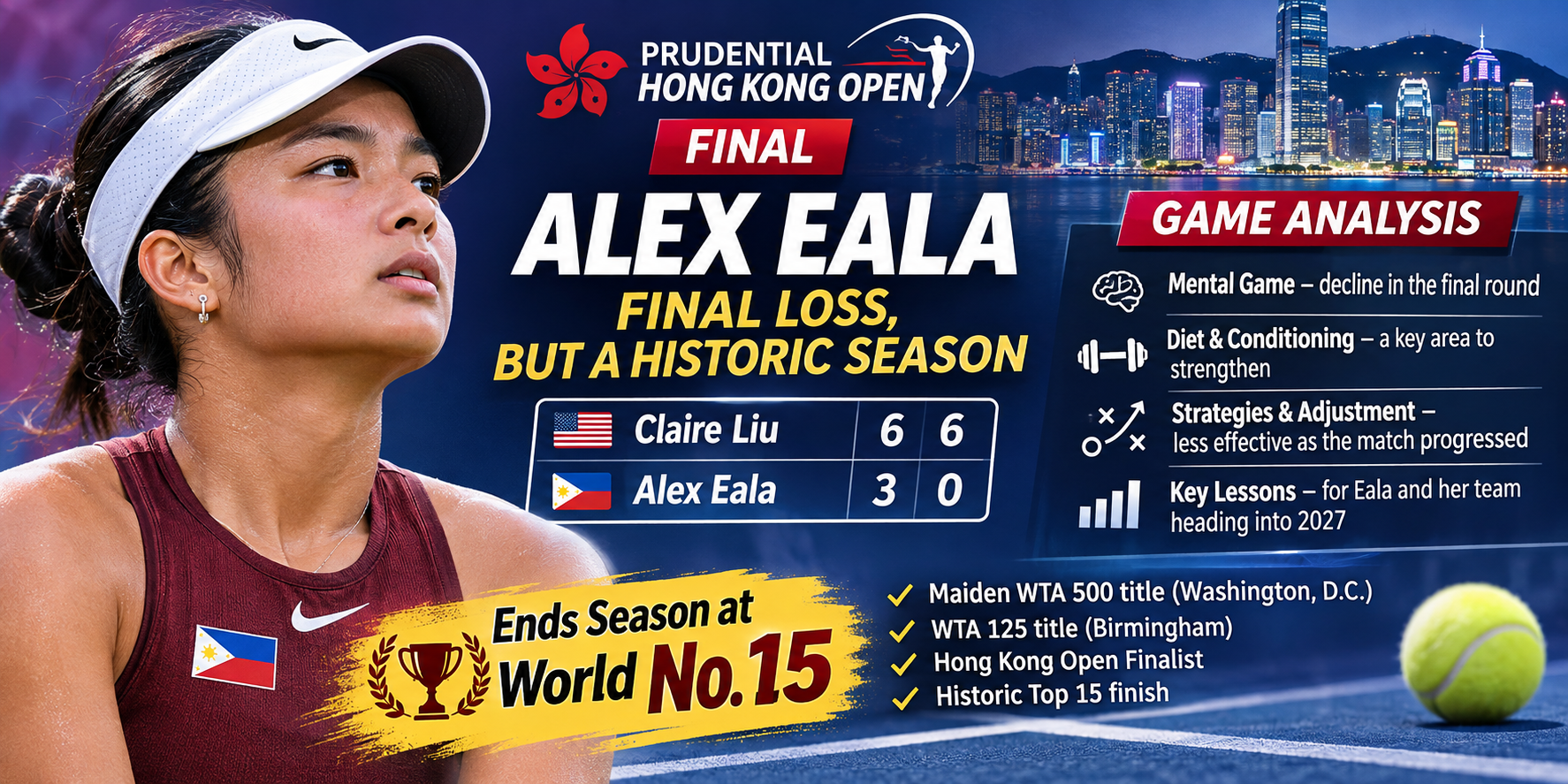
A disappointing final, but a historic season for Philippine tennis
Alex Eala's 2026 season ended with a difficult defeat against American Claire Liu in the Prudential Hong Kong Open final. The 21-year-old Filipina lost 6-3, 6-0, but the result should not overshadow what has been an outstanding season.
Eala is set to finish the year at World No. 15, achieving a historic ranking milestone and further establishing herself as one of Southeast Asia's leading female tennis players.
However, the final provides several important lessons about professional tennis, particularly the relationship between mental toughness, physical conditioning, nutrition, recovery and tactical decision-making.
A championship final is not simply about having better strokes. It is about maintaining physical performance and making intelligent decisions when fatigue, pressure and unexpected physical problems begin affecting the match.
1. Mental game: Fighting through adversity
One of the most remarkable aspects of Eala's performance was her willingness to continue competing despite physical difficulties.
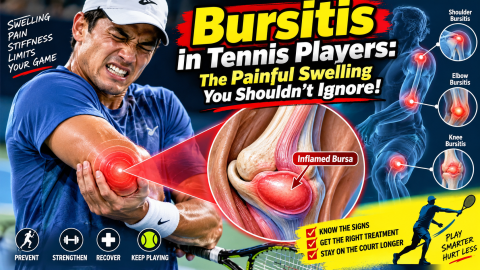
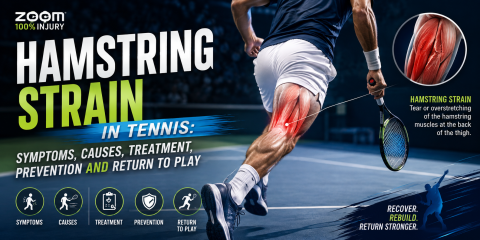
After the players exchanged breaks early in the match, Eala requested a medical timeout while preparing to serve at 3-4 in the first set. Her right thigh and knee were subsequently heavily strapped.
From that moment, her movement and ability to compete consistently appeared to become more challenging.
Nevertheless, she continued fighting.
The second set demonstrated her competitive mentality. In the opening game, Eala battled through 11 deuces and five break points in a game lasting more than 20 minutes.
The lesson: Mental toughness does not mean ignoring pain or forcing the body to continue at any cost. It means remaining composed, accepting difficult circumstances and making the best decisions possible.
For developing tennis players, this is an important distinction. A strong competitor must know when to fight for a point and when to protect their physical condition.
2. Physical conditioning: The importance of endurance and recovery
Professional tennis requires more than strength. Players need explosive acceleration, repeated directional changes, balance, muscular endurance and the ability to recover between points.
Eala's thigh and knee difficulties during the final raise an important question about physical readiness.
However, the available match information does not establish that inadequate conditioning or poor nutrition caused her difficulties. An injury can occur even when an athlete follows an excellent training and nutrition program.
Areas that professional players need to continually develop include:
-
Leg strength: Building strength in the quadriceps, hamstrings, glutes and calves.
-
Movement efficiency: Maintaining balance while accelerating, stopping and changing direction.
-
Core stability: Controlling body position during powerful groundstrokes.
-
Muscular endurance: Maintaining movement quality during long rallies and extended games.
-
Recovery: Allowing muscles and joints sufficient time to recover between matches.
Physical conditioning is particularly important during tournaments when players must compete on consecutive days.
3. Nutrition and diet: Fueling a professional tennis player
Nutrition is another important component of professional tennis. Players competing in demanding tournaments need sufficient energy to sustain performance and recover properly.
A balanced tennis nutrition program generally includes:
|
Nutritional requirement |
Importance |
|---|---|
|
Carbohydrates |
Provide energy for high-intensity movement |
|
Protein |
Supports muscle repair and recovery |
|
Healthy fats |
Support overall health and energy needs |
|
Electrolytes |
Replace sodium and other minerals lost through sweating |
|
Water |
Maintain hydration and temperature regulation |
|
Vitamins and minerals |
Support normal muscle and body functions |
For a player like Eala, nutrition planning should be adjusted according to training intensity, match duration, climate and recovery requirements.
Important: We should not conclude that Eala lost because of a weak diet. There is no established evidence of a nutritional problem in the information available. Nutrition is an area for continuous professional management, not a diagnosis based on one defeat.
4. Tactical game analysis: What happened against Claire Liu?
The match result tells an interesting story.
Final score: Claire Liu defeated Alex Eala 6-3, 6-0.
First set: Eala 3-6 Liu
The opening games were competitive, with both players exchanging breaks. Eala initially demonstrated that she could challenge Liu from the baseline.
However, Liu gradually gained control of the match. Her consistency, reliable serving and ability to capitalize on Eala's errors became increasingly important.
The medical timeout at 3-4 was a significant turning point.
Second set: Eala 0-6 Liu
The opening game became an exhausting battle, lasting approximately 20 minutes. Eala had several opportunities to hold serve but could not convert them.
Liu eventually secured the break and continued building momentum.
The American won nine consecutive games from 3-3 in the first set to close out the championship.
Three tactical adjustments worth studying
A. Improve serve protection
Liu's first serve was a major weapon. According to the match report, she won 88% of points behind her first serve.
Eala needed to make Liu work harder on return games and find opportunities to attack second serves.
B. Change the rally pattern
When a player is struggling physically, repeatedly engaging in long baseline exchanges can become increasingly difficult.
Possible adjustments include:
-
Using more variation in shot depth.
-
Introducing slices to change the rally rhythm.
-
Taking selected balls earlier when positioning allows.
-
Using angles to move the opponent rather than relying entirely on power.
-
Looking for opportunities to finish points at the net.
C. Manage high-pressure situations
The second-set opening game demonstrated how important game management can be.
After so many deuces and missed opportunities, winning that game could have helped Eala regain confidence.
However, tactical adjustments must also account for the player's physical condition. If movement is compromised, some normally effective strategies may become difficult to execute.
5. Mental pressure and decision-making during a championship final
A final is different from an ordinary tournament match.
There is additional pressure because players know that a championship is within reach. Every missed opportunity can become psychologically demanding.
For developing players, Eala's match provides four important lessons:
-
Reset after losing a game. Do not carry frustration into the next service game.
-
Concentrate on the next point. Avoid thinking about the final score while the match is still being played.
-
Use a tactical plan. Know when to attack, defend, change direction and slow down the rally.
-
Respect physical limitations. Pain and injury require appropriate assessment and management.
Mental strength is not measured by the number of points a player forces themselves to play through. It is measured by the quality of their decisions under pressure.
6. What should Alex Eala and her team prioritize for 2027?
The Hong Kong final should be treated as a learning opportunity rather than a reason to question an entire successful season.
Here are five areas worth prioritizing:
|
Development area |
Recommended focus |
|---|---|
|
Physical conditioning |
Strength, mobility and tennis-specific endurance |
|
Injury prevention |
Individualized strength and rehabilitation program |
|
Nutrition |
Match-day fueling and recovery nutrition |
|
Tactical development |
Serve returns, rally variation and point construction |
|
Mental preparation |
Pressure management and competitive routines |
The immediate priority should be proper medical assessment and recovery of her right leg before returning to intensive competition.
There is no need to rush the next training cycle. A healthy athlete with adequate recovery has a better foundation for long-term development.
7. Lessons for Filipino tennis players and coaches
Eala's journey demonstrates that reaching the highest levels of professional tennis requires much more than technical ability.
For coaches and aspiring competitive players in the Philippines, this final provides a valuable teaching opportunity.
During training, coaches should develop:
-
Consistent footwork and proper distance from the ball.
-
Efficient recovery positioning after every shot.
-
Stronger serve and return fundamentals.
-
Endurance for extended rallies.
-
Decision-making under pressure.
-
Proper hydration, nutrition and recovery habits.
Most importantly, players should learn to recognize the difference between being mentally tired and physically injured.
A good tennis player does not simply hit powerful forehands and backhands. A complete player understands movement, energy management, tactical discipline and physical preparation.
8. A historic achievement despite the final defeat
The result in Hong Kong does not erase Eala's achievements throughout 2026.
Her season included:
-
Her maiden WTA 500 championship in Washington, D.C.
-
A second WTA 125 title in Birmingham.
-
A run to the Hong Kong Open final.
-
A projected rise to World No. 15 in the next rankings update.
Her rise to the top 15 represents an extraordinary achievement for Philippine tennis.
Final thoughts: Losing a final does not mean losing the season
Alex Eala's defeat against Claire Liu is a reminder that professional tennis is a combination of physical readiness, mental resilience, tactical intelligence and consistent preparation.
There are matches when an opponent simply performs better. There are also matches when physical difficulties change the entire competitive situation.
The important thing is learning from the experience.
For Eala, the next chapter should be about recovery, strengthening her physical foundation and continuing to develop her tactical game.
For Philippine tennis, her achievements are an inspiration to young players who dream of competing internationally.
A championship trophy may have slipped away in Hong Kong, but the future of Philippine tennis remains bright.
Congratulations, Alex Eala, for an unforgettable 2026 season!
Mabuhay ang Philippine Tennis!